


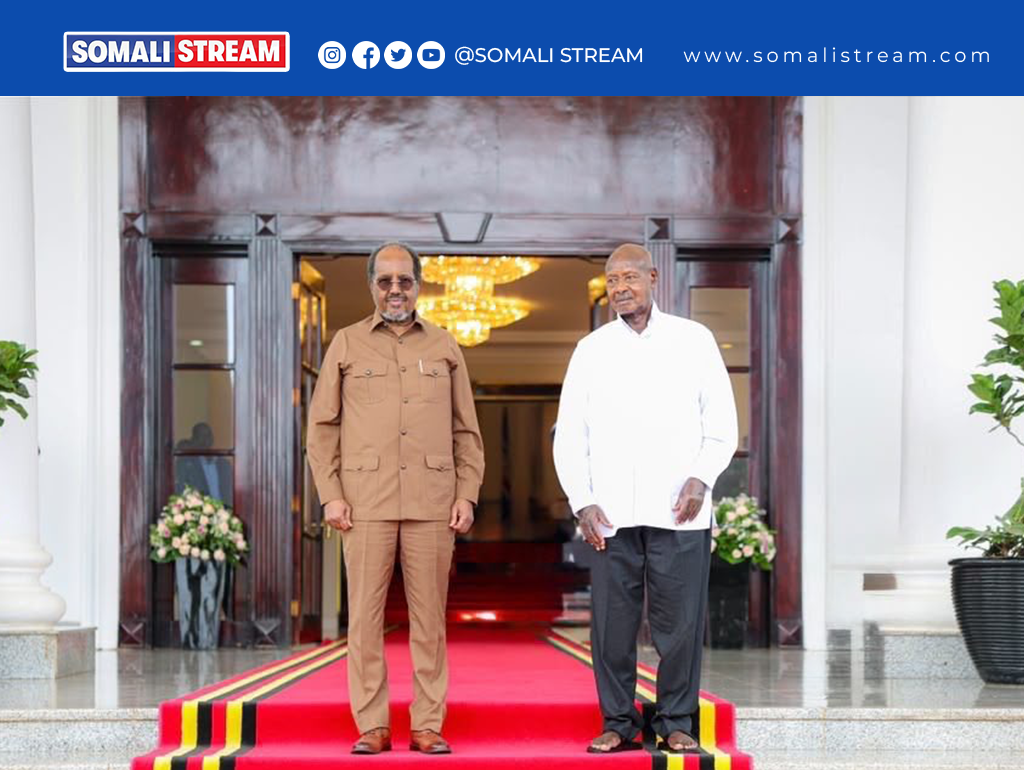
Somali President Hassan Sheikh Mohamud has invited opposition leaders to political consultations after reversing his position on discussing the country’s leadership, amid reports that Ugandan President Yoweri Museveni exerted pressure on Mogadishu over Uganda’s military presence in Somalia.
The invitation follows a shift in Mohamud’s position a week after he said he would not put the country’s leadership up for discussion. His latest move comes amid continued tensions between the federal government and opposition figures over Somalia’s political direction.
Highly placed sources familiar with the discussions revealed that Museveni had warned Mohamud that Uganda could withdraw troops deployed under a bilateral security agreement between the two countries and redeploy its personnel serving under the African Union Support and Stabilization Mission in Somalia (AUSSOM) from the coastal town of Barawe to Mogadishu.
The sources said the warning added pressure on the Somali president to reconsider his position and open dialogue with opposition leaders, although Uganda’s public account of the meeting did not mention the alleged threat.
The reported intervention places Somalia’s domestic political tensions alongside its dependence on regional security partnerships, raising questions about the extent to which developments in Mogadishu are influenced by the priorities of neighbouring countries.
Museveni calls for political unity
During an official visit to Uganda on Monday, October 26, Mohamud met Museveni at State House in Entebbe. According to the Uganda Media Centre, their discussions focused on Somalia’s security situation, efforts to defeat al-Shabaab and opportunities to expand bilateral trade and economic cooperation.
Museveni used the meeting to argue that Somalia’s challenges were rooted in ideological divisions and a failure to identify the underlying causes of the country’s problems.
“The problem of Somalia is ideological and a misdiagnosis of problems,” Museveni said, according to the Uganda Media Centre.
He called for a united approach to the country’s challenges, warning that divisions within the majority could allow a smaller group to retain influence.
“Unite the many to defeat the few, but some Africans want to annoy the many to stay with the few,” he added.
Museveni’s remarks offer a public indication of his thinking on Somalia’s political challenges. However, the Ugandan statement did not explicitly link his comments to Mohamud’s invitation to opposition leaders or disclose any conditions attached to Uganda’s military presence.
The reported warning over troop deployments, if accurately described by the sources, would add a significant dimension to the meeting, suggesting that security cooperation may have featured in the wider political calculations surrounding Mohamud’s decision.
Somalia seeks continued Ugandan military support
The meeting also underscored Mogadishu’s continued reliance on Uganda’s military contribution to Somalia’s security operations.
According to the Uganda Media Centre, Mohamud briefed Museveni on the security situation and commended the Uganda People’s Defence Forces (UPDF) for their role in supporting efforts to restore peace.
The Somali president also thanked Museveni for Uganda’s continued military contribution and expressed hope that Ugandan troops would remain in Somalia longer to help achieve lasting stability.
Uganda has played a significant role in African Union-led security operations in Somalia, supporting Somali forces against al-Shabaab, the al-Qaida-linked militant group that continues to pose a major threat to the country.
The alleged warning to withdraw troops under the bilateral agreement and move Ugandan personnel serving under AUSSOM from Barawe to Mogadishu would carry potentially significant consequences for Somalia’s security arrangements.
The two deployments operate under different frameworks: one is based on bilateral cooperation between Somalia and Uganda, while the other forms part of the African Union’s mission. Any changes would therefore have implications for both the countries’ bilateral relationship and the wider international security effort.
Uganda’s public statement did not announce a withdrawal or confirm a threat to redeploy its forces. The account did, however, record Mohamud’s request for Ugandan troops to remain in Somalia longer, highlighting the importance Mogadishu attaches to continued military support.
Any substantial reduction in Uganda’s contribution could complicate Somalia’s efforts to strengthen its security institutions and sustain operations against al-Shabaab.
Trade adds another dimension to the talks
Security was not the only issue on the agenda. The two leaders also discussed expanding commercial ties, with particular emphasis on opening a more direct route for Ugandan coffee exports to the Somali market.
The Uganda Media Centre said Museveni welcomed Somalia’s decision to allow Uganda to establish a warehouse in the country through which processed Ugandan coffee would be marketed and sold.
The proposed arrangement is intended to help Ugandan exporters reach Somali consumers more directly, reducing reliance on intermediaries and strengthening commercial relations between the neighbouring countries.
Nelson Tugume, who recently returned from Somalia, told the two presidents that Somalia imports coffee from European countries and that Ugandan coffee reportedly passes through other markets before reaching Somali consumers.
The warehouse initiative could provide Ugandan exporters with a more direct commercial channel while creating new opportunities for trade and investment.
The discussions illustrate the breadth of Uganda’s interests in Somalia, spanning military cooperation, regional stability and economic ties. They also provide a broader context for the two presidents’ engagement beyond the question of troop deployments.
Opposition scepticism clouds prospects for dialogue
Mohamud’s invitation to opposition leaders could provide an opening for negotiations, but initial criticism and resistance suggest that the initiative has yet to secure broad political support.
The president’s challenge will be to demonstrate that the proposed consultations can produce meaningful political compromises rather than simply provide a platform for dialogue.
For opposition figures, the central question is whether the process will address their substantive concerns and allow them to influence decisions about Somalia’s political future.
The reported pressure from Kampala could also complicate the political process if opposition leaders view the invitation as a response to external demands rather than a genuine commitment to an inclusive settlement.
At the same time, Museveni’s public emphasis on unity reflects Uganda’s stated interest in a more cohesive political environment in Somalia, where persistent divisions can undermine efforts to confront al-Shabaab and stabilise the country.
Whether the president’s initiative will produce a negotiated settlement remains uncertain. Its prospects will depend on the willingness of the government and opposition to agree on the substance of their disagreements and establish a credible framework for further talks.
A turning point or another political impasse?
Mohamud’s reversal could create an opening for negotiations at a time when relations between the government and opposition remain strained. But the reported warning over Uganda’s military deployment raises questions about the circumstances surrounding the initiative and the competing pressures facing the Somali president.
The immediate test will be whether the proposed consultations lead to an agreed framework for negotiations and concrete steps towards a broader political settlement.
