


By: AVV. Ahmed Kheir Osman:
On 17 September 2026, the Prime Minister of Somalia issued a directive requiring the recruitment and appointment of public-service officials to be conducted on the basis of merit. The first phase, commencing on 20 September, focused on departmental directors in federal ministries, with the process subsequently intended to extend to Directors-General. The directive required candidates to be assessed according to qualifications, experience, competence, and merit, and expressly relied on Article 161(1) of the Constitution, Article 7 of the Civil Service Law, and relevant regulations. These provisions are examined later in this article.
Following the directive, several ministries began advertising departmental director positions. The Prime Minister subsequently reiterated that the recruitment exercise would be conducted through the Office of the Prime Minister in coordination with the National Civil Service Commission.
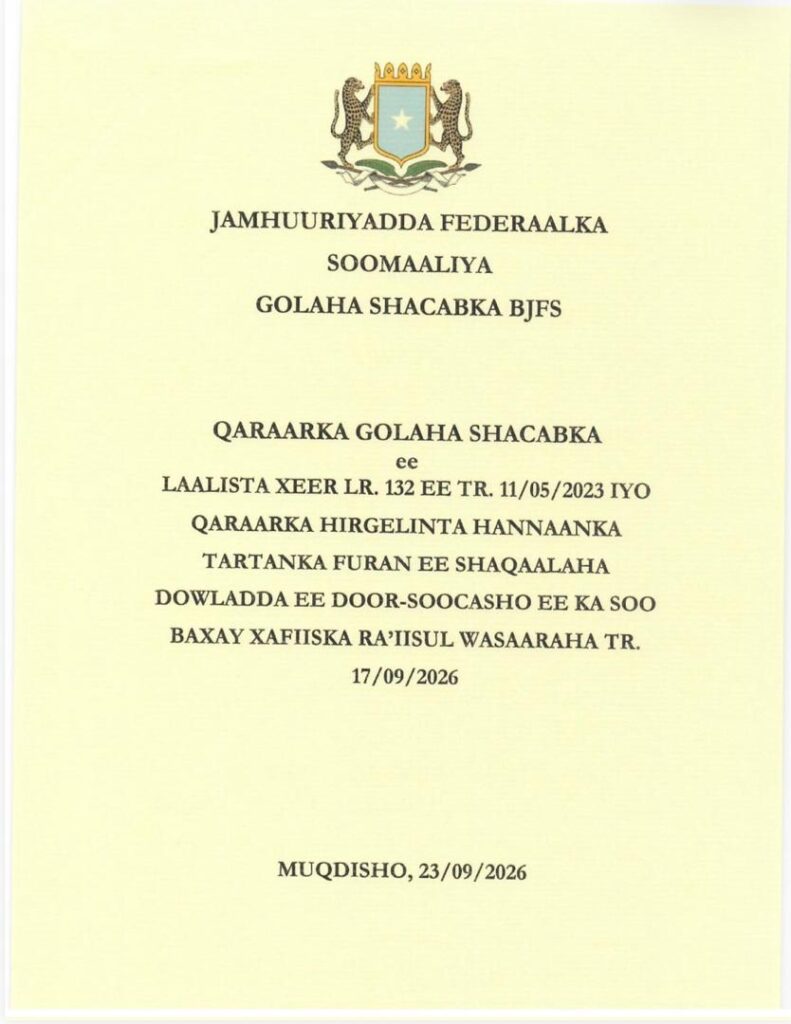
On 21 September 2026, the Federal Parliament’s Social Services Development Committee submitted a motion entitled ‘Request to Suspend the Prime Minister’s decree.’ Subsequently, on 23 September 2026, the House of the People adopted a motion seeking to nullify the Prime Minister’s directive concerning departmental directors and civil-service recruitment, by 136 votes in favor, 2 against, and 2 abstentions. This development raises the constitutional question of whether Parliament has the authority to suspend, nullify, or otherwise invalidate an executive directive issued by the Prime Minister.
Key Constitutional Questions and Issues
The civil-service dispute of September 2026 raises several interrelated constitutional questions concerning the allocation, exercise, and review of public authority in Somalia. This article examines the principal legal issues arising from the dispute, including:
- Did the Prime Minister have constitutional and statutory authority to issue the directive concerning public servants and their recruitment?
The critical legal question is whether the Prime Minister has a direct and independent legal authority to determine the merit, recruitment, appointment, or other conditions governing public servants. No written law expressly confers upon the Prime Minister such a general and unilateral power. Rather, the statutory framework assigns a specific role to the National Civil Service Commission (NCSC). Article 7 of Law No. 11 of 2006 requires government institutions seeking recruitment to submit their requirements to the Commission, which is responsible for conducting the recruitment process independently.
During the Prime Minister’s press release, he referred to Article 161 of the so-called new Constitution. Yet Article 161(4) requires vacant positions to be openly advertised so that the public may compete. In practice, the ministries restricted these vacancies to existing public servants within the respective ministries, rather than opening them to the general public, raising questions about compliance with Article 161(4).
Again, if the Prime Minister intended to introduce such changes, why did he not pursue them through the Ministry of Labour and Social Affairs, the institution responsible for matters concerning the public service and labour administration, and instead resort to a decree? This approach may raise questions about whether institutional interests or other underlying considerations influenced the decision-making process.
The National Civil Service Commission of Somalia was established under Law No. 10 of 2006, based on the 2004 Transitional Federal Charter, with a mandate to recruit, manage, and regulate the federal civil service. Its mandate was also recognized by the Office of the Prime Minister and emphasized in the parliamentary motion. However, the existing Commission has fourteen (14) members, whereas Article 158(3) of the 2026 Constitution which requires fifteen (15) members nominated by the Council of Ministers, approved by Parliament, and appointed by the President through presidential decree.
- Did Parliament have constitutional authority to nullify, suspend, or otherwise invalidate an executive directive of the Prime Minister?
The issue is whether Parliament’s legislative and oversight powers permit it to suspend or invalidate a Prime Ministerial directive or exceed the authority granted by the Constitution and law. Legislative oversight involves monitoring and evaluating executive action to ensure compliance with laws and budgets, serving as a key constitutional check against the concentration of governmental power.
Accordingly, Parliament’s constitutional role is to legislate by enacting or amending laws, rather than suspending or nullifying a Prime Ministerial directive through a motion. As an oversight mechanism, Parliament could instead have held committee hearings to question the Prime Minister and relevant ministers or officials about the directive’s legal basis, scope, and implementation.
The House of the People’s Resolution of 23 September 2026, purporting to suspend the open competitive recruitment system, raises serious questions about its constitutional and statutory basis. The Constitution does not expressly grant Parliament a general power to suspend or nullify executive directives through parliamentary resolutions, making the legal validity of the Resolution constitutionally questionable.
The dispute may therefore be viewed as an instance in which a questionable executive approach was pursued through an equally questionable parliamentary response. If the Office of the Prime Minister acted without a sufficient legal basis for directing the recruitment process, that defect should have been addressed through the proper legislative, administrative, or judicial mechanisms rather than by Parliament itself assuming the power to nullify executive action.
The maxim error non facit jus an error does not create law captures the underlying principle: a perceived legal defect in executive action does not, by itself, confer upon another institution a power that the Constitution or statute has not granted. The appropriate remedy for one alleged legal error should not be the creation of another.
- Petitions Against Final Administrative Decisions and Judicial Jurisdiction
The judiciary is a principal branch of government, responsible for interpreting and applying the law and adjudicating disputes, including disputes arising from the exercise of public administrative power. In Somalia, the Judicature Act of 1962, although an old statute, provides an important statutory basis for judicial jurisdiction over administrative decisions.
Article 5(3)(b) provides for petitions against final decisions of the public administration, while Article 10 specifically provides for petitions to the Supreme Court against such decisions on questions of law and, where expressly provided by law, questions of fact. It also requires the administration to comply with the Court’s judgment and empowers the Court to take measures to enforce it.
If the Prime Minister’s directive resulted in a final administrative decision covered by these provisions, its legality could have been challenged before the Supreme Court. Rather than Parliament suspending or nullifying the directive, the matter could have been referred to the competent court for determination in accordance with the law.
Finally, the dispute highlights the continuing weakness of separation of powers in Somalia. The Executive exercises substantial influence over legislation, while Parliament retains significant political and oversight powers. However, parliamentary intervention in matters potentially within judicial jurisdiction raises concerns about judicial independence.
The result is an institutional imbalance in which the Executive and Legislature exercise greater practical influence, while the judiciary remains institutionally weaker and access to judicial redress is constrained by litigation costs. Under the 2023 court-fee regulations, challenging government decisions may reportedly cost approximately US$300–US$2,000, excluding legal and other expenses.
The recruitment dispute thus reveals a broader constitutional concern: alleged executive overreach should not be remedied by parliamentary overreach, but through the prescribed judicial mechanisms. Effective separation of powers requires each branch to exercise its constitutional mandate while respecting the authority and independence of the others.