


By Abdinur Mohamed Ahmed
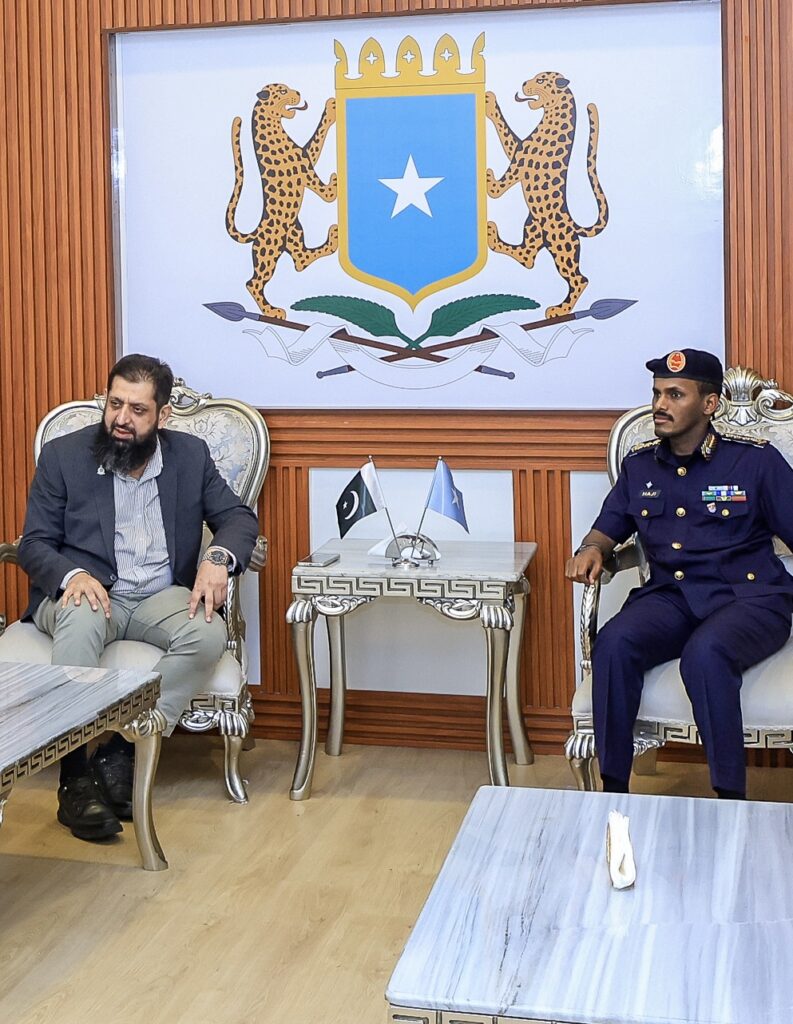
Pakistan’s growing military engagement with Somalia took a new step on Saturday, 19 September, when a senior Pakistan Air Force delegation arrived in Mogadishu for talks on air defence and closer cooperation between the two countries’ air forces.
Led by Air Marshal Muhammad Sarfraz, Commander of Air Defence and Deputy Chief of the Air Staff, the delegation was received by the Commander of the Somali Air Force, Brigadier General Abdirisak Mohamud Haji.
The meeting was the latest in a series of contacts that are taking Pakistan-Somalia defence ties from broad diplomatic commitments towards practical military cooperation.
It also showed that the relationship is not new.
Brigadier General Haji was part of the Somali engagement with Pakistan in August, when Defence Minister Ahmed Moallim Fiqi led a high-level delegation to Islamabad.
During that visit, Somalia and Pakistan signed a memorandum of understanding covering counter-terrorism, military training, exchanges of military expertise and knowledge, defence-capability development and wider security cooperation.
The two sides also discussed the development of the Somali Air Force, including training and professional exchanges.
A relationship built over years
The current push follows an earlier period of military-to-military engagement. In 2020, the then Commander of the Somali Air Force, Brigadier General Mohamed Sheikh Ali, visited Pakistan Air Headquarters in Islamabad. He was received by Pakistan’s then Chief of the Air Staff, Air Chief Marshal Mujahid Anwar Khan.
The visit focused on strengthening ties between the two air forces and expanding military training. Six years later, the relationship is being pursued at a higher level and against a very different regional backdrop.
Pakistan brings considerable military capacity to the partnership. Global Firepower’s 2026 assessment places Pakistan 14th among 145 countries and estimates its total military personnel at about 1.71 million, including roughly 660,000 active personnel.
For Somalia, the significance is less about rankings than access to an established military system with extensive experience in air operations, training and defence cooperation.
Air power could become the most consequential element of the partnership. Somalia is rebuilding military institutions after decades of conflict, but its air capabilities remain limited.
Developing an effective air force requires pilots, engineers, technicians, maintenance facilities, airfields and command-and-control systems as well as aircraft.Pakistan can potentially provide expertise across those areas.
The two countries have also been linked in reports to a possible Somali purchase of up to 24 JF-17 Thunder fighter aircraft, with the package reportedly valued at about $900 million.
If confirmed, such a purchase would be a major investment in Somalia’s military aviation and would create a long-term relationship between the two air forces.
But the aircraft themselves would be only the beginning. Pilot training, maintenance, spare parts, weapons and technical support would determine whether Somalia could turn the reported acquisition into a sustainable capability.
Pakistan’s involvement in Somalia has a much longer history. Pakistani troops served in United Nations operations in Somalia during the early 1990s, including UNOSOM II, and were involved in the fighting in Mogadishu in 1993. Pakistan remained part of the international force until its withdrawal in 1995.
The relationship today is fundamentally different.
Pakistan is no longer in Somalia under a UN mandate. It is engaging directly with the Somali government as a bilateral defence partner.
That shift comes as Mogadishu seeks to strengthen the Somali National Army and reduce its long-term dependence on foreign forces. Training is therefore likely to be as important as equipment.
The development of Somali officers, pilots and technical personnel could shape military doctrine and professional standards long after individual training programmes or procurement contracts have ended.
Why Somalia matters to Pakistan
Somalia’s geography gives the partnership a significance beyond counter-terrorism.
The country sits on the Gulf of Aden, linking the Indian Ocean with the Red Sea and the Suez Canal. The maritime corridor is critical to international trade and has become increasingly contested amid conflict in Yemen and attacks on commercial shipping.
Pakistan has participated for years in multinational counter-piracy and maritime-security operations in the Arabian Sea and Gulf of Aden.
Closer ties with Mogadishu could therefore give Islamabad another security and diplomatic channel into a maritime environment directly connected to its western approaches.
There is, however, no public evidence that Pakistan is preparing to establish a permanent military base in Somalia.
The August memorandum provides for training, counter-terrorism, expertise exchange and defence-capability development. It does not announce a Pakistani military installation.
A training partnership, temporary deployment and permanent base would represent very different levels of involvement.
Pakistan is entering a Somali security environment already shaped by several external partners.
Türkiye has built a substantial military relationship with Mogadishu and plays an important role in training Somali forces. The United States remains involved in counter-terrorism and security assistance, while the African Union Support and Stabilisation Mission in Somalia, AUSSOM, supports the Somali government alongside regional security partners including Kenya. Pakistan’s arrival therefore adds another layer to an existing network rather than replacing one of Somalia’s established partners.
For Mogadishu, the challenge will be to make these relationships reinforce a single national security structure rather than create competing systems of training, equipment and doctrine.
The wider regional picture
Pakistan’s engagement also comes after its August defence agreement with Saudi Arabia and Türkiye.
The Makkah Joint Defence Agreement established a framework for closer collective defence cooperation between the three countries, giving Pakistan a more formal security relationship with two states with significant interests in the Middle East and Red Sea.
It does not create an alliance between Pakistan and Somalia.
But it provides context for Islamabad’s expanding defence diplomacy across the region.
Türkiye is already a major defence partner for Somalia, while Saudi Arabia has important security interests across the Red Sea and Horn of Africa.
Somaliland adds another layer. Israel’s recognition of Somaliland in December 2025 heightened diplomatic tensions surrounding the territory and drew renewed attention to its strategic position along the Gulf of Aden.
For Somalia, the issue is closely tied to sovereignty and territorial integrity. For outside powers, Somaliland’s coastline is also part of the wider maritime security equation.
Beyond the military relationship
The Pakistan-Somalia relationship is not confined to defence.
Thousands of Somalis have studied in Pakistan, creating longstanding educational and professional links between the two countries. Those connections provide a wider foundation for government, military and institutional cooperation.
The relationship also has a humanitarian and historical dimension. Pakistan’s earlier UN deployment means its military has direct institutional experience of operating in Somalia, even though today’s bilateral engagement is fundamentally different.
What comes next
The next stage will be measured by what the two countries actually build. Further announcements on Somali pilot training, air-defence cooperation and the reported JF-17 acquisition will indicate the scale of Pakistan’s military role.
Maritime surveillance, coastguard development and counter-piracy cooperation could also emerge from the partnership, given Somalia’s coastline and Pakistan’s experience in the region.
For now, the evidence points to a relationship centred on training, capability development and defence cooperation rather than a permanent Pakistani military presence.
But the direction is clear
The August memorandum created the framework. The September air-force delegation has begun putting it into practice.
And with the Somali Air Force commander now engaging his Pakistani counterparts both in Islamabad and Mogadishu, the relationship is becoming institutional rather than episodic.
For Somalia, Pakistan offers another source of military expertise as it rebuilds its security forces.
For Pakistan, Somalia provides a strategic opening on the Gulf of Aden, at the intersection of the Indian Ocean, Red Sea and Horn of Africa. How far that relationship goes will depend on what comes next.
Abdinur Mohamed Ahmed is the former Acting Chief of Staff to the Somali Presidency and a former sub-editor at the Daily Pakistan Observer. He currently serves as a non-executive director of Somali Stream and co-hosts the Geedfadhi Podcast. He can be contacted at sherifabdinur@gmail.com.