


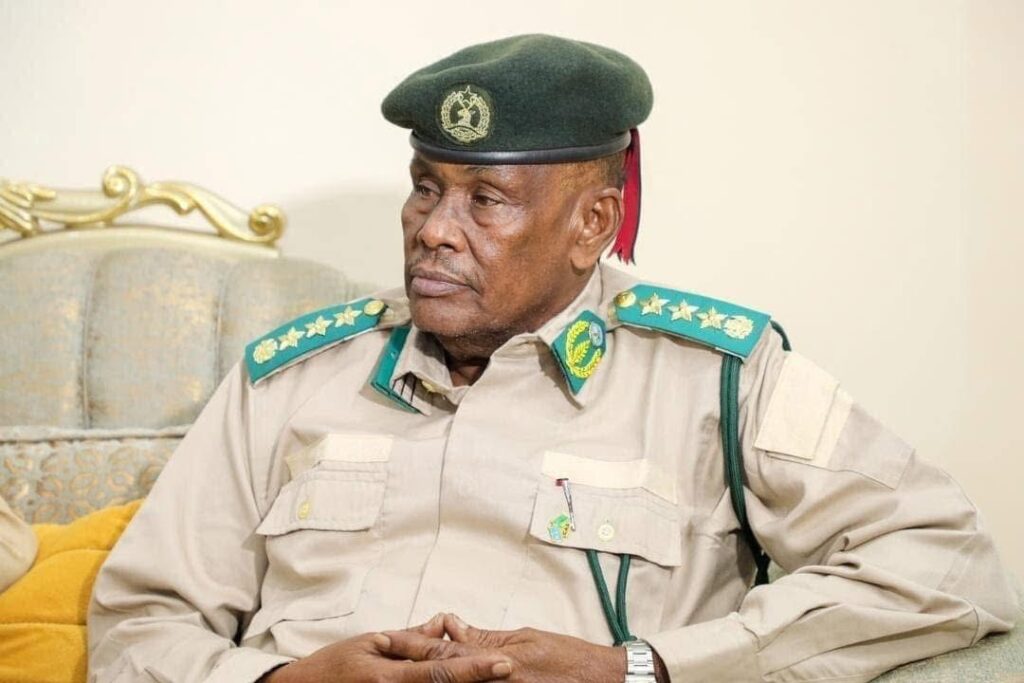
The sound came first. High above the sleeping town of Dollow, the roar of fighter jets circling above Dollow through the darkness.
Inside his family home, General Mahad Abdirahman Aden widely known as Taliye Shub, and a former commander of the Somali Custodial Corps said he could hear the aircraft overhead but had no idea that the night was about to turn into a scene of blood, shattered glass and destruction.
“I couldn’t sleep because of the noise from the jets,” Mahad recalled. Then the strikes came.
Months later, after receiving medical treatment abroad, Mahad has given his most detailed account yet of the attack, describing how he survived what he says was a series of airstrikes on his home in Dollow.
Speaking in an exclusive interview with the Geedfadi Podcast, hosted by Abdikarim Alikaar and Abdinur Mohamed Ahmed, Mahad appeared with visible facial injuries and swelling.
He described the marks on his face and body as lasting scars from the attack. His account, however, remains his personal testimony. The allegations he made about those responsible have not been independently established.
A return to Dollow
Mahad said that after being released from house arrest, he chose to return to Dollow to recover. The town, he explained, carried a deeply personal significance. It was his hometown and the place where many members of his family were buried, including his parents and siblings.
There was another reason for his decision, he said: the heat.
Mahad told the podcast that he had been struggling with cold weather and believed Dollow’s warmer climate would aid his recovery. It was there, he said, that the attack unfolded.
The night the jets came
As darkness settled over Dollow, Mahad said he remained awake, listening to the aircraft above him. Then the explosions began.
According to his account, multiple strikes hit the compound, including areas close to his bedroom. “We were hit by several airstrikes,” he said, describing one explosion as striking the toilet attached to his room and another landing close to his bed.
He said another strike appeared to be aimed directly at the room where he was located.
The impact left him badly wounded. “My whole body was covered by blood,” Mahad recalled.
Vehicles parked inside the compound were also damaged, he said. Among them was a new vehicle he had recently purchased in Beled Hawo, its windows shattered by the force of the attack.
For Mahad, the episode was not simply an attack on a building. It was a moment in which, he said, death came directly through the walls of his home.
Walking through the aftermath
When the explosions subsided, Mahad said he and other injured members of his family had to make their way to hospital. They walked while wounded, he said, seeking emergency treatment.
Mahad praised the medical staff who treated them, saying they had worked tirelessly to save their lives and care for the injured.
He said he initially received emergency medical attention locally before being transferred for further treatment.
His journey for medical care would eventually take him from Dollow to Suuf, then to Mandera, before he was airlifted to Nairobi.
He also said he received treatment in Ethiopia and Kenya during the weeks that followed.
A woman identified by Mahad as Suban was among those he said were injured, alongside members of his security detail.
Mahad has accused several senior Somali officials of being behind what he described as an assassination attempt.
He specifically named President Hassan Sheikh Mohamud, intelligence Chief Mahad Salad and parliamentary speaker Abdulkadir Mohamed Nur Jama. Mahad acknowledged that he could not personally verify some of the information he had received.
He recounted an alleged conversation in which, according to information relayed to him, Jama contacted President Hassan Sheikh Mohamud and said: “You will never receive disturbing news from Dollow again.”
Mahad presented the alleged exchange as evidence of a wider plot against him. He did not provide independent evidence during the interview establishing that the conversation occurred.
The driver arrested
In the immediate aftermath, Mahad said, authorities took action against his driver.
“The area governor immediately arrested my driver as being a suspect involved in planning the attack,” he said.
After recovering sufficiently to travel, Mahad said he returned to his home at the request of others. What he found, he said, was a house badly damaged by the attack.
The physical destruction, he suggested, reinforced his belief that the incident had been an airstrike rather than an explosion originating from inside the property.
His account directly contradicts another version of events that he said had been circulating that no aircraft had attacked the compound and that an improvised explosive device had detonated inside the house.
Mahad rejected that explanation. He also denied having any history of involvement in manufacturing explosives.
“Why am I being targeted?”
The former commander also rejected suggestions that he was involved with militant activity. He argued that neither his family nor his wider community had a history of association with Al-Shabaab, the terrorist group that has waged an insurgency in Somalia for years.
“I have been living peacefully in Dollow,” he said. “I am not involved in arming or training or coordinating any fighters between Baidoa and Gedo.”
He also denied ever declaring himself president or claiming political leadership. “Why am I being targeted?” he asked.
A challenge to the government
Mahad described the alleged strike as an extraordinary use of force against a Somali citizen. “If indeed there was statehood in Somalia, no government would have ordered an airstrike against its own citizen,” he said, describing himself as a war veteran who had fought for Somalia for nine months.
“Which government bypasses striking Al-Shabaab and comes all the way to my house, hundreds of kilometres to strike an individual citizen?”
His comments cast the attack not merely as a personal assault, but as part of what he portrayed as a much wider confrontation involving Somalia’s security establishment and political leadership.
A wounded survivor
Today, General Mahad’s account is framed by the physical evidence he says remains on his body: injuries to his face, eyes and other parts of his body.
His journey through the medical system from emergency treatment to transfer through Mandera and onward to Nairobi, followed what he describes as a narrowly survived attack.
Mahad also claimed that F-16 aircraft have continued to conduct strikes in parts of South West State.
The attack has left behind unanswered questions: who ordered it, what weapons were used, what intelligence led to the operation, and why Mahad’s home became a target?