


A real direct election was never built. With no time left to build one now, the honest choice is not a direct vote in name only but the enhanced indirect model Somalia has already survived, used to buy the stability and time a true direct system will need.
The talks that broke down in May have reconvened in Mogadishu in recent days. Turkey brokered the new roundand the United Nations mission convenes the sittings, with the European Union, Britain and the United States in the room, though Puntland and Jubaland have stayed away, questioning the neutrality of the mediation. The opposition has finally laid its models on the table, and Somalia’s partners shuttle between the delegations in search of a way forward. There is none yet to be found. The one thing every party in that room has ever agreed on lies behind them.
I should say at the outset where I stand. A direct election is the right goal, and Somalis have wanted it for a generation. My case is not that the old model is good, but that it is the one path that can avoid conflict in the time we have. A direct election is not a slogan but an administration: a register, constituencies, commissions, courts, a security plan, laid down over years by a government with a mandate and the consent of the states. We have built none of it. Two administrations in a row took up the words one person, one vote and neither built the substance beneath them. So the question today is not which election is best in principle. It is which can function in the weeks that remain, without tipping the country into a fight it cannot afford.
There is a further reason these designs do not converge, offered as my reading of the field rather than a charge against any person. Several are shaped as much by whom their authors are running against as by what the country needs, each drawn to advantage its sponsor and disadvantage a rival. A proposal built to defeat an opponent is not a settlement; it is a move in the very contest a settlement is supposed to end. That is why an appeal to the common floor, not to any camp’s preferred design, is the only one with a chance of holding.
Four proposals, and the model they all leave out
Four main proposals are on the table. The government wants what it calls one person, one vote, run on a constitution it rewrote without the consent of Puntland and Jubaland, administered by a commission it appointed alone. The Somali Future Council, the main opposition coalition, carries those two states and offers a single-day vote under the existing 4.5 formula, overseen by two commissions, one federal and one for the states. Former president Mohamed Abdullahi Farmaajo, of the Nabad iyo Nolol (Peace and Life) party and backed by no state, revives the party model his government drew up in 2018, in which citizens vote for parties that then fill parliament. Former prime minister Omar Sharmarke’s Somali National Unity Council offers a party model of its own. Three of the four turn on party lists rather than clan delegates; only the Future Council builds on the 4.5 formula openly. Government and opposition sit far apart, yet their designs land close together.
A careful and useful map of these four has been set out by Mohamed Mukhtar Ibrahim, whose comparison treats them fairly and lays their mechanics side by side better than anything else now circulating. It is the right place for any reader to begin. But it maps four roads to one destination and leaves out a fifth, the one Somalia has actually travelled twice without war: the enhanced indirect model of 2016 and 2022. And it treats time as one factor among several, a column in the table, when time is the binding constraint that decides all the others. Put the fifth model back, and weight the clock as heavily as reality does, and the comparison points somewhere his does not.
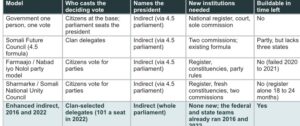
The four proposals now under debate, and the fifth road they leave out. The last row is the only model every party at the table has already consented to, and the only one buildable in the weeks that remain.
They land so close because they measure the same way once you ask what actually names the president. In a direct election the citizen’s ballot alone seats the officeholder; in an indirect one the citizen chooses an intermediary who then chooses him. By that measure none of the four is direct: each resolves the presidency through a parliament whose seats are apportioned by the 4.5 clan formula, whether those seats are filled by clan delegates or by party lists. The only difference between them, the old model included, is the number of hands that apply the formula: 135 elders in 2012, 51 delegates a seat in 2016, 101 in 2022. Somalis call this the enhanced indirect model, and enhancement means only more people casting the same clan-bound vote. The real question, then, is not what to call these models but what any of them would require to work, and whether that can exist in the weeks that remain. All four need the backing of the federal member states. The government holds three, the Future Council two, Farmaajo and Sharmarke none, and no camp commands the five a national vote requires. The government calls its design settled, yet a settled thing would not keep sitting at a table, chasing the same missing consent as everyone else.
No forward has consent, and there is no time to build one
Take the government’s plan first, since it holds power and calls its plan one person, one vote. Somalia’s own Heritage Institute for Policy Studies lists the prerequisites of a real direct vote, and none is in place: no national register, no constitutional court yet stood up, and a commission named by the government alone. A contest whose referee is chosen by one of the contestants is not settled by winning it. Nor is the ground ready: large regions remain under al-Shabaab, and independent assessments, including the Heritage Institute and the 2026 Transformation Index country report, judge that roughly half the population cannot realistically be reached. A vote that silently leaves out whole regions, and that two federal member states reject outright, is not a national election, whatever it is called. The Future Council’s proposal is the most serious of the four, and its weakness is arithmetic, not principle: it brought two states and needs the three the government holds.
The two former leaders fail on the same ground, from opposite directions. Farmaajo’s proposal sounds the most principled at first hearing, but it is the very model he signed into law on the twentieth of February 2020 and could not build: it named no constituencies, allocated no seats, and settled neither the women’s quota nor the vote in contested regions. When it stalled, his own leaders agreed in September 2020 to suspend it for an indirect election; when that too faltered, his parliament voted him a two-year extension in April 2021, and Mogadishu came to the edge of war, with opposition fighters holding parts of the capital before he reversed course. Sharmarke’s proposal is the opposite problem: the most ambitious of the four and the least ready. It does not adjust the system in place but builds a new one, a register, fresh constituencies, two new commissions. Its difficulty is not that it lacks a bloc, though it does; its difficulty is time. The Heritage Institute puts biometric registration alone at eighteen months to two years, and only if the laws, funding and security are already in place, none of which they are. One man could not build the substance when he held power; the other proposes to build far more with none. Neither can be done in the weeks that remain.
Time is not the only clock running. A real direct election is built over months by a government with a mandate, and that mandate expired on the fifteenth of May. When a government whose mandate has elapsed stays on to run a vote it cannot deliver, the illegality itself becomes a source of conflict. That is what happened in April 2021, when an extension pushed through without the upper house was widely judged unconstitutional and the capital fell into armed clashes. A model half-built in haste by an expired administration is not one person, one vote. It is the promise of it, which has already failed, and the last time it was attempted it very nearly cost the country its peace.
The one virtue the old model keeps
Where a proposal claims to have left the clan formula behind, look at where power settles. In Baidoa in May 2026 a member state held direct polls for its assembly, the first such exercise, but the presidency was decided weeks later by a small chamber, in secret, from a single candidate anointed in advance. Mogadishu did the same in December 2025. The citizen is given the ballot at the base, and the office above him is kept beyond reach. The old model, for all its faults, has one virtue its rivals lack: the whole parliament chooses the president, and that vote scatters beyond any single hand. Farmaajo helped seat a parliament in 2022 and it denied him the presidency; Hassan Sheikh helped seat one in 2016 and it refused him too. A system that has repeatedly refused to hand its own architect the outcome he designed is safer than a machine of one constitution, one commission and one chairman a president chose for himself.
It needs no new machinery either. The two-tier body that ran both cycles, the Federal Indirect Electoral Implementation Team and its state counterparts, has only to be reappointed, not built. Even the Future Council reaches for the same design, proposing a fresh federal and state committee of its own; the difference is that the old teams have already done the job, while every rival must stand its version up from nothing.
A clear word to the mediators
Stop asking the parties to agree on a future none of them will accept, and offer them the one thing they have agreed on before. Put the provisional constitution and the enhanced indirect model back on the table, not as an ideal but as the floor: the arrangement everyone in the room once consented to, the one that has produced government after government without tipping the country into war. Every actor is holding out for the outcome that suits him, and the states are in no condition to bargain, some seats contested, some leaders lame ducks halfway out the door. To ask them to settle a wholly new order now is to ask for the very thing that has failed each time it was tried. Ask them only to accept the floor, whose single virtue is that it works when the actors themselves do not.
But the floor is not the destination, and it must not be sold as one. Returning to the indirect model is defensible only if it is bound to a dated road out of it: a fixed term, no longer than the next cycle, with the register, the courts, the security plan and the consent of all five states built on a published timetable and audited in the open. That condition is the whole difference between my argument and the stall it could be mistaken for. Farmaajo and Hassan Sheikh both promised one person, one vote and delivered neither, because each treated the promise as a reason to hold power rather than a schedule to keep. An indirect election with no roadmap is simply their failure repeated; one tied to a binding roadmap is the only way the direct vote ever arrives.
I know the objection, because it is the fair one. The indirect model is not clean; in 2016 and 2022 seats were bought and delegates leaned on, and to return to it is, the critic will say, to reward the manipulation it invites. I do not pretend otherwise. But the choice is not between a flawed system and a clean one. It is between a flawed system that has twice handed power over without war, and untested designs that, on the evidence, would not. Perfection is not on the table; peace, narrowly, still is.
This is not an argument against direct elections. It is an argument against pretending to hold one. To leave one indirect system only to adopt another painted as direct is not progress; it is the same machine with a new label, bought at a price Somalia cannot afford. A real direct election was never built, because two administrations preferred the word to the work, and it cannot be conjured in the weeks that remain. The honest choice is the enhanced indirect model of 2016 and 2022, taken not because it is good but because it is the one every party has already consented to, and because, tied to a dated path out of it, it is the one that finally buys the time to build the direct election Somalia has been promised and denied.
Awale Kullane is a Somali diplomat and political analyst. He has served as Somalia’s ambassador to China and Sweden, as deputy permanent representative to the United Nations, and as permanent secretary and chief of staff of the Office of the Prime Minister.