


By Mustafa Osman
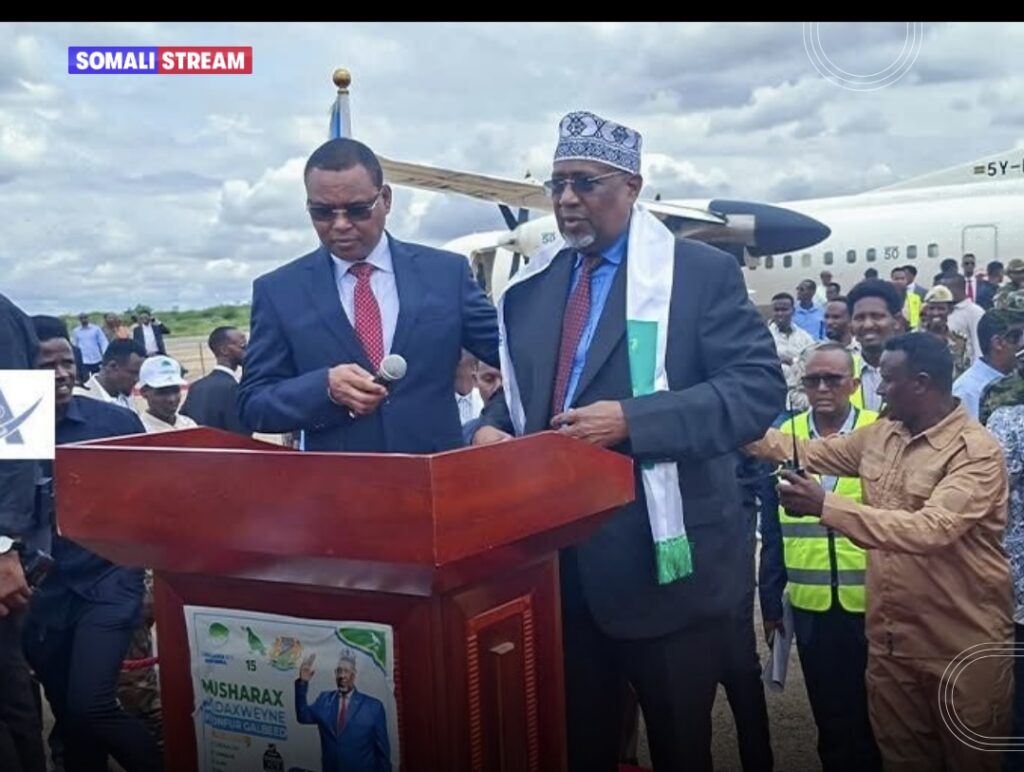
Few days ago, President Hassan Sheikh Mohamud finalised an agreement at Villa Somalia: Parliament Speaker Sheikh Aden Mohamed Nur “Madobe” would stand as the JSP party’s candidate for the presidency of South West State. This morning, the Speaker landed in Baidoa, where acting president Jibril Abdirashid Haji Abdi who simultaneously serves as Second Deputy Prime Minister of the federal government received him at the airport. A candidate confirmed at the presidential palace at night, delivered to a regional capital by morning, and welcomed by a federal cabinet member acting as state president. This is not a democratic process. It is a delivery.
The federal government’s central argument since 2022 has been that Somalia is transitioning to democracy through one person, one vote. This promise has justified every major institutional change: the March 2024 amendments centralising presidential power; the November 2024 electoral laws placing the machinery under federal control; and the March 2026 vote extending terms from four to five years. When national elections were delayed, the explanation was consistent the system requires more time. Democracy takes preparation.
The events in South West State dismantle this argument. President Lafta-Gareen was not an adversary. He had been a close ally of President Hassan Sheikh Mohamud since 2022, cooperating with the federal agenda for four years. It was only when he broke ranks over the disputed constitutional amendments that the federal government moved against him. On March 30, federal troops entered Baidoa. Lafta-Gareen resigned and left the country. The Prime Minister appointed his own deputy as acting state president. And last night, the president personally selected the replacement candidate. The entire operation military intervention, removal of a former ally, and candidate selection was executed in under four weeks.
Cooperation with the federal government, it turns out, is not a partnership. It is a condition. The moment a state leader exercises independent judgment, the machinery of removal activates.
This matters beyond South West State because it establishes a precedent for the entire federal architecture. Somalia’s federal compact constructed through the Arta conference of 2000, the Mbagathi negotiations of 2002–2004, and the Provisional Constitution of 2012 was not an administrative experiment. It was a political settlement born from trauma. Siad Barre’s hyper-centralised regime collapsed in 1991 and took every national institution with it. Federalism was the guarantee that this would never recur that power would be distributed, negotiated, and constitutionally constrained.
The Baidoa operation violates this guarantee. If a state leader even a loyal ally can be removed by force, replaced by a federal cabinet member, and succeeded by a candidate selected at Villa Somalia, then the federal compact has ceased to function as a constraint on central authority. Jubaland’s president faces federal arrest warrants. Puntland has withdrawn from the federal system. If this model holds, Somalia’s federalism is no longer a governing framework. It is a set of permissions the centre issues and revokes at will.
The security consequences compound the problem. The most effective counter-Al-Shabaab operations of 2022–2023 succeeded because they were federated built on cooperation between federal, state, and local forces. When federal-state relations fractured, Al-Shabaab exploited the gap. Its 2025 offensive reversed territorial gains across central and southern Somalia. The group struck the presidential motorcade, the Halane compound, and killed UN personnel inside Mogadishu. ATMIS has withdrawn. AUSSOM is not yet operational. ISIS-Somalia operates from Puntland the state that has severed ties with Mogadishu. Centralisation has not strengthened counterterrorism. It has dismantled the coalition that made it possible.
Somalia now operates in a constitutional vacuum. Parliament’s mandate expired on April 14. The presidential mandate expires on May 15. No negotiated political agreement exists. The 30 days ahead will determine whether Somalia’s political class can produce what every successful Somali political settlement has required — inclusive negotiation and shared legitimacy — or whether the Baidoa model becomes the national template: outcomes decided in Villa Somalia, delivered by aircraft, and received by appointees. A democracy that arrives by cargo plane is not a democracy at all.