


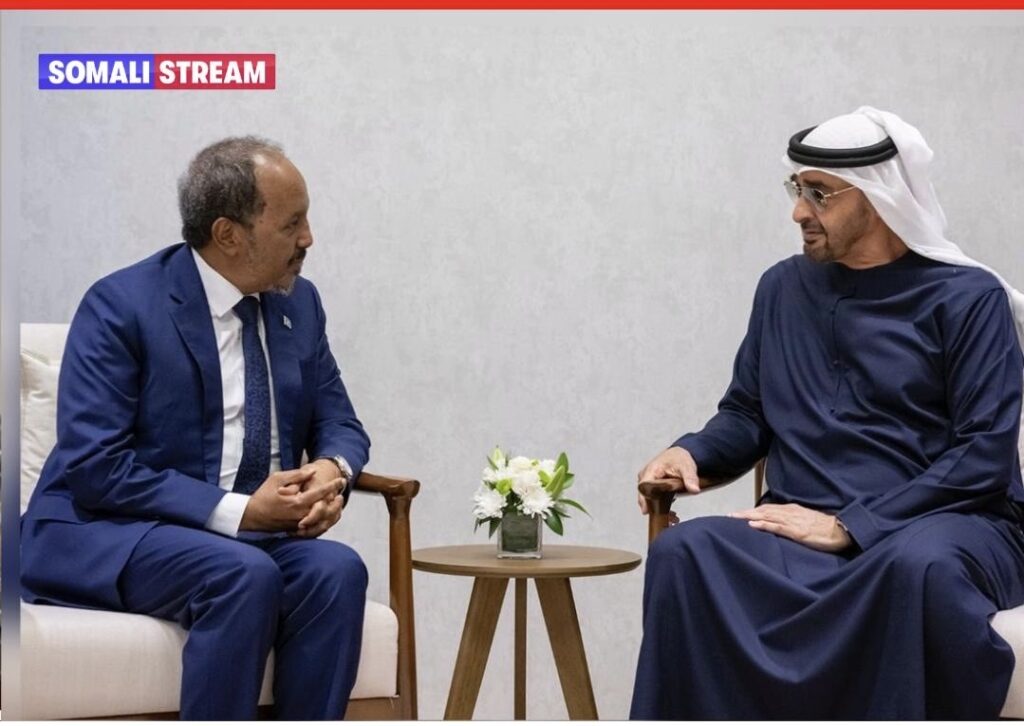
In a dramatic escalation of its diplomatic stance, the Federal Republic of Somalia has formally terminated all bilateral security and defense agreements with the United Arab Emirates, including cooperation at the strategic ports of Berbera, Bosaso, and Kismayo.
The Cabinet resolution, adopted on January 12, 2026, cites compelling reports and evidence that UAE actions compromised Somalia’s sovereignty, territorial integrity, and political independence, sending shockwaves through the Horn of Africa and signaling the severest rupture in Somalia-UAE relations in years.
The move reflects decades of fraught interactions. In August 2025, Somalia’s President Hassan Sheikh Mohamud received Sheikh Shakhboot bin Nahyan Al Nahyan, UAE Minister of State, in Mogadishu at the start of a working visit meant to foster dialogue. But lingering disputes, including UAE support for Somaliland, Jubaland and Puntland administrations, semi-autonomous states often in tension with Mogadishu , had already poisoned the partnership. Somali officials argue that UAE backing for these regional authorities repeatedly undermined federal authority.
The Cabinet’s decision also resurrects historical grievances. In 2018, Somalia filed a complaint with the Arab League over a $422 million deal involving the UAE port operator DP World, Ethiopia, and Somaliland at Berbera port, arguing it was signed without federal approval and threatened Somalia’s constitutional order and national unity. Somalia formally declared the tripartite deal “null and void”, although parties to the agreement dismissed the claim, insisting Somalia had no authority over the matter. Somali lawmakers passed legislation to ban UAE port operator DP World, with 168 MPs voting in favor, sending the law to the Upper House for final approval.
Security concerns further exacerbated tensions. Somali ports were rumored to be used for weapons transfers originating from the UAE, raising red flags in Mogadishu. In February 2024, three soldiers including Corporal Suleiman Saeed Al Shehhi and First Warrant Officer Mohamed Saeed Al Shamsi of the UAE Armed Forces, and an officer from the Bahrain Defense Force were killed in an attack on the General Gordon military base in Mogadishu, claimed by al-Shabaab, which accused the UAE of violating Sharia law by supporting the Somali government’s counterterrorism operations.
Diplomatic efforts to repair ties have repeatedly faltered. Following his re-election in February 2023, President Mohamud met Sheikh Mohamed bin Zayed Al Nahyan at IDEX 2023 in Abu Dhabi, where the two leaders discussed military cooperation, counterterrorism, and development. A security and anti-terrorism agreement was signed by the then Somalia’s Defense Minister Abdulkadir Mohamed Nur and his UAE counterpart, Mohammed bin Ahmed al-Bowardi, intended to strengthen Somalia’s security institutions and support efforts to combat al-Shabaab.
Yet, trust eroded further when the UAE allegedly facilitated the escape of Southern Transitional Council (STC) leader Aidarous al-Zubaidi from Yemen via Berbera port in Somaliland in early 2026, bypassing planned peace talks in Riyadh.
The Saudi-led coalition reported that Zubaidi had “escaped in the dead of night,” intensifying Mogadishu’s suspicions of UAE interference in Somali internal politics.
These steps underline Somalia’s determination to assert control over strategic ports and national security policy, signaling that foreign engagement cannot override constitutional authority.
The January 2026 Cabinet resolution emphasizes Somalia’s sovereign authority over its territory, ports, and national security, reaffirming that international cooperation must be based on mutual respect, recognition of sovereignty, and adherence to constitutional and international law.
Somalia has directed the Ministry of Foreign Affairs to formally communicate the termination of agreements to the UAE and inform regional and international partners including the African Union and United Nations, of the federal government’s constitutional prerogatives.
The resolution is seen as both a defensive assertion of sovereignty and a strategic rebuke.
It signals that while Somalia remains committed to international partnerships, alliances that compromise federal authority, enable external interference, or bypass national legal processes will no longer be tolerated.
In the volatile landscape of the Horn of Africa, Somalia’s bold move is a reminder that even longstanding partners can quickly become sources of geopolitical conflict when national sovereignty is perceived to be at stake.