


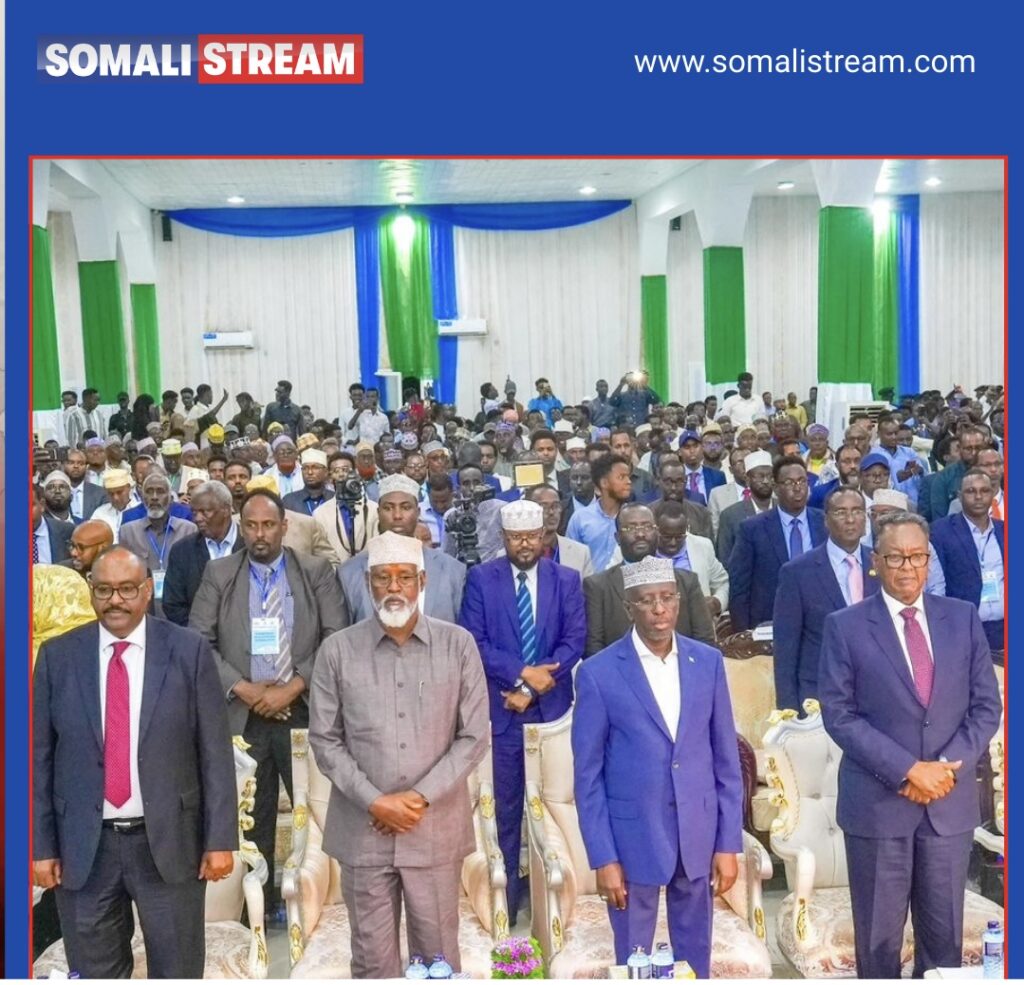
A broad coalition of Somali opposition figures, lawmakers, former senior officials, and civil society representatives has issued a sharply worded political statement warning that Somalia is heading toward deep instability unless the federal government changes course on governance, security, and elections.
The statement followed a three-day National Somali Self-Determination Conference held in Kismayo from December 18 to 20, convened under the umbrella of the Somali Future Council. Participants said discussions focused on what they described as a deteriorating political, security, economic, and humanitarian situation across the country.
According to the conference Communiqué, briefings presented to delegates painted a troubling picture of the administration of President Hassan Sheikh Mohamud. Participants accused the government of political mismanagement, weakening national cohesion, and concentrating power in ways they argue undermine Somalia’s federal system.
The forum alleged that constitutional checks and balances have been eroded, accusing the presidency of unilaterally altering the provisional constitution and sidelining institutions meant to restrain executive authority. It also raised concern that some Federal Member States have remained in office beyond their constitutional mandates with federal acquiescence, an issue the conference described as unprecedented and destabilizing.
Security policy featured prominently in the criticism. Delegates argued that momentum against Al-Shabaab has stalled, blaming what they called poor leadership, corruption, and politicization within the security forces for weakening morale and operational effectiveness. They warned that these failures risk reversing gains made against extremist groups, even as Somali troops continue to suffer casualties on the front lines.
The conference further accused the Federal Government of presiding over economic decline and a worsening humanitarian situation, citing allegations of widespread corruption, forced displacement of vulnerable communities, illegal sales of public land, and a loss of confidence among both domestic and international investors. According to the statement, capital flight and asset losses among Somali citizens have accelerated as a result.
A major focus of the communiqué was the ongoing electoral process in Benadir Region. Conference participants described the exercise as “one-sided,” arguing it is driven by a single political camp and conducted without agreement on the constitutional status of Mogadishu. They warned that proceeding under these conditions violates the provisional constitution and risks deepening divisions among residents of the capital.
The forum also called on leaders of Federal Member States whose terms have expired to organize elections in line with their respective constitutions and electoral laws.
Strong criticism was directed at what the conference described as the forced displacement of poor communities, allegedly carried out by security forces. Delegates condemned the use of state power to evict civilians rather than protect them and urged an immediate halt to evictions, land seizures, and the sale of public assets.
Concerns were also raised about restrictions on independent media, civil society organizations, and academic institutions. The communiqué accused authorities of pressuring universities and schools to participate in political activities linked to the president’s electoral agenda, and of politicizing civilian air travel and migration services.
Despite its criticism, the forum praised Somali security forces fighting Al-Shabaab and ISIS, acknowledging what it called their sacrifices in defending the country under difficult conditions.
Looking ahead, the conference emphasized unity and constitutionalism as the only viable path forward. It reaffirmed that Somalia’s state-building project rests on the 2012 provisional constitution and rejected any unilateral amendments made by the federal executive.
The forum underlined that the current parliament’s term ends on April 14, 2026, and the president’s mandate on May 15, 2026, warning that any extension would trigger political uncertainty, constitutional crisis, and security risks.
While critical, the opposition grouping left the door open to dialogue. It said it is prepared to engage President Hassan Sheikh Mohamud on organizing an inclusive, transparent election, one it argues should improve on the 2022 process, strengthen regional representation, and be overseen by an agreed, independent electoral commission.
The conference called on the president to convene all political stakeholders within one month, by January 20, 2026, to reach consensus on a timely and credible electoral framework. Should that call be ignored, the forum warned it would consider alternative steps to prevent a constitutional vacuum.
The statement also appealed to federal and regional authorities, religious leaders, business figures, diaspora communities, and humanitarian organizations to mobilize urgent assistance for communities affected by drought. International partners were thanked for their long-standing support and urged to back efforts toward a broadly accepted, on-time election.
The conference concluded by expressing appreciation to the Somali Future Council for organizing the meeting and to the Jubaland authorities and public for hosting the event in Kismayo.