


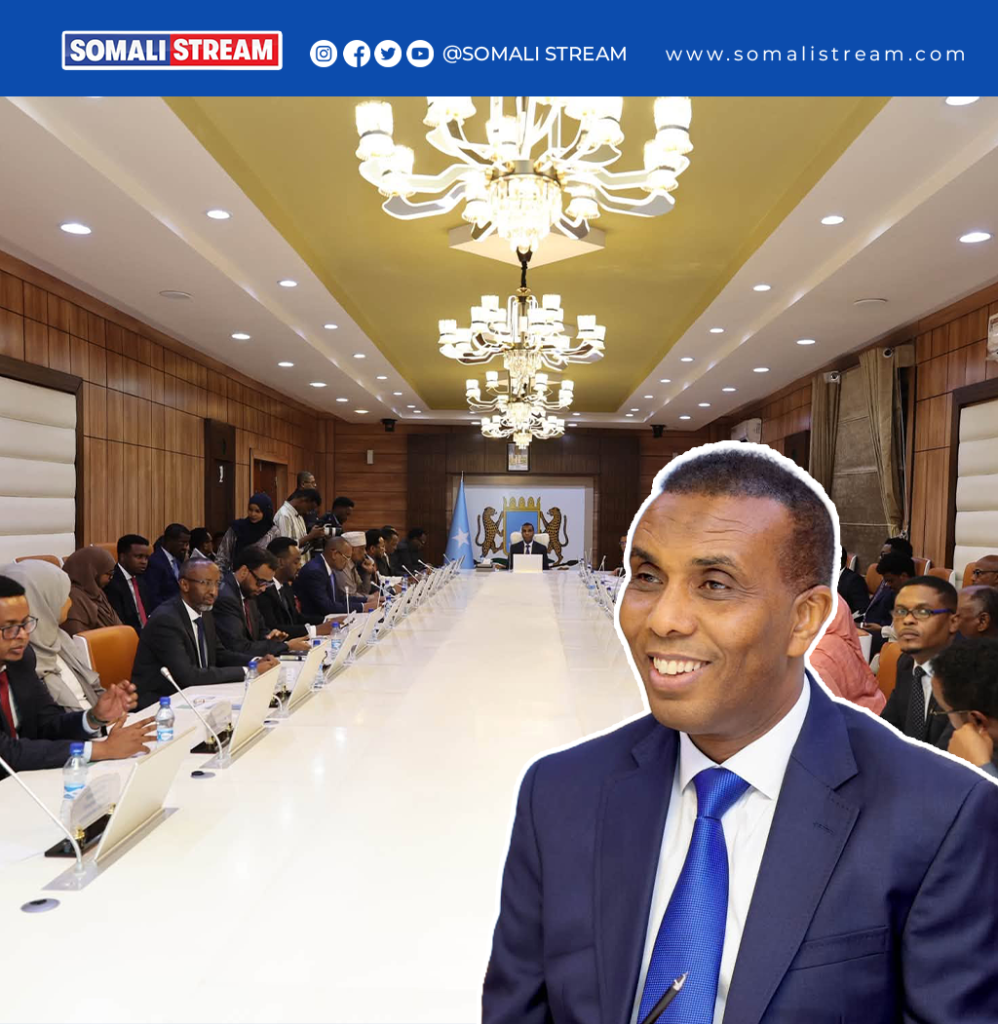
Somalia’s Council of Ministers has approved sweeping amendments to the country’s electoral and political party laws, advancing President Hassan Sheikh Mohamud’s efforts to reshape the national electoral framework amid an unresolved political standoff with opposition groups and the Federal Member States.
The approval, announced following an extraordinary Cabinet meeting chaired by Prime Minister Hamza Abdi Barre on Tuesday evening, covers amendments to 23 articles of the National Electoral Law No. 28 of November 2024 and eight articles of the Political Organisations and Parties Law.
As Somali Stream previously reported, the proposed changes include introducing a closed-list proportional representation system, removing the existing three-party limit, establishing a 10 per cent parliamentary threshold for national party recognition and fundamentally restructuring the composition and selection of the Upper House.
The amendments also propose replacing Federal Member State-based Senate representation with an electoral arrangement based on Somalia’s 18 historical administrative regions, potentially opening the way for Banadir to secure representation in the Upper House.
According to the government, the amendments are intended to align existing electoral legislation with the Federal Constitution, arguing that the laws were enacted before the constitutional changes and therefore require corresponding revisions.
However, the Cabinet approval comes amid continuing opposition to the government’s electoral roadmap, with major political stakeholders yet to reach agreement on the country’s next electoral arrangements.
Closed-List Voting Places Political Parties at the Centre of Elections
One of the most consequential changes concerns the introduction of a closed-list proportional representation system.
Under the approved amendments to Articles 11 and 12 of the National Electoral Law, parliamentary elections would operate through a proportional representation model in which registered political organisations and parties submit lists of candidates.
Parliamentary seats would be allocated according to each organisation’s electoral performance, with successful candidates taking their seats in the order in which they appear on the submitted lists.
Unlike an open-list system, where voters can influence the selection of individual candidates, the closed-list arrangement gives political organisations greater control over candidate ranking and determines who enters Parliament based on the order established by their respective parties.
The government says the broader electoral framework will enable citizens to directly elect local councils, representatives to Federal Member State assemblies and members of both chambers of the Federal Parliament.
The official Cabinet statement further describes a system in which officeholders ranging from district commissioners to the President of the Republic would be selected through the relevant representative councils and assemblies.
The precise relationship between this broader description and the detailed presidential election provision in Article 12 will be important as the amended legislation is published.
Presidential Election Remains a Parliamentary Process
Under the specific wording of the revised Article 12 provided in the draft, the President of the Federal Republic would continue to be elected through a joint sitting of both chambers of the Federal Parliament, following the procedure stipulated in Article 107 of the Federal Constitution.
This means the proposed transition to direct parliamentary elections would not, under that provision, introduce a direct popular vote for the presidency.
Instead, citizens would elect their parliamentary representatives, while members of the House of the People and the Upper House would jointly select the head of state.
The distinction is significant because it places the composition of the Federal Parliament at the centre of the presidential selection process.
Upper House Overhaul: From Federal States to the 18 Historical Regions
Perhaps the most politically consequential provision concerns the restructuring of Somalia’s 54-member Upper House.
Under the proposed amendments to Article 14, the Senate would be elected through Somalia’s 18 historical administrative regions rather than the existing Federal Member State-based representation framework.
Registered voters residing in each respective region would directly elect their senators, with registered political organisations and parties competing for the seats.
The proposal represents a substantial departure from the existing federal power-sharing arrangement, under which the Upper House serves as the chamber representing Somalia’s Federal Member States.
Replacing state-based representation with a regional electoral model could significantly alter the balance of political influence between Mogadishu and the regional administrations.
Most notably, the proposed arrangement could create a pathway for Banadir, which includes the capital Mogadishu, to obtain representation in the Upper House.
The draft, however, does not specify in the provisions reviewed how the 54 seats would be distributed among the 18 regions.
Alternative Senate Seat Allocation Where Elections Cannot Be Held
The amendments also introduce a contingency mechanism for circumstances in which Senate elections cannot take place in a particular Federal Member State because of insecurity or other exceptional conditions.
Under the proposed provision, political organisations would receive the relevant seats according to their respective shares of seats won in other Federal Member States where elections have successfully taken place.
The arrangement seeks to prevent parliamentary representation from remaining unresolved in areas where security challenges make direct voting impossible.
However, it also raises questions about how regional representation would be determined when electoral participation differs significantly across the country.
Three-Party Limit Removed as 10% Threshold Introduced
The approved amendments to the Political Organisations and Parties Law also seek to reshape Somalia’s multiparty system.
Under the revised framework, any political organisation securing at least 10 per cent of the vote in federal elections would qualify for recognition as a national political party, according to the Cabinet announcement.
The existing provision restricting the country to a maximum of three political parties would also be removed.
This would potentially allow a wider range of political organisations to achieve national party status, subject to the proposed electoral threshold and other registration requirements.
Combined with the closed-list electoral model, the changes would place political organisations at the centre of candidate selection, parliamentary representation and the formation of the country’s future political leadership.
SSC-Khaatumo Reference Removed from Electoral Framework
Another significant provision identified in the draft reviewed by Somali Stream concerns the removal of references to SSC-Khaatumo from the electoral legislation.
The proposed omission is politically sensitive given the continuing debates surrounding Somalia’s federal arrangements, territorial administration and the representation of emerging federal structures.
Its removal raises questions about how the proposed electoral framework would accommodate SSC-Khaatumo’s political and administrative status and how its representation would be addressed under the new regional arrangement.
Electoral Commission Given Greater Flexibility on Voter Registration
The Cabinet also endorsed provisions allowing the National Independent Electoral and Boundaries Commission to introduce technical mechanisms to facilitate voter registration and voting.
According to the government’s announcement, the commission would be empowered to develop practical arrangements that make electoral participation easier for citizens, drawing on the constitutional requirement to facilitate the exercise of voting rights.
The provision gives the electoral authority room to develop administrative and technical solutions aimed at expanding voter access and addressing practical challenges associated with registration and participation.
The extent of this authority and the mechanisms eventually adopted will be important in determining how the new electoral system operates across Somalia’s diverse geographical and security environments.
Opposition Boycott Leaves Political Consensus Unresolved
The Cabinet’s decision comes against the backdrop of an increasingly polarised political environment, with the federal government and opposition groups yet to agree on the country’s next electoral arrangements.
The Somali Future Council, an opposition alliance bringing together former presidents, senior political figures and the administrations of Puntland and Jubaland, has challenged the government’s approach to the electoral transition.
Opposition leaders have rejected unilateral electoral arrangements and called for an inclusive political settlement involving the federal government, Federal Member States and other key political stakeholders.
Their objections extend beyond the technical details of electoral legislation to questions concerning constitutional authority, the distribution of federal power, the composition of electoral institutions and the legitimacy of the next political transition.
The disagreement has also centred on the mandate of the current federal leadership and the legal implications of constitutional amendments adopted earlier this year.
The government, meanwhile, maintains that the transition towards direct elections and a multiparty political system represents an important step in moving Somalia away from its longstanding indirect, clan-based electoral arrangements.
The Cabinet’s latest decision demonstrates that the administration intends to advance its electoral framework through the formal legislative process, despite the absence of a comprehensive agreement with the principal opposition stakeholders.

