


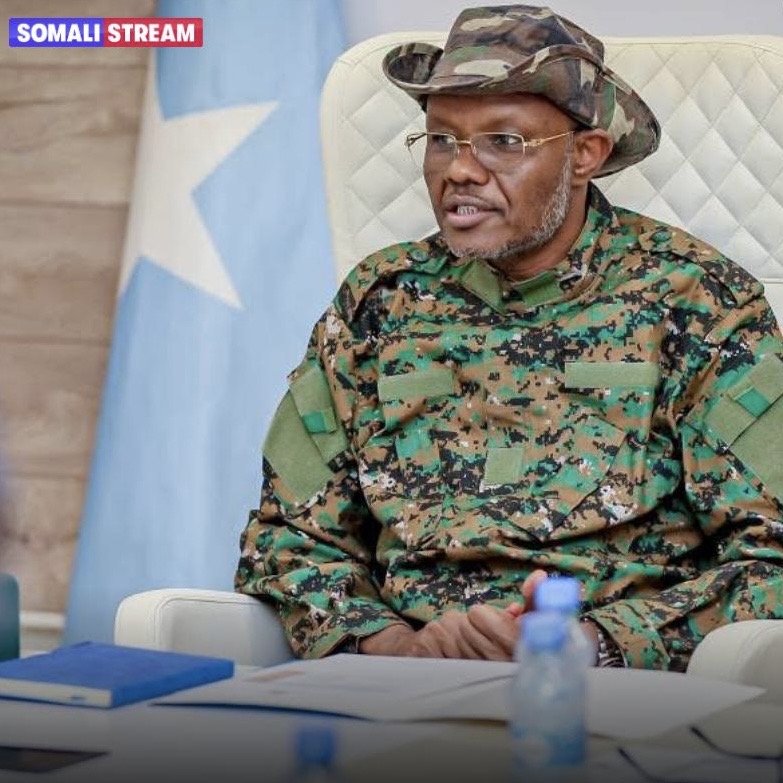
It did not begin with a speech, a decree, or even a visible disagreement. In Somalia’s political culture, fractures rarely announce themselves. They emerge gradually through silence, through a shift in tone, through meetings that stop happening and messages that go unanswered.
What is now unfolding between President Hassan Sheikh Mohamud and South West leader Abdiaziz Laftagareen follows that familiar pattern, but with far higher stakes.
For months, the two men stood as pillars of the same political structure, leading the Justice and Solidarity Party as Chairman and Deputy.
Their alignment was not just symbolic, it was strategic, anchoring a broader political project. Yet today, that alignment appears to be quietly collapsing, replaced by a relationship defined less by trust and more by calculation.
The early signs of strain were subtle. Political pressure began to build around Laftagareen through the usual instruments of influence, backchannel conversations, shifting alliances, and carefully calibrated signals from Mogadishu.
It was, by all appearances, an attempt to contain or weaken his position without triggering open confrontation. But the effort misfired. Rather than isolating him, it seemed to reinforce his standing, both within his regional base and among political actors watching the balance of power shift.
Laftagareen’s quiet return to Baidoa on Tuesday, after an unannounced trip marked a turning point. Away from the spotlight, he began a series of consultations with allies, constituency leaders, and other influential stakeholders effectively repositioning himself not as a cornered political figure, but as one preparing for a longer contest.
Those meetings, according to sources familiar with the process, were less about immediate reaction and more about building a durable response.
A window for de-escalation briefly opened. A phone call, facilitated by intermediaries trusted by both Villa Somalia and Villa Southwest, sought to restore a measure of confidence between the two leaders. It was the kind of quiet diplomacy that often stabilizes Somali political tensions before they spill into the open. This time, it failed.
Instead of compromise, Laftagareen presented terms; four of them, precise and uncompromising.
They called for the dismissal and investigation of key federal ministers, a reversal of recent constitutional changes back to the 2012 framework, the freedom for Federal Member States to conduct their own elections within a defined timeline, and, only after these steps, a National Consultative Forum on the country’s electoral future to be held on neutral ground.
In substance, the demands did more than set conditions for dialogue; they challenged the prevailing structure of political authority.
For President Hassan Sheikh, the moment is equally revealing. His current political method departs sharply from the coalition-driven approach that defined his earlier rise. Where once power was shared among networks and negotiated across factions, it is now increasingly concentrated within a narrower circle. Familiar figures from earlier phases have receded, replaced by actors whose influence is more closely aligned with the presidency itself. It is a system that prizes cohesion over plurality, discipline over negotiation.
Within such a framework, figures like Laftagareen present a dilemma. His political base, his independence, and his ability to act beyond the immediate orbit of Villa Somalia make him valuable, but also unpredictable. And unpredictability, particularly in the period leading toward future electoral contests, carries risk.
In Mogadishu, the response has been measured but unmistakably cautious. Signals of willingness to repair the relationship have been conveyed, yet without movement on the core demands, the gap remains wide.
At the same time, a parallel track of political recalibration is underway. Meetings involving senior figures, including Speaker of the House of the People Aden Mohamed Nur ‘Madoobe’, have focused on assessing the failure of earlier efforts to sideline Laftagareen and exploring alternative strategies. The conclusion, increasingly shared, is that the first round has been lost—but the contest is far from over.
Attention is now shifting back to Baidoa, where Laftagareen is expected to articulate his position publicly for the first time since tensions escalated.
Those familiar with the anticipated statement describe it to Somali Stream as firm in tone and expansive in scope, likely to frame not only his immediate grievances but also a broader vision of Somalia’s political trajectory.
What is taking shape, then, is not a sudden collapse of an alliance, but a slow and deliberate unravelling, one that reflects deeper currents within Somalia’s evolving political order. It is a movement away from the fluid, coalition-based politics of the past toward something more centralized, more controlled, and arguably more fragile.
As the political distance between Mogadishu and Baidoa continues to widen, the question is no longer whether the relationship can be restored to what it once was.
It is whether the system itself can accommodate competing cente