


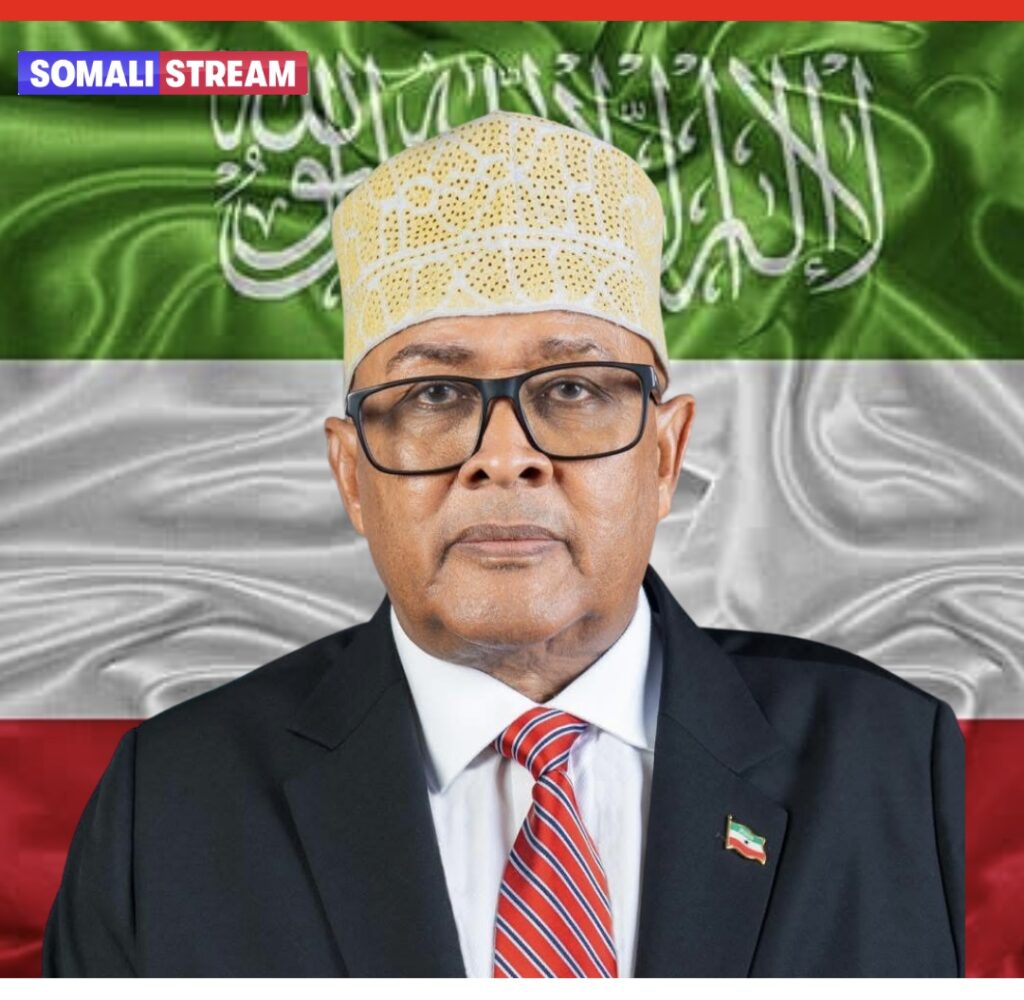
December 2025 marks one year since President Abdirahman Mohamed Abdullahi (Irro) was sworn in as the sixth President of Somaliland, a self-declared state in northern Somalia. His first year in office has been defined by bold diplomacy, internal political recalibration, and most controversially, the agreement signed with Israeli Prime Minister Benjamin Netanyahu, a move that has drawn intense regional and international scrutiny.
To understand the significance of that decision, it is essential to understand the man behind it.
Early Life and Education
Abdirahman Mohamed Abdullahi was born on April 29, 1955, in Hargeisa, into a large family of ten children. His father served in the British colonial-era police force, a background that exposed him early to discipline, public service, and administration. He lost his mother, Amina Jama Ashuur, during his childhood, an experience that shaped his resilience from an early age.
He received his primary and secondary education across Somaliland, studying in Hargeisa, Berbera, Burco and later at the prestigious Ahmed Gurey School, before completing high school at Sheikh High School in 1977.
Early Career and Social Development Work
Following high school, Irro began his professional life as a primary school teacher, reflecting an early commitment to public service. Like many Somalis of his generation, he later moved to Mogadishu, then the capital of Somalia, seeking broader educational and professional opportunities.
There, he joined the Settlement Development Agency, an NGO responding to the devastating droughts known as Dabadeer, which caused massive livestock losses across northern and Southern Somalia. Between 1978 and 1981, Irro worked closely on humanitarian and development programs—experience that grounded his later political worldview in social welfare and institutional rebuilding.
While working, he pursued post-secondary studies at SIDAM (Somali Institute of Development Administration and Management) and later trained in accounting, eventually studying at California State University, where he was part of the pioneering accounting cohort. He went on to earn a Master of Business Administration (MBA) from New York State University at Albany.
Diplomatic Career and International Exposure
Irro entered formal diplomacy in 1981, joining Somalia’s Ministry of Foreign Affairs, where he worked on economic cooperation portfolios. In 1988, he was appointed Deputy Ambassador and Deputy Head of Mission at Somalia’s Embassy in Moscow, serving until 1996.
During his posting in Russia, he earned a Higher Diploma in African Studies from Moscow’s African Studies Institute. This period proved formative, exposing him to Cold War geopolitics, multilateral diplomacy, and international statecraft. He later continued studies in Finland, becoming a founding member of the Somaliland diaspora community in Helsinki.
Return to Somaliland and Entry into Politics
Irro returned to Somaliland in 1999, at a time when the region was rebuilding its institutions following years of conflict. He became involved in education and development initiatives, helping secure support for projects such as Candlelight School in Burco and the Hargeisa Institute, while also establishing private businesses in Hargeisa.
His formal political career began in 2005, when he was elected to Somaliland’s first elected parliament, representing the Saaxil region under the UCID Party, which he co-founded. Through inter-party agreements, he was elected Speaker of Parliament, a position he held for 12 years, shaping legislative norms and parliamentary procedure in Somaliland’s evolving political system.
Waddani Party and the Road to the Presidency
In 2011, Irro founded the Waddani Party, which rapidly grew into Somaliland’s largest opposition movement. Running for president in 2017, he narrowly lost to President Muse Bihi Abdi, but emerged as the central figure of the opposition.
In 2024, Irro won the presidency in a landmark election, positioning himself as a leader focused on foreign engagement, economic diversification, and institutional legitimacy.
A Controversial Diplomatic Turn
Irro’s first year in office has culminated in his most consequential and controversial decision: the agreement signed with Israel’s Prime Minister Benjamin Netanyahu, including Israel’s recognition of Somaliland. Supporters view the move as a calculated attempt to break Somaliland’s diplomatic isolation. Critics, including Somalia’s federal government and regional bodies, argue it violates international law and risks destabilizing the Horn of Africa.
What is clear is that Irro’s long background in diplomacy and international engagement shaped his willingness to pursue unconventional alliances.
Married with five sons, President Irro presents himself as a pragmatic, internationally minded leader. His supporters praise his integrity, patience, and strategic thinking. His critics question whether bold diplomacy can substitute for broader regional consensus.
One year into his presidency, Abdirahman Mohamed Abdullahi (Irro) stands at the center of a defining moment for Somaliland, testing whether decades of experience in diplomacy, governance, and institution-building can translate into lasting political recognition, or whether the risks of unilateral moves will outweigh their promise.