


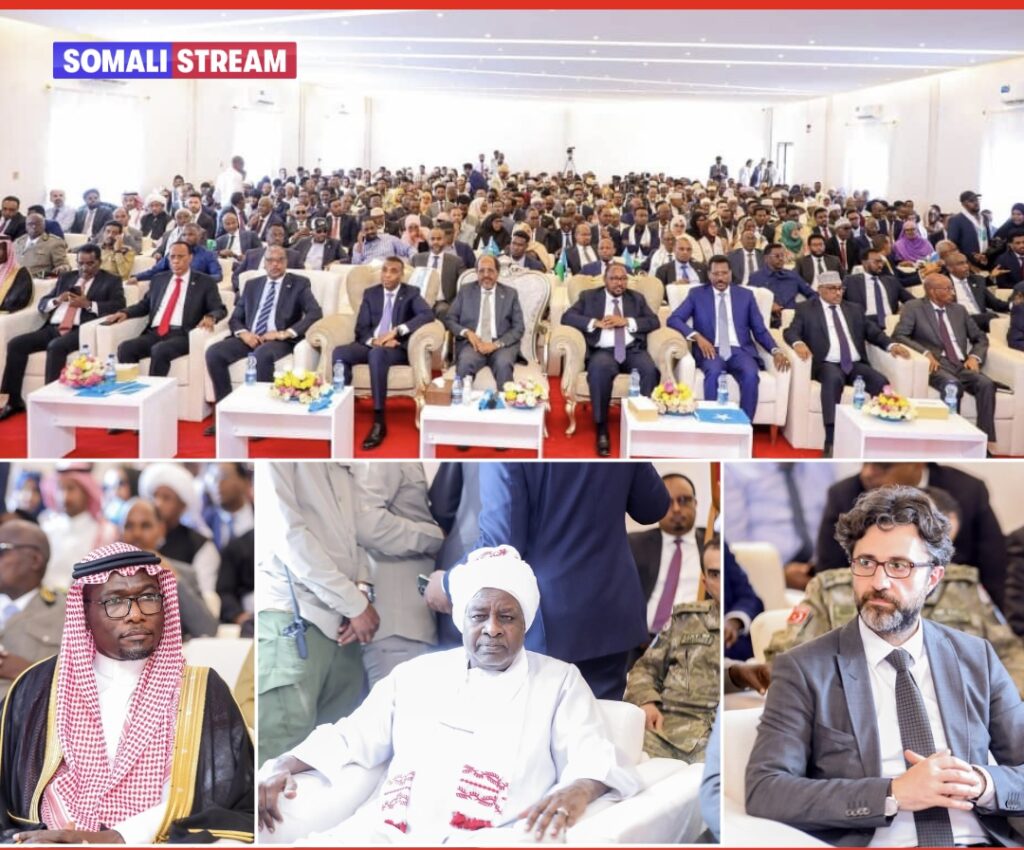
Saturday, January 17th, 2026, marked a historic day in Somalia. After decades of struggle, uncertainty, and the longing for recognition, the great day arrived. The official inauguration of President Abdulkadir Aw Ali (Firdhiye) brought together leaders from across the Horn of Africa and the globe, filling the inauguration hall with the senior Federal Government of Somalia, representatives of Federal Member States, traditional elders, military and security chiefs, and distinguished diplomats.
The atmosphere was electric. Somali flags waved from every corner, songs of unity and patriotism echoed through the hall, and the faces of thousands of citizens reflected hope, pride, and the realization of a long-awaited dream.
For the people of Las Anod, this was more than a ceremony, it was the affirmation of belonging, of recognition, and of a future built within a united Somalia.
The moment was amplified on Friday, January 16th, when President Hassan Sheikh Mohamud and Prime Minister Hamza Abdi Barre touched down in Las Anod, marking the first visit by a sitting Somali leader to the city in more than four decades, since the era of President Mohamed Siad Barre.
Their arrival was met with jubilation, as the people of Las Anod lined streets, waved flags, and celebrated a connection to the federal government that had been absent for generations.
The residents of Las Anod were the true stars of the day. For over forty years, they had not seen a Somali President walk their streets. Now they welcomed one not as a visitor, but as a legitimate representative of their country. The city’s pride, discipline, and joy transformed every street into a stage of national unity.
The ceremony highlighted the Northeastern Federal Member State of Somalia, which administers about 45% of what was formerly the British Protectorate of Somaliland. This region, long marginalized and caught in territorial disputes, now officially participates in Somalia’s federal system.
During the colonial period, the northern regions were collectively called the British Protectorate of Somaliland. Today, these lands are divided politically: the northeastern part, which supports the unity of Somalia under a newly established Federal Member State, and the northwestern part, known as Somaliland, which seeks secession and has recently been recognized by Israel as an independent state.
The inauguration thus symbolized more than political authority; it was a manifestation of unity, sovereignty, and Somali identity, celebrated with color, music, and ceremony.
Among the distinguished guests were Boqor Burhaan Boqor Muuse, representing the enduring voice of traditional authority, and Ali Mohamed Gedi, former Prime Minister of Somalia, linking the struggles of the past with the promise of today.
Somalia’s security and justice institutions were fully represented, signaling both legitimacy and protection: Mahad Mohamed Salad, Director General of the National Intelligence and Security Agency (NISA); General Asad Cismaan Cabdullaahi, Commander of the Somali Police Force; and Mahad Abdirahman also knows asTaliye Shub, Commander of the Somali Custodial Corps.
Senior ministers attending included Minister of Defence Ahmed Moallim Fiqi, Minister of Interior, Federal Affairs and Reconciliation Ali Yusuf Ali, Minister of Internal Security Abdullahi Sheikh Ismail, Minister of Health Dr. Ali Haji Adam Abubakar, Minister of Transport and Civil Aviation Mohamed Farah Nuh, Minister of Commerce and Industry Gamal Mohamed Hassan, Minister of Water and Energy Abdullahi Bidhan, Minister of Justice and Constitutional Affairs Hassan Moallin Mahmoud Sheikhali, Minister of Ports and Marine Transport Abdulkadir Mohamed Nur, and Minister of Public Works, Reconstruction and Housing Ayub Ismail Yusuf.
Their presence emphasized that Las Anod is no longer peripheral, it is fully integrated into Somalia’s federal system, protected by its institutions, and central to its national identity.
Las Anod’s significance reached beyond Somalia. Delegations from Kenya, Djibouti, and the Somali Region of Ethiopia attended, alongside senior ambassadors from Türkiye, Saudi Arabia, and Sudan, all reaffirming Somalia’s sovereignty and the legitimacy of its federal system.
From Kenya came former Mandera Senator Billow Kerrow, MP Farah Maalim, and Kamukunji MP Yusuf Hassan, with a broader delegation observing closely. Djibouti was represented by Minister of Religious Affairs and Endowments Mu’min Hassan Barre, and Minister of Communications Ridwan Cabdullaahi Bahdoon.
Senior ambassadors included Alper Aktaş of Türkiye, Ahmed bin Mohammed Saleh Al-Muwalad of Saudi Arabia, Abdulrahman Khalil Ahmed Abakr Afandi of Sudan and Djiboutian Ambassador to Somalia, Mohamed Ibrahim Yusuf. Their presence sent a powerful message: Somalia’s unity is recognized internationally, and Las Anod is a cornerstone of that federal legitimacy.
The inauguration was a feast for the senses. Patriotic songs and traditional music filled the hall, including a memorable performance by artist Ismail Aarka, who delivered the ‘birmade’ anthem in honor of the President, lifting the crowd to their feet in jubilation.
Flags waved, drums echoed, and the energy of a united people was palpable. Every cheer, every chant, every handclap carried the emotional weight of decades of struggle and the hope of generations. For the citizens of Las Anod, this was proof that their voices, loyalty, and resilience mattered.
Not all political actors were present. The Puntland Regional State, led by President Said Abdullahi Deni, abstained from the inauguration, maintaining that the northeastern region remains an integral part of its territory.
Although Puntland opposed the Federal Government’s decision against the UAE, it has yet to clarify its position regarding Israel’s recognition. Maps of Somaliland handed to Foreign Minister Gideon Saar included the regions of Sool and Sanaag, and Puntland has not indicated whether it contests Israel’s recognition over the areas it claims, particularly the SSC (Sool, Sanaag, and Cayn) regions.
Relations between Somaliland and Puntland, however, have warmed since the northeastern region joined the Federal Government, opening cautious avenues for dialogue and stability in the north.
Despite Somaliland authorities’ objections and mobilization, reality on the ground was clear: no external force could stop this historic moment. Ministers and lawmakers from disputed regions, particularly Awdal, openly participated, reaffirming the federal government’s authority and popular will.
Las Anod did not merely host history; it shaped it. In a nation often defined by conflict and division, the city offered a model of federalism, unity, and hope. It proved that statehood built from the people, with their trust and participation, can endure. Four decades after the state’s absence, Somalia returned to Las Anod, not as an idea, but as a living, breathing promise. And this time, it was welcomed home.
