


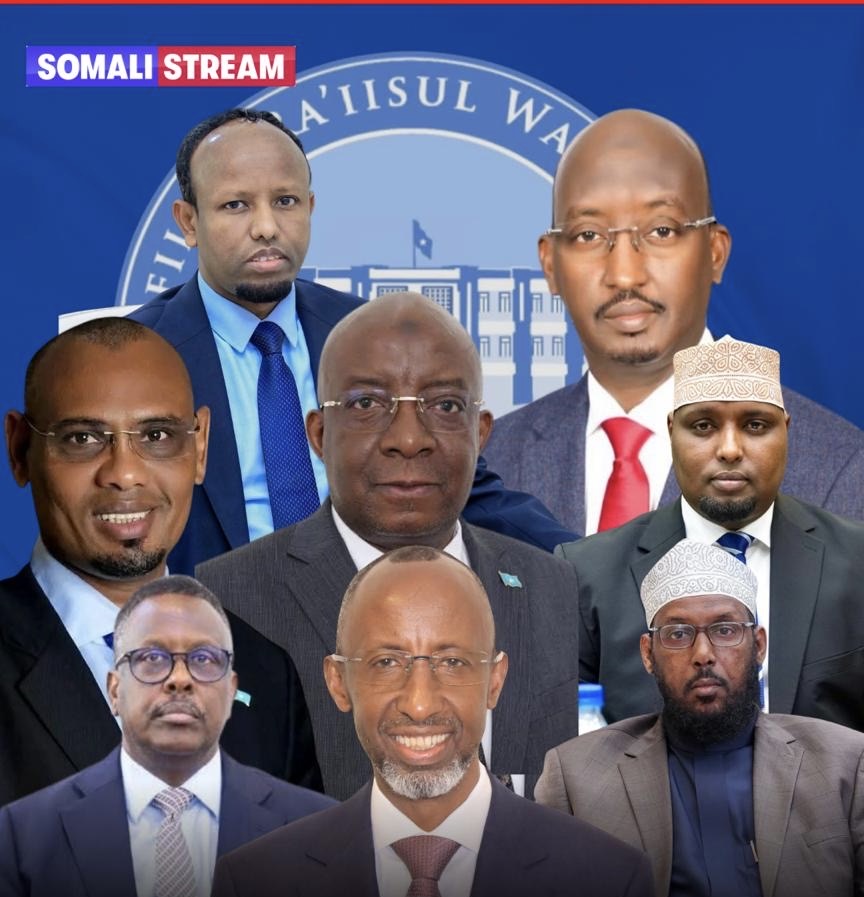
Since assuming office in August 2022, Somali Prime Minister Hamza Abdi Barre has been quietly, yet systematically, reshaping his cabinet. What began as a 26-member team of technocrats, loyalists, and political heavyweights has, over three years, become a revolving door, a political chessboard where portfolios, alliances, and loyalties are constantly in flux.
The original August 2022 cabinet was designed to stabilize Somalia’s fragile governance structures, yet by December 2025, only eight ministers remain untouched, holding onto their portfolios despite waves of reshuffles. Figures like Mukhtar Robow Abu Mansur, the Minister of Endowments and Religious Affairs and Dr. Ali Haji Aden, the Minister of Health, have become symbols of continuity in a sea of change.
Some ministers have become the ultimate political chess pieces. Ahmed Moallim Fiqi, for example, has moved from Interior to Foreign Affairs and finally to Defense, demonstrating Hamza’s trust in him for the most sensitive portfolios. Similarly, Bihi Iman Ige shifted from Labour to Finance, and Jibril Abdirashid rotated from Commerce to Defense before becoming Deputy Prime Minister. Abdulqadir Mohamed Noor, originally the Minister of Defense, was moved to Ports and Transport, while Khadija Al-Makhzuumi, once Minister of Environment and Climate Change, was reassigned to Family and Human Rights. General Bashir Mohamed Jama Goobe swapped portfolios from Family and Human Rights to Environment. These moves reflect Hamza’s strategy of rewarding loyalty, testing competence, and keeping ministers politically dependent.
Yet reshuffles have not been limited to rotations. By the end of 2025, fourteen ministers from the original cabinet had been fully removed. Among them are key figures like Dr. Elmi Mahmoud Nur in Finance and Public Works, Abshir Omar Huruse in Foreign Affairs, Yusuf Mohamed in Labour, and Mohamud Adam Geesood in Commerce. Even portfolios critical to Somalia’s economy and security —Petroleum, Defense, and Internal Security — have been sites of high-profile exits. The December 2024 firing of Petroleum Minister Abdirizak Omar Mohamed, a close ally of President Hassan Sheikh Mohamud, highlighted Hamza’s willingness to assert authority, even at the risk of straining relations with the presidency.
Not all reshuffles have been outright dismissals. Some have been tactical swaps, designed to test loyalty and reshape alliances without provoking widespread fallout. The December 2024 rotation of Khadija Al-Makhzuumi to Family and Human Rights and General Bashir Mohamed Jama Goobe to Environment exemplifies this method. Such moves have sparked discussions in Mogadishu’s political circles: are these signs of a tactical genius, or evidence of underlying instability? In a country where political power is fragile and contested, even minor swaps can generate ripples across clan networks and party alliances.
Hamza’s cabinet reshuffles reveal a calculated balancing act between loyalty, competence, and political survival. Nearly all ministers from the August 2022 cabinet have either been rotated, reassigned, or fired, leaving only a small core of untouched ministers as the backbone of continuity.
For Somali political watchers and the African public, this raises provocative questions. Is Hamza consolidating power, or undermining institutional stability? Are these reshuffles a method to neutralize potential rivals? How do these moves affect Somalia’s economic governance, foreign relations, and security apparatus? Each reshuffle fuels debates, sparks alliances, and sometimes ignites tension across the Horn of Africa’s most politically dynamic nation.
For the average citizen, cabinet reshuffles might seem like abstract political theater, but for political analysts, journalists, and Somalia’s stakeholders, they are windows into power, influence, and strategy. Hamza’s reshuffles show a leader unafraid to play the game ruthlessly, yet careful to preserve a semblance of continuity. As Somalia heads further into 2026, one certainty remains: nobody’s seat is truly safe, and every minister must navigate the delicate dance of loyalty, competence, and survival under Prime Minister Hamza Abdi Barre.