


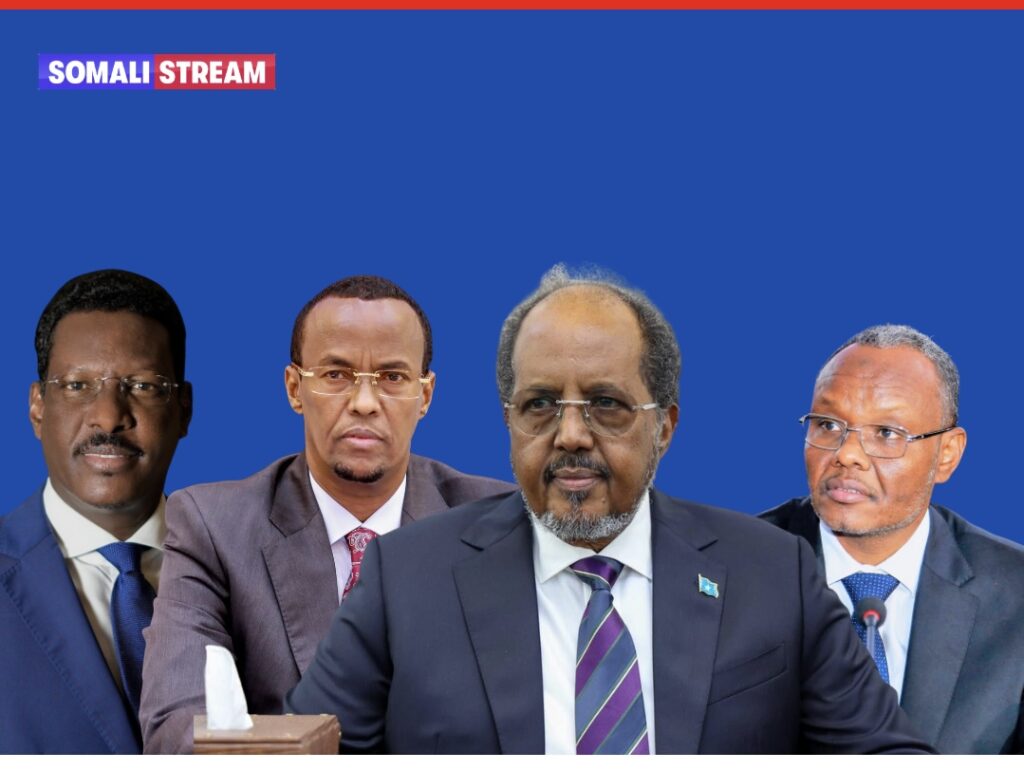
MOGADISHU— In Somali politics, alliances are rarely permanent; they are seasonal, transactional, and often built on quiet understandings rather than written contracts. What once looked like a tightly knit political brotherhood between President Hassan Sheikh Mohamud and several regional leaders is now fraying into open mistrust, a story not of ideology, but of expectations unmet and deals gone sour.
At the heart of the rupture lies timing. President Hassan Sheikh Mohamud’s current term is constitutionally expected to end in May 2026, a fact that has sharpened anxieties across the political spectrum. Yet long before his return to Villa Somalia in 2022, most of the regional presidents now at odds with him were already firmly in power, some well beyond their original mandates. What bound them together was not coincidence, but a shared assumption that political survival would be mutual, protection reciprocal, and favors returned when needed. For years, the arrangement appeared to hold.
Ali Abdullahi Hussein, widely known as Ali Gudlawe, was elected President of Hirshabelle State following an indirect election in Jowhar for a four-year term. Nearly six years later, he remains in office. In Galmudug, Ahmed Abdi Kariye “Qoor-Qoor” assumed the presidency in February 2020, while Abdiaziz Hassan Mohamed “Laftagareen” has led South West State since December 2018, following his election by local lawmakers. The newest among them, Abdulkadir Ahmed Aw-Ali (Firdhiye), became president of the newly formed North Eastern State of Somalia in August 2025.
When Hassan Sheikh Mohamud returned to the presidency, these leaders were not merely colleagues. They were political capital. Their endurance in office offered stability, voting leverage, and regional influence. In return, there was an unspoken understanding that Villa Somalia would not aggressively reopen questions of mandates, succession, or electoral accountability. It was a pact of convenience, quiet, effective, and brittle. That brittleness was exposed on a tense Saturday.
While President Hassan Sheikh chaired a virtual National Consultative Council meeting from Villa Somalia, bringing together Ali Guudlaawe, Qoor-Qoor, Laftagareen, Firdhiye, and Banadir Governor Hassan Mohamed Hussein (Muungaab), another political conversation was unfolding elsewhere outside Mogadishu.
Leaders of the Somali Future Council met representatives of the international community, including senior officials from the United Nations, the European Union, the United Kingdom, and the United States. Their discussion centered on Somalia’s increasingly fragile political landscape, with particular focus on the stalled constitutional review and the deepening electoral impasse.
Notably, the Somali Future Council, while formally accepting the February 1st Leadership Consultative Council conference, used the meeting to deliver a pointed message. Council leaders emphasized that it was essential for President Hassan Sheikh Mohamud to take concrete steps to ensure the conference is held in an atmosphere of trust and goodwill, and that the dialogue be genuinely productive. Central to this, they argued, was a complete halt to any amendments to the 2012 Provisional Federal Constitution and the urgent need to reach a broad, inclusive agreement on an electoral framework for the election of Federal Government institutions, an issue the Council described as one of Somalia’s most pressing national priorities.
The symbolism was unmistakable. One meeting sought to consolidate authority. The other set conditions for engagement.
Inside the virtual NCC session, Villa Somalia advanced a proposal that immediately unsettled its allies, preparations for simultaneous elections covering State-level parliaments and local councils. Framed by the Presidency as a step toward constitutional normalization, the proposal was perceived by regional leaders as the opening act of a political reckoning.
South West State, Galmudug, and Hirshabelle pushed back firmly. They argued that the selection of State Parliaments remained their constitutional prerogative, traditionally managed through clan elders, and that conditions were neither politically nor technically suitable for such elections. Privately, their concern was more stark. Elections administered under a federal framework they no longer trusted could end their political careers.
Notably, South West State President Abdiaziz Hassan Mohamed Laftagareen’s opposition carried particular weight. Following his recent election to the ruling Justice and Unity Party’s top leadership body as Deputy Chairman for Security Affairs and Federal Member States, Laftagareen’s resistance underscored a widening rift within the President’s own political camp. His stance signaled that the dispute was no longer merely federal versus regional, but also internal, cutting across party lines once assumed to be secure.
That distrust has crystallized around the National Independent Electoral and Boundaries Commission, chaired by Abdikarim Ahmed Hassan. Though constitutionally mandated to operate independently, several Federal Member States view the commission as politically aligned with Villa Somalia, an institution perceived less as an impartial umpire than as an instrument of the center.
The commission’s recent role in overseeing elections in the Banadir region only deepened those suspicions. Once confidence in the referee evaporates, the legitimacy of the entire process collapses with it.
Complicating matters further are Jubaland and Puntland, two Federal Member States whose leaders remain in openly strained relations with Mogadishu and who have already moved ahead with their own presidential elections.
In November 2024, Jubaland conducted a contested indirect election that resulted in the re-election of Ahmed Mohamed Islam (Madobe) for a third term as regional president, a process Villa Somalia rejected but failed to reverse. Similarly, on January 8, 2024, Said Abdullahi Deni, the incumbent President of Puntland, secured re-election in a vote held in Garoowe, Puntland’s capital, once again outside the federal consensus framework.
These parallel political tracks have further fractured the national electoral landscape. With some states renewing mandates unilaterally, others resisting elections entirely, and the federal government pushing accelerated reforms, Somalia’s election debate now risks stretching indefinitely, entangled in unresolved constitutional disputes, competing claims of legitimacy, and raw power plays.
For President Hassan Sheikh Mohamud, resistance from former allies has felt like betrayal. According to individuals familiar with discussions following the NCC meeting, the President questioned the sincerity and loyalty of some long-standing partners, suggesting in private that political accountability would need to be enforced before the month of Ramadan.
From the regional leaders’ perspective, the President has altered the political contract. The same leader who once depended on their prolonged tenure now appears determined to reset the rules, reviving disputed constitutional amendments, accelerating local elections, and asserting federal authority in ways that threaten their grip on power.
What makes this rupture especially striking is not simply the policy disagreement, but its personal dimension. These were leaders who defended one another during crises, coordinated quietly behind the scenes, and presented a united front when challenged. Their partnership was built on shared vulnerability. Each needed the others to survive in an unforgiving political landscape. Today, that shared vulnerability has turned into mutual suspicion.
With his own term approaching its constitutional end, President Hassan Sheikh is widely seen as seeking tighter control over the political transition. For regional leaders whose mandates have long lapsed, elections are no longer a reform mechanism. They are an existential threat. The old understanding, I protect you, you protect me, has collapsed under the weight of ambition and fear.
Somalia’s politics, rich in irony, offers a familiar lesson. Alliances forged in the name of stability can just as easily become engines of uncertainty. Former friends drift into rivals. Rivals quietly position themselves as successors.
In Mogadishu’s inner circles, the question is no longer whether this political brotherhood can be repaired, but whether it was ever more than a temporary ceasefire, destined to end the moment survival demanded a different choice.