


By 2027, Somalia will mark a quiet yet profoundly consequential milestone in its diplomatic history, the 60th anniversary of the historic state visit of King Faisal bin Abdulaziz Al Saud to Mogadishu, undertaken on 25 September 1967 at the invitation of Somalia’s then-President, Abdirashid Ali Sharmarke.
That four-day visit was far more than ceremonial. It signaled Saudi Arabia’s emergence as Somalia’s first Arab strategic partner and the Kingdom’s earliest endorsement of Somalia’s pro-Arab political alignment at a formative moment in the young republic’s post-independence trajectory.
It also marked the first state visit by a foreign Head of State following President Sharmarke’s election earlier that year, imbuing the occasion with deep symbolic and geopolitical weight.
Unlike transactional partnerships defined by optics or episodic interventions, Saudi-Somali relations have been shaped by enduring people-to-people ties anchored in faith, education, and shared identity.
Each year, tens of thousands of Somali citizens both from within Somalia and across the diaspora, travel to the Kingdom to perform Hajj and Umrah, reinforcing a living bridge between the Two Holy Mosques and one of Islam’s oldest societies. These journeys are not merely spiritual milestones; they are among the most powerful instruments of Saudi Arabia’s soft power, renewing trust, affinity, and cultural continuity across generations.
Religion occupies a central place in Somalia’s social fabric, and Saudi Arabia’s long-standing investment in Islamic education, Arabic language instruction, and scholarly training has had a stabilizing effect that transcended periods of political collapse. While many state institutions struggled during the civil war, Saudi-supported religious and educational networks continued to function; producing scholars, teachers, and community leaders who preserved religious learning, moral authority, and social cohesion.
Saudi Arabia today remains one of the most influential contributors to the production of Arabic-language teachers and Islamic scholars in Somalia, sustaining a critical pillar of national identity and continuity.
Saudi Arabia has also served as a second home for generations of Somalis. Thousands of families who fled conflict or migrated decades earlier, rebuilt their lives in the Kingdom. Entire generations of Somali children were born and raised on Saudi soil, forming a diaspora community deeply integrated into Saudi society while maintaining strong emotional and cultural ties to Somalia.
This human dimension of diplomacy rarely quantified and even less publicized, represents one of the most durable and emotionally rooted investments any partner has made in Somalia.
While other international actors have often favored high-visibility interventions; military displays, aid handovers, or political theatrics, Saudi Arabia’s engagement with Somalia has been defined by strategic restraint and principled consistency. The Kingdom has historically avoided parallel power structures, choosing instead to engage directly and exclusively with Somalia’s internationally recognized federal government in Mogadishu.
The Saudi government has repeatedly and unequivocally rejected any attempts to undermine Somalia’s unity, territorial integrity, or sovereignty. In a Cabinet session chaired by the Custodian of the Two Holy Mosques, King Salman bin Abdulaziz Al Saud, Riyadh reaffirmed its opposition to the creation of parallel entities and welcomed outcomes of the OIC’s extraordinary meeting on Somalia held in Jeddah.
That position was underscored again on 27 December 2025, when Saudi Arabia strongly condemned Israel’s illegal recognition of Somaliland describing it as an entrenchment of unilateral and separatist measures in violation of international law. The Kingdom reaffirmed its full support for Somalia’s sovereignty and legitimate state institutions, reinforcing Riyadh’s role as one of Mogadishu’s most reliable diplomatic defenders.
Saudi-Somali engagement continues at the highest diplomatic levels. In Doha, Somali Foreign Minister Abdisalam Abdi Ali met with Saudi Deputy Foreign Minister Waleed bin Abdulkarim Al-Khereiji on the sidelines of the OIC Contact Group on Somalia continuing a pattern of sustained coordination on security, development, and political stabilization.
In July 2025, Deputy Minister Al-Khereiji emphasized the need for greater international mobilization behind Somalia’s long-term development, highlighting infrastructure investment, productive economic projects, and alignment with Somali government priorities. He reiterated the Kingdom’s commitment to humanitarian relief through KSrelief, as well as its support for the Somalia–Ethiopia reconciliation process hosted in Türkiye.
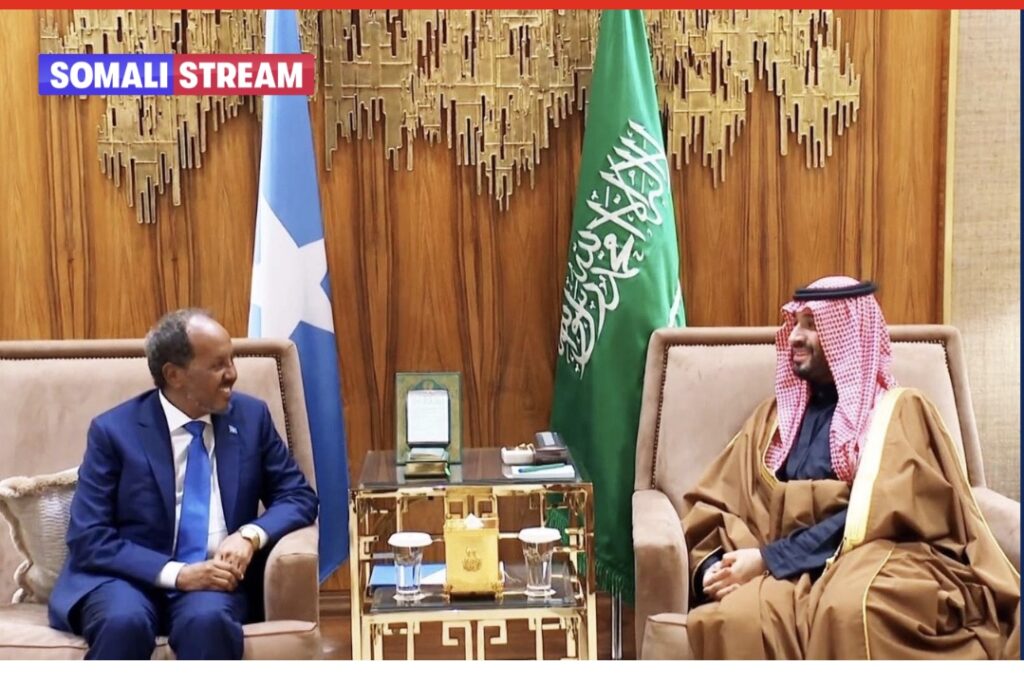
Earlier, in April 2024, Somali President Hassan Sheikh Mohamud was received in Makkah by Crown Prince and Prime Minister Mohammed bin Salman bin Abdulaziz Al Saud, where both leaders reviewed bilateral cooperation and regional issues of shared concern, signaling continuity, trust, and mutual respect at the highest level.
Saudi Arabia remains a critical economic partner, importing Somali livestock that constitutes a significant share of Somalia’s export revenues. The Kingdom has also contributed to Somalia’s economic and intellectual revival through donations of academic materials, scholarly resources, and long-term humanitarian assistance particularly during droughts and Ramadan, when food aid and dates are consistently delivered.
Six decades after King Faisal’s historic visit, Saudi Arabia’s relationship with Somalia stands as a case study in quiet diplomacy, moral consistency, and strategic patience. It is a partnership not built on fleeting headlines, but on faith, family, and a shared vision of sovereignty and stability.
As Somalia looks toward its future, the Kingdom’s role, rooted in history yet oriented toward long-term development, remains not only relevant, but indispensable.
In an era of transactional geopolitics, Saudi Arabia has chosen something rarer in Somalia: enduring brotherhood.