


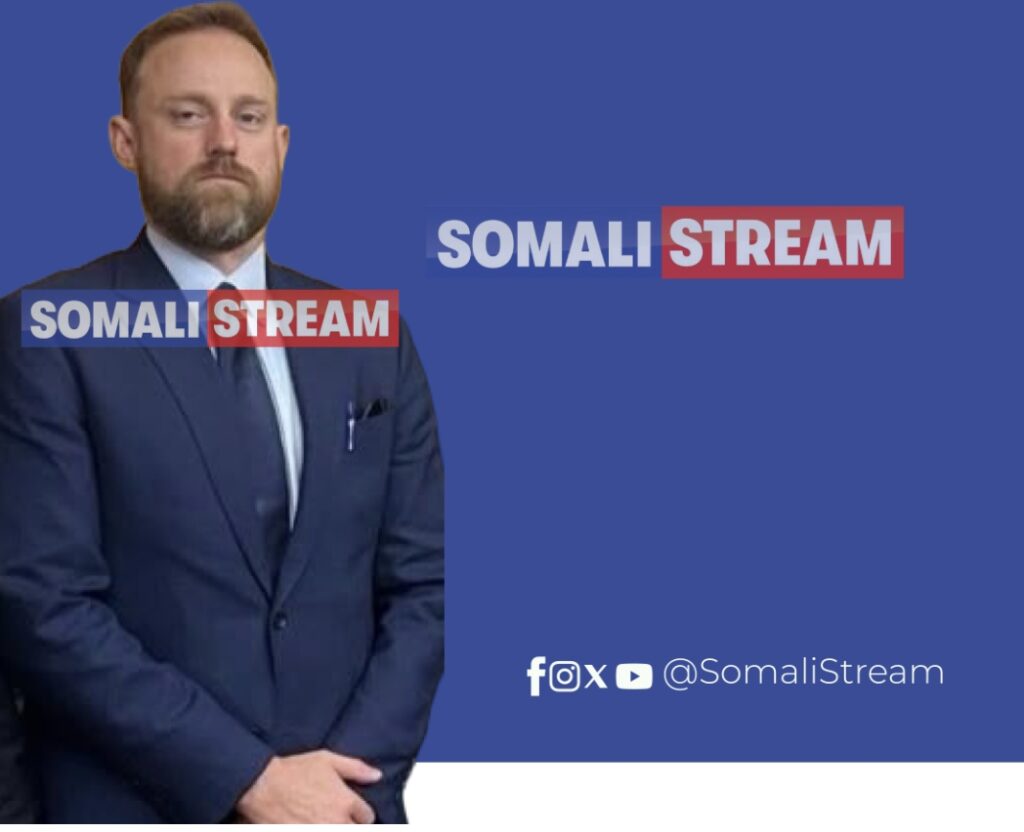
The United States has tapped career Foreign Service Officer Devin Kennington for a senior diplomatic role in Somalia, bringing to Mogadishu a diplomat with extensive experience in African affairs, conflict mediation and political-military diplomacy at a time when Washington is recalibrating its engagement with the Horn of Africa.
Kennington’s appointment comes as the U.S.-Somalia relationship enters a consequential phase, with security cooperation, the fight against Al-Shabaab, Somalia’s political transition ahead of the 2027 elections, economic engagement and migration expected to feature prominently on the bilateral agenda.
Kennington has held several leadership positions within the U.S. Department of State’s Bureau of African Affairs. He currently serves as Special Advisor for the Great Lakes, where he is the department’s principal liaison with armed groups operating in eastern Democratic Republic of the Congo (DRC).
In that position, he has led U.S. diplomatic efforts to support implementation of the DRC-Rwanda peace agreement and has facilitated peace talks between the DRC government and the March 23 Movement (M23) in coordination with Qatari partners.
His previous assignments include serving as Chief of Staff to the President’s Senior Advisor for Arab and African Affairs and as Great Lakes Chief in the Office of Central African Affairs.
Kennington has also served in key diplomatic positions at U.S. missions in Somalia, Djibouti, the Democratic Republic of the Congo, Brazil, Jamaica, and the U.S. Consulate General in Hong Kong and Macau, China.
From 2023 to 2024, he served concurrently as Acting Deputy Chief of Mission and Political-Military Affairs Counselor in Mogadishu, giving him direct experience with the political, security and diplomatic dynamics shaping the U.S.-Somalia relationship.
Before joining the State Department, Kennington worked in foreign relations with private-sector organizations and other U.S. government entities.
He has received several U.S. Department of State awards, including Superior Honor Awards and the Barbara M. Watson Award for Consular Excellence, recognizing his service at the U.S. Embassy in Djibouti. He speaks French and Portuguese.
Security and the fight against Al-Shabaab
One of the central challenges awaiting Kennington in Mogadishu will be sustaining U.S. support for Somalia’s campaign against Al-Shabaab, the terrorist group that remains one of the most serious security threats in the Horn of Africa.
Washington has been a major security partner of the Somali government, providing military assistance, training, intelligence and other forms of support aimed at weakening Al-Shabaab and strengthening Somalia’s security institutions.
Kennington’s background in political-military affairs and his previous experience in Mogadishu could give him a significant role in coordinating the diplomatic and security dimensions of that partnership.
Beyond the battlefield, however, the next phase of the U.S. engagement is likely to place greater emphasis on the political conditions needed to prevent a resurgence of instability and create a more durable framework for Somali state-building.
U.S. mediation and Somalia’s 2027 elections
Another potentially significant priority will be strengthening the U.S. diplomatic role in supporting a political settlement among Somalia’s federal government, federal member states and other political stakeholders ahead of the country’s 2027 elections.
The electoral process is expected to be a major test of Somalia’s political institutions, particularly amid disagreements over constitutional reforms, the distribution of political power between Mogadishu and the federal states, and the framework under which future elections will be conducted.
For Washington, supporting an inclusive political process and encouraging dialogue among Somali actors could become an increasingly important component of its diplomatic strategy.
Kennington’s experience in conflict mediation and negotiations in the Great Lakes region could prove valuable as the United States seeks to use its diplomatic influence to encourage political compromise and help Somalia move toward a credible, peaceful and broadly accepted electoral process.
The U.S. role, however, is likely to require careful diplomacy. Somalia’s political disputes are deeply rooted in domestic questions of federalism, power-sharing and constitutional authority, meaning that any American mediation effort would have to balance support for democratic institutions with respect for Somali-led political negotiations.
Economic engagement and Somalia’s search for U.S. investment
Economic diplomacy is also likely to emerge as another area of focus. Somalia has previously sought greater American investment and engagement in its emerging economy, including interest in investment opportunities in the country’s mineral resources and other sectors.
For Mogadishu, attracting U.S. capital and expertise could provide an opportunity to diversify international economic partnerships while supporting efforts to develop sectors capable of generating employment and government revenue.
For Washington, deeper economic engagement could complement its security and development assistance by strengthening the foundations of Somalia’s long-term stability.
The challenge will be translating political interest into commercially viable investment while addressing Somalia’s security, regulatory and infrastructure constraints.
Migration and the Somali diaspora in the United States
Migration-related issues are also likely to feature in discussions between Washington and Mogadishu.
The large Somali community in the United States has created a significant human and political link between the two countries, while immigration, asylum, deportation and family-reunification issues have periodically become sensitive areas of bilateral engagement.
Greater coordination between the Somali and U.S. governments could therefore become important in addressing migration-related concerns affecting Somali nationals and the wider Somali-American community.
For Mogadishu, maintaining strong diplomatic engagement with Washington on the treatment and status of Somali nationals in the United States will remain important. For Washington, cooperation with Somali authorities could assist efforts relating to identity documentation, repatriation arrangements, consular matters and broader migration management.
A new chapter in U.S. diplomacy in Somalia
Kennington’s appointment comes as Washington undergoes another transition in its diplomatic representation in Somalia.
Following the departure of Ambassador Richard H. Riley, a veteran Foreign Service officer, in December 2025, Justin Davis served as Chargé d’Affaires at the U.S. Embassy in Mogadishu, effectively leading the mission in the absence of a permanent ambassador.
Davis, who assumed the role in 2024, subsequently concluded his tenure as Chargé d’Affaires after serving as the senior U.S. diplomatic representative in Mogadishu.
Ruth Anne Stevens-Klitz has since assumed duties as Chargé d’Affaires ad interim at the U.S. Embassy in Mogadishu, succeeding Davis.
The latest transition comes against the backdrop of a long and complicated history of U.S. diplomacy in Somalia.
The United States closed its embassy in Mogadishu on January 5, 1991, as Somalia descended into civil war. American diplomatic personnel, including the ambassador, were evacuated during the fighting, and the U.S. diplomatic mission was subsequently based in neighboring Kenya.
Washington formally recognized Somalia’s new federal government in 2013, marking an important step in the restoration of formal diplomatic relations. Five years later, in December 2018, the United States re-established a permanent diplomatic presence in Mogadishu with the U.S. Mission to Somalia.
The return to Mogadishu reflected Washington’s renewed engagement with Somalia as the country sought to rebuild state institutions, strengthen its federal system and confront the growing threat posed by Al-Shabaab.
“Since the closure on January 5, 1991, the United States has maintained its partnership with the Somali people, including the re-establishment of a permanent diplomatic presence in Mogadishu in December 2018 with the U.S. Mission to Somalia,” the U.S. mission has said.
A broader U.S. strategy for the Horn of Africa
Kennington’s return to a senior Somalia-related diplomatic role comes at a pivotal moment for U.S. policy in the Horn of Africa.
His experience in conflict mediation, political-military affairs and African diplomacy gives him a background suited to an increasingly complex U.S. agenda in Somalia, one that extends beyond counterterrorism to political reconciliation, democratic governance, economic engagement and migration.
For Mogadishu, the appointment presents an opportunity to deepen one of its most important international partnerships. For Washington, Kennington’s tenure could provide a fresh channel for advancing U.S. interests while supporting Somalia’s efforts to consolidate political stability and strengthen its institutions.
The immediate test will be whether the United States can translate its substantial diplomatic, security and economic influence into a coordinated strategy that helps Somalia address the Al-Shabaab threat while building the political consensus needed for a peaceful and credible transition toward the 2027 elections.