


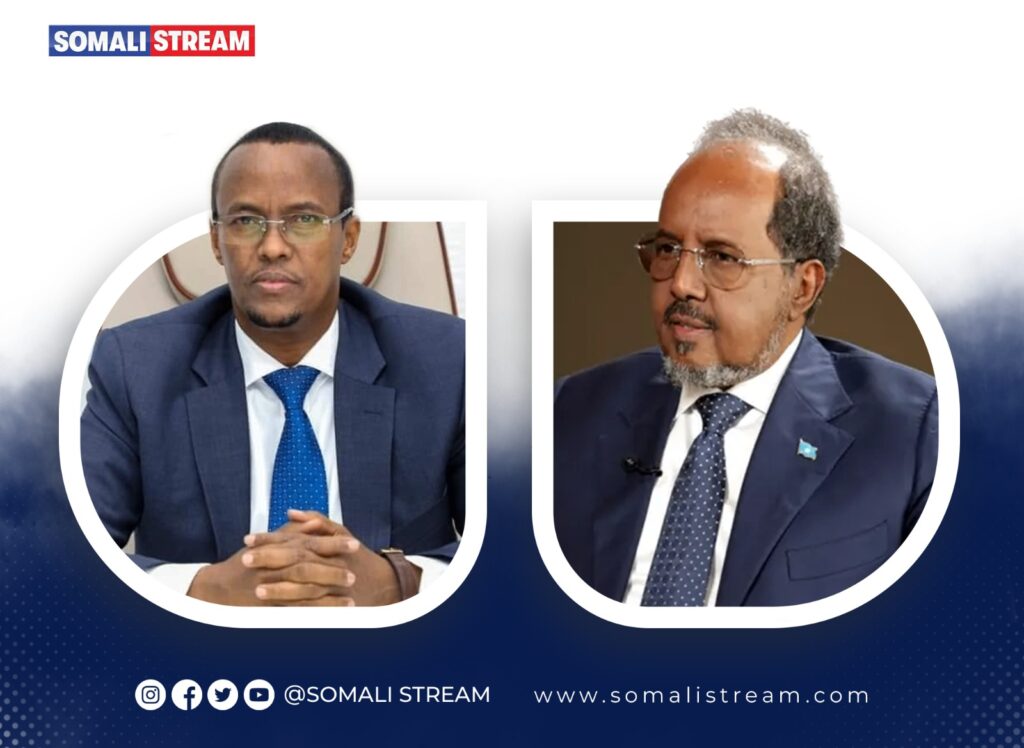
President Hassan Sheikh Mohamud’s political strategy in Somalia’s federal states is gathering pace.
His Justice and Solidarity Party (JSP) has formally named incumbent Hirshabelle leader Ali Abdullahi Hussein Guudlaawe as its candidate for the state presidency, putting the president’s preferred man at the centre of the coming contest and setting the stage for a potentially consequential political transition ahead of Somalia’s 2027 presidential election.
The announcement came at a formal naming ceremony at JSP headquarters in Mogadishu, where Guudlaawe was presented with his official certificate of candidacy in front of senior party officials, ministers, MPs, women’s and youth representatives and other political figures.
The ceremony was less a coronation than a declaration of intent.
Guudlaawe has not yet been elected to another term. But by placing the machinery of the president’s party behind him, Hassan Sheikh has made clear where Villa Somalia stands.
The remaining question may prove more politically delicate: who will become Guudlaawe’s deputy?
That name has not been publicly settled, at least not at the JSP ceremony. Yet people familiar with the political calculations around the presidency say the choice may already have been narrowed inside Villa Somalia, with competing factions now lobbying to place their candidate alongside Guudlaawe.
Among the names circulating is Dahir Shire, the federal petroleum minister. One scenario being discussed would see Shire move into the Hirshabelle leadership, while his federal portfolio could return to Abdirisaq Omar Mohamed, the politician from whom Shire is understood to have taken the ministry.
Another contender is Abdifatah Hassan Afrah, the former governor of Hiiraan, whose supporters regard him as a potential political bridge at a time when relations between Hirshabelle’s leadership and influential figures in Hiiraan remain strained.
Businessman Mohamed Ahmed Noor, known as Fooday, has also emerged among the names being discussed, particularly in political circles around Jowhar.
Mohamed Dheere, a former education minister under Guudlaawe and who is fhe current Federal Accountant General is another candidate said to enjoy support from sections of the president Hassan Sheikh Mohamud’s political network. And there may be a dark horse.
Ahmed Maalim Hassan, director of Somalia’s Civil Aviation Authority, is not among the most prominent names in the public debate, but political insiders have suggested that he could still emerge if the presidency opts for a less obvious choice.
The uncertainty is significant because the deputy position is not merely a personnel decision. It could become the mechanism through which Hassan Sheikh attempts to balance the competing interests of Hirshabelle’s regions, clans and political factions.
A president reshaping the map
The Hirshabelle manoeuvre comes at a particularly consequential moment in Somalia’s federal politics.
Across the country, the relationship between Mogadishu and the federal member states has become increasingly contested, with disputes over elections, constitutional reform and the distribution of political power frequently turning into open confrontation.
Nowhere is that more visible than South West State. Fighting has repeatedly erupted in and around Baidoa between federal forces and militias aligned with former South West president Abdiaziz Hassan Mohamed Laftagareen, following the federal government’s intervention and Laftagareen’s subsequent resignation. In August, federal forces pushed Laftagareen-aligned fighters out of Baidoa after fierce clashes; in September, further fighting was reported on the city’s outskirts.
The South West confrontation illustrates the stakes of Hassan Sheikh’s federal strategy. What began as a political dispute over state leadership and elections has repeatedly spilled into the security arena.
Hirshabelle offers the president a very different possibility: a transition achieved through political alignment rather than open confrontation.
That would be especially meaningful for Hassan Sheikh because Hirshabelle is his home political constituency. The president was born in Jalalaqsi, in Hiiraan, making the fate of the state unusually personal as well as strategically important.
If Guudlaawe succeeds, Hassan Sheikh could portray the outcome as another successful piece of his federal political strategy.
Galmudug is also part of the emerging calculation. The withdrawal of President Ahmed Abdi Karie Qoorqoor from the regional race has altered the political landscape in a state that has long been an important pillar of Hassan Sheikh’s federal strategy.
The subsequent positioning of businessman Liban Ahmed Hassan, widely known as Liban Shuluq, as the JSP candidate has given the president’s party another vehicle through which to shape the coming contest.
Liban is no ordinary political newcomer. His business background and extensive networks have made him a significant figure in Mogadishu’s political economy, and his emergence as the JSP candidate has fuelled speculation over the extent of Villa Somalia’s ambitions in Galmudug.
If the Galmudug transition goes Hassan Sheikh’s way, it would add another strategically important administration to his political orbit. And that matters because the next presidential election is already casting a long shadow over every federal-state contest.
The president’s influence is not confined to the older federal member states.
In the newly established North-East State, President Cabdulqaadir Ahmed Aw-Ali, known as Firdhiye, has emerged as the region’s leader. He was elected in 2025 and subsequently sworn in as president of the new administration.
Firdhiye is also associated with Hassan Sheikh’s JSP, giving the president a political ally at the head of another federal administration.
Taken individually, these developments are not enough to establish federal political dominance. Taken together, however, they reveal the outlines of a strategy.
South West is being contested. Galmudug is being recalibrated. Hirshabelle is being aligned. North-East has a JSP-linked president. The emerging map is difficult to ignore.
Yet Hassan Sheikh’s Hirshabelle calculation carries its own danger. A number of politicians and traditional elders from Hiiraan have opposed the continued leadership of the incumbent Guudlaawe, and resistance to his return has become one of the central political obstacles facing the arrangement.
The position of Yusuf Ahmed Hagar (Dabageed), the current Hirshabelle deputy president, is particularly revealing. He is understood not to be seeking another term and has reportedly aligned himself with political figures from his constituency who oppose another Guudlaawe presidency.
That leaves Hassan Sheikh with a delicate balancing act.
A Guudlaawe victory without sufficient accommodation of Hiiraan’s political establishment could simply move the dispute from the presidential contest into the next administration.Hence the intense interest in the deputy’s identity.
The person chosen could signal whether Villa Somalia intends to reward loyalty, placate an aggrieved constituency, strengthen its own political network or attempt some combination of all three.
The significance of Hirshabelle ultimately extends beyond Jowhar. Somalia is heading towards another national presidential contest in 2027, and every federal-state election is increasingly being viewed through that lens.
For Hassan Sheikh, controlling or influencing the political direction of the federal member states could provide a formidable electoral platform. It could deliver allies, institutional networks and political leverage well before the national campaign begins.
But the strategy carries risks. The federal government has already faced armed resistance in South West, while disputes over electoral control and constitutional changes have fuelled tensions with state authorities. Hirshabelle therefore offers Hassan Sheikh something South West has not: the possibility of securing political alignment without another major rupture.
