


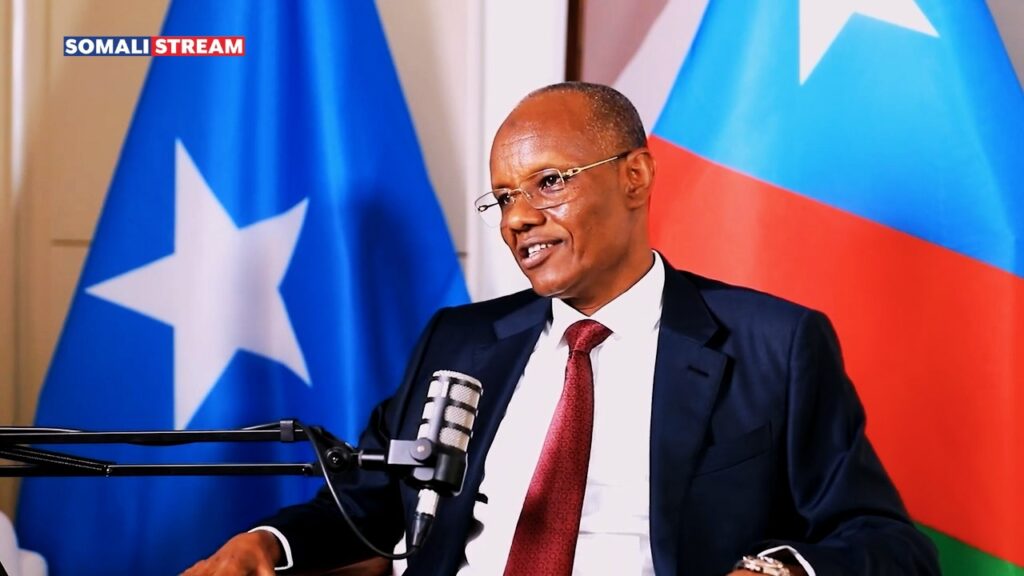
The Somali federal government has denied designating self declared South West State President Abdiaziz Hassan Mohamed Laftagareen and his forces as terrorists, in a statement that threatens to deepen an already bitter political and security confrontation surrounding Baidoa. Abdifatah Qasim, the Minister of Information and spokesman for the Federal Government, said on Saturday that there was no government decision identifying Laftagareen or his forces as a terrorist organisation.
On 30 August, the administration led by Sheikh Adan Mohamed Nur Madobe placed Laftagareen on a list of individuals it identified as linked to terrorism and Al-Shabaab. The Madobe administration justified the move by accusing Laftagareen of pursuing a political and military agenda against its authority, including an alleged attempt to retake Baidoa, the strategic South West State capital from which federal forces had removed his administration. Laftagareen, however, continues to maintain that his administration is the legitimate authority in South West State.
The declaration effectively distances Mogadishu from a decision issued by the recently elected administration of former Speaker of the House of the People, Adan Mohamed Nur Madobe, which currently controls Baidoa and has branded Laftagareen’s administration as terrorist. The reversal, or apparent repudiation, comes at an extraordinarily sensitive moment for Somalia, following an air strike in Gedo region’s Dolow area on the night of 3 September that targeted former Somali Custodial Corps commander General Mahad Abdirahman, widely known as taliye Shub.
Although Minister Qasim insisted that the federal government had never designated Laftagareen and his administration as terrorists, his remarks is unlikely to end the controversy. Somali politicians point to the government’s failure to publicly disown Adan Madobe’s decision when it was first announced. That silence has now become politically significant. The Dolow drone strike has emerged as one of the most explosive issues in Somali politics, with opposition figures and sections of civil society demanding answers over the circumstances surrounding the attack.
Federal leaders have faced mounting criticism for failing to appear before the public and directly address questions surrounding the operation. Mahad Abdirahman, a former senior security commander and parliamentarian, survived the strike, according to the account provided. The attack has nevertheless triggered widespread condemnation from former Somali leadres, senior opposition politicians and other sections of Somali society. Just four days after Madobe’s declaration, the former Custodial Corps commander was targeted in an air strike in Doolow and survived. The timing has intensified scrutiny of the relationship between the federal government, the Madobe administration in Baidoa and Laftagareen’s forces.
Qasim’s latest statement appears intended to draw a line between the federal government and Madobe’s controversial designation. Yet it has also raised a more fundamental question: if Laftagareen was never considered a terrorist by Mogadishu, why did the federal government not immediately reject the declaration made in its name by the authorities it installed in Baidoa?