


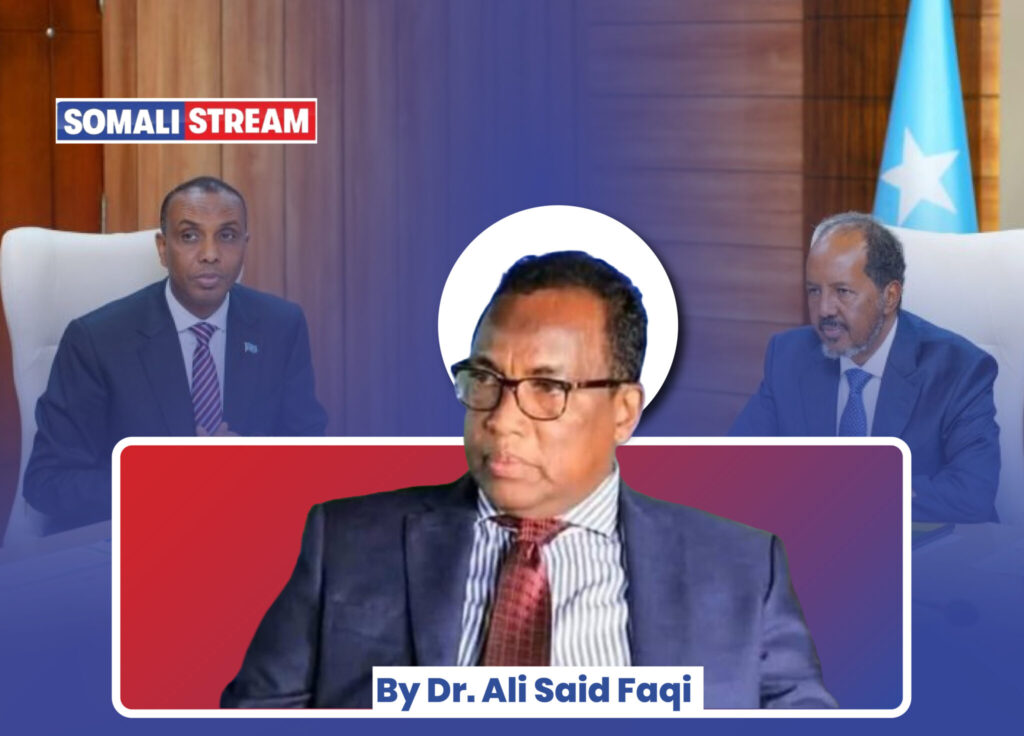
When President Hassan Sheikh Mohamud campaigned under the slogan, “Somalis at peace with themselves and at peace with the rest of the world,” many Somalis believed the country was entering a new political chapter defined by reconciliation, institutional recovery, and national unity. After years of political uncertainty and division, the message resonated deeply across the country.
Four years later, many Somalis believe the country has become more divided, institutionally weakened, and increasingly harmed in its international reputation. Public trust has been deeply shaken, divisions have deepened, and uncertainty about Somalia’s direction has grown both at home and abroad.
This op-ed reflects on the policies and direction pursued during the last four years under President Hassan Sheikh Mohamud. It examines how decisions presented as reforms or nation-building initiatives instead contributed to polarization, institutional tension, and growing uncertainty about Somalia’s future.More importantly, many of these crises were not inevitable. They were political choices that could have been avoided through broader consultation, compromise, and inclusive governance.
What makes the outcome particularly surprising is that President Hassan Sheikh Mohamud was not a newcomer to Somali politics. Before becoming president in 2012, he was active in civil society and the education sector and was widely viewed as a moderate figure who understood reconciliation, institution-building, and dialogue, although the public was extremely dissatisfied with his performance during his first term in office.
After leaving office in 2017, he spent nearly five years as an opposition leader strongly criticizing unilateral governance, political exclusion, weak consultation, and the concentration of power within the presidency.Many Somalis therefore expected that his return to office would reflect the lessons learned from both governing and opposing government.Instead, concerns quickly emerged about the concentration of decision-making around the presidency. Allies and friends of President Hassan Sheikh Mohamud openly stated that he made it clear early on that his approach to governance would be highly centralized and driven primarily by his own judgment, with limited interest in listening to alternative views.
What makes this leadership style difficult to understand is that President Hassan Sheikh knew the realities and limitations of the Somali state before returning to office. He understood that the federal government does not exercise full authority across the country. He knew that Somalia’s security architecture remains heavily dependent on external assistance and international partnerships. He also understood that the country continues to rely significantly on donor funding and international budgetary support to sustain core state institutions and public operations.These realities should have encouraged a leadership style grounded in compromise, coalition-building, and political restraint. Instead, the administration projected the authority of a strong centralized state while governing a country still dependent on delicate political arrangements and international support.
Only a leader who fully controls national borders, commands independent institutions, and governs a financially self-sustaining state can realistically attempt to pursue iron-fist policies for a prolonged period. But Somalia is not that kind of state.
Power without legitimacy rarely produces stability in politically divided societies.
In post-conflict states, legitimacy matters more than political force. Consensus is not a luxury. It is a necessity for stability and survival.The issue was never whether Somalia needed strong leadership. It does. But strong leadership in politically vulnerable environments is measured by the ability to unite stakeholders, manage competing interests, preserve national cohesion, and build trust — not by concentrating power around one office.The formation of the cabinet reinforced concerns about centralized governance. Loyalty appeared to take precedence over competence and state-building experience. In a country still rebuilding from institutional collapse, Somalia required experienced technocrats and administrators capable of strengthening institutions and representing the country effectively on the international stage.
The public, both inside and outside the country, witnessed video clips of unqualified cabinet members facing humiliations in international forums, where Somalia’s representatives at times appeared unprepared and unable to clearly articulate coherent national positions. For a country dependent on international partnerships, such moments weakened confidence rather than strengthened it.But that never appeared to anger the president. It is incomprehensible for a leader to claim commitment to national progress while at the same time shielding incompetence from accountability and allowing weak performance to persist at the highest levels of government.
Nothing illustrated the administration’s centralized approach more clearly than the constitutional amendment process. Constitutional reform in politically fragile federal systems requires broad ownership, consultation, and political compromise. Instead, the process became deeply divisive and controversial, widening mistrust between political actors and deepening institutional fractures.Rather than strengthening national cohesion, the constitutional amendment process deepened tensions between the federal government and several federal member states, many of which viewed the process as unilateral and politically exclusionary.The administration’s relationship with the federal member states became one of the clearest examples of its increasingly confrontational approach to governance. Rather than strengthening federal cooperation, relations between the federal government and several federal member states deteriorated significantly during the last four years.The administration effectively abandoned constructive political engagement with Puntland and Jubaland, two federal member states that repeatedly expressed concerns over constitutional changes, elections, power-sharing, and the overall direction of federal governance. Instead of addressing those concerns through sustained dialogue and compromise, relations became characterized by mistrust, political isolation, and confrontation.
At the same time, in the eyes of much of the public, as well as through repeated statements and admissions by political insiders, Southwest State, Hirshabelle, and Galmudug appeared to remain under heavy pressure and influence from the president. Their leadership structures appeared heavily dependent on political survival through alignment with the federal leadership rather than through independent regional legitimacy. The repeated extension of leadership mandates without meaningful political conditions or broad agreement further deepened concerns about the weakening of federal institutions and democratic accountability.
Nothing symbolized this trend more than the events in Baidoa. Frustrated by what many viewed as continued political pressure and humiliation from President Hassan Sheikh Mohamud, Southwest State President Abdiaziz Hassan Mohamed Laftagareen decided to proceed with a state election process independently of the federal government’s preferred political direction. The move ultimately triggered military intervention by the federal government and significantly deepened tensions in Baidoa. Today, public dissatisfaction remains high over the individual widely believed to be the president’s preferred candidate for Southwest State leadership. Likewise, the presence of federal troops is fueling resentment and mistrust, while many residents and political stakeholders believe the outcome of the election has already been decided in favor of the president’s party. In essence, the president’s approach toward Southwest State has created political divisions whose consequences may continue to affect the region for years to come.
There are now growing fears that similar tactics could also emerge in both Hirshabelle and Galmudug as the two states approach upcoming elections. Such concerns continue to fuel anxiety about the future of Somalia’s federal system and whether genuine decentralization can survive under increasing centralization from the federal government.The tensions surrounding Baidoa were part of a broader pattern that many Somalis believed also characterized the administration’s national approach to elections and political power-sharing.
No single political actor can impose a national electoral model on a deeply divided and politically fragile society without broad consensus and public legitimacy.Yet the administration insisted on promoting a one-person, one-vote framework without first building broad political agreement on implementation mechanisms, legal safeguards, security arrangements, and institutional readiness. Many Somalis still question how such a process could realistically function under current conditions.The concern was never opposition to democratization itself. The concern was the absence of consensus, transparency, and national ownership in the way the process was pursued.
Foreign policy also became increasingly inconsistent, with Somalia’s diplomacy often appearing reactive, contradictory, and driven more by short-term strategic positioning than by a coherent long-term doctrine.One day President Hassan Sheikh Mohamud aligned closely with Egypt on issues tied to Egyptian national interests, and shortly afterward engaged warmly with Ethiopia while appearing supportive of Ethiopia’s position on the Grand Ethiopian Renaissance Dam (GERD), despite the deep dispute between the two countries over the project.
The same pattern emerged in relations with Eritrea and Ethiopia. At times, the administration projected close ties with both countries despite the longstanding tensions between them, particularly following disputes over regional influence, security arrangements, and the delicate post-Tigray political environment in the Horn of Africa.
Diplomatically, it is extremely difficult for a country to maintain close alignment with opposing regional powers pursuing conflicting strategic interests. Somalia’s shifting regional alignments created confusion about the country’s long-term foreign policy direction and raised questions about its strategic consistency. Regional actors increasingly began questioning the reliability and predictability of Somalia’s diplomatic positioning.Similar concerns about inconsistency and lack of transparency also emerged in the administration’s handling of major international agreements.
The administration’s controversial agreements with Turkey involving fisheries, oil, and gas cooperation generated significant public concern. Political stakeholders argued that these agreements lacked transparency, parliamentary scrutiny, and meaningful national consultation. In countries with weak institutions, agreements involving strategic national resources must be grounded in institutional legitimacy and public trust. Otherwise, they risk becoming long-term sources of political conflict and public suspicion.
Furthermore, the decision to join the East African Community also raised serious questions among many Somalis regarding timing, preparedness, and the country’s overall economic readiness for regional integration. While regional integration can provide long-term economic and diplomatic opportunities, many accession requirements involving infrastructure, regulatory harmonization, and trade integration remain far from complete, raising concerns about whether Somalia entered the bloc before adequately preparing its institutions and economy.
These broader governance and policy inconsistencies were also reflected in the administration’s security strategy.
The administration’s campaign against Al‑Shabaab initially generated optimism. Early offensives created momentum and public support. However, long-term stabilization failed to materialize because military operations were not consistently followed by durable governance, local administration, institutional recovery, and public service delivery.Security experts have long argued that insurgencies cannot be defeated through military operations alone. Sustainable stability requires governance, legitimacy, economic opportunity, and public trust.
Today, many Somalis believe the country remains politically divided, institutionally fragile, economically uncertain, and diplomatically inconsistent. The promise of unity instead produced deeper mistrust between the federal government, federal member states, opposition groups, and sections of the public.Many of the political and institutional gains achieved through years of compromise and reconciliation now appear dangerously fragile.
Yet much of this could have been prevented.
Somalia’s political reality demands humility from leadership, not political overreach. It demands coalition-building, not concentration of power. It demands consultation, not unilateralism.The central failure of these four years was not simply poor policy choices. It was the abandonment of the very principles of consensus, patience, and inclusive governance that post-conflict states like Somalia require in order to survive and progress.
Arrogance, overconfidence, and the belief that one individual alone possessed the answers to Somalia’s complex challenges ultimately pushed the country backward and cost it valuable opportunities for unity, stability, and national progress.Somalia cannot afford to repeat the mistakes of the past four years. The country’s future will depend on leaders who understand the importance of consultation, compromise, institutional strength, and national unity over personal political ambition.
Dr. Ali Said Faqi,
Horn of Africa Center for Drugs, Food Safety and Environmental Health (HACTEDH)