


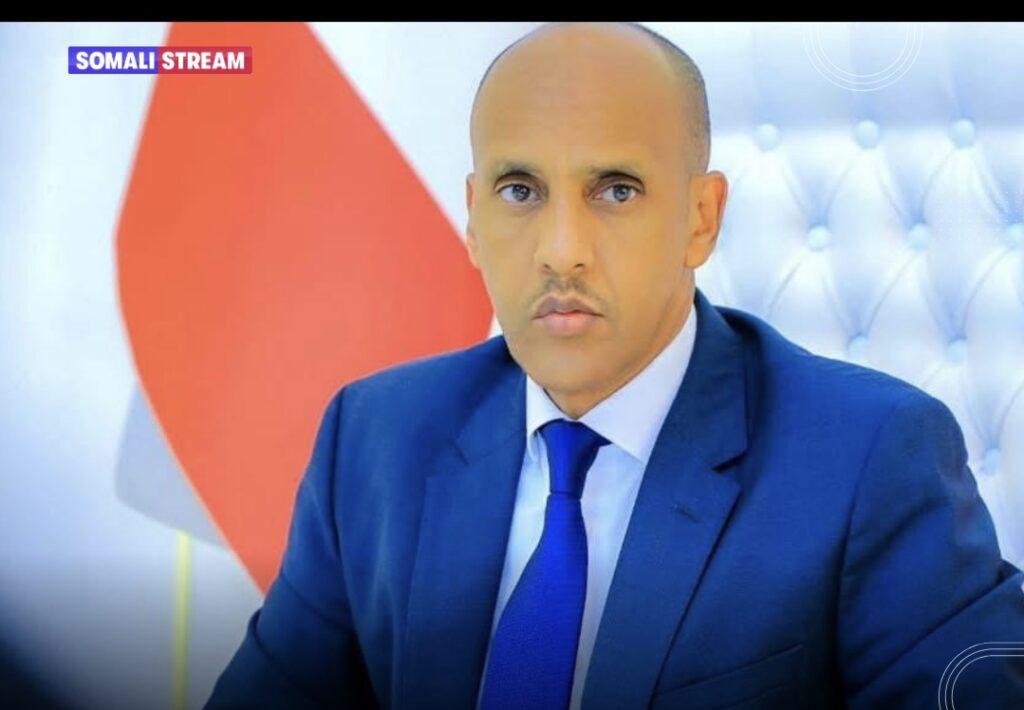
By Abdi Sheikh
In the past few days, Ethiopians have witnessed a revealing spectacle in the Somali Regional State. Mustafa Omer, its president for the last eight years, has lost the Amharic-speaking constituency he once courted so carefully. In panic, he has not reached for policy or apology. Instead, he claimed that he had been attacked because of his defense of “Soomaalinimo” and has fallen back on the oldest political reflex: a sudden, defensive surge to invoke Somali nationalism as a cover. The tantrum is ugly. Yet the deeper story is not the tantrum itself. It is what the tantrum unmasks.
This piece is not another dry catalogue of administrative shortcomings—the runaway corruption, the human-rights violations, or the mobile “black torture sites.” Those indictments have been made elsewhere. The concern here is narrower, but far more corrosive in the long run: Mustafa Omer believes in nothing at all—least of all in the history of the very people he was selected to lead. There is no moral boundary he would not violate to keep himself ensconced in the office he currently holds.
I do not cherish writing this piece. I have known Mustafa for many years, long before the titles, the convoys, and the trappings of power. I knew him in quieter rooms and informal discussions, when ambition had not yet hardened into instinct. I write because what we are witnessing today is not merely politically troubling; it is personally disquieting.
There is a particular kind of tragedy reserved for those who change their stance to become whatever the moment demands, those who cease to be guided by any inner compass, instead adjusting their tone, convictions, and even memory to suit the audience before them. In politics, such figures are called shapeshifters. In Mustafa’s case, it is not the shift itself that unsettles me—leaders evolve—but the absence of continuity, sincerity, or any visible thread connecting who he was to who he now claims to be.
Origins: The Pattern Was Always There
Mustafa’s current iteration did not begin in office. Its trajectory was visible much earlier.
In the early 2000s, he was not a dissident voice but an active participant in exclusionary state practices. In early 2001 at the Edom Hotel in Jijiga, I met an angry and frustrated man, complaining about individuals whose parents fled the country in the 1970s, denying him and others—whose families had chosen to remain—opportunities for better jobs. He showed me an article he had drafted, which he hoped to publish in Addis Zemen and other newspapers.
Following its publication, Mustafa was selected to serve on a committee tasked with purging individuals educated in Somalia and Sudan from public service on the grounds that they were not “Ethiopian enough.” Hundreds of capable citizens were systematically excluded. Mustafa would later boast about his role in persuading Abay Tsehaye to initiate this purge—an effort he helped shape and implement.
Reward followed soon. He was promoted to Deputy Bureau Head of Education. Within months he constructed the well-known villa, financed through the diversion of the already limited education funds. In this position, he regarded himself as the most deserving as he was better educated than graduates of the Civil Service College, the institution that churned out the political operatives sustaining the EPRDF system.
Despite visible efforts to signal loyalty—including avoiding even greeting acquaintances in Jijiga for fear of being seen by Meressa Redda, the Ministry of Federal Affairs official assigned to oversee the region, and his cohorts—he was eventually pushed out. What followed was not introspection but repositioning. As his position within that system weakened, his posture shifted. He adopted the language of “Somalinnimo” and recast himself as a fierce critic of the same system he had served.
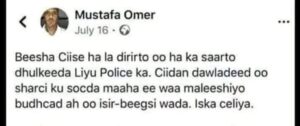
Even in our renewed closeness, the pattern remained evident. His social and political views oscillated with circumstance, often masked as humor. It was not humor when he wrote “tola’ayey Sanqoolow,” appealing to clan mobilization neither was it a joke when, as a professional UN staff member, he proposed that the Issa clan should fight militias—referring to the Liyu police. Now under his command, he uses the very local force he once disparaged to intimidate, harass, and reportedly torture his perceived dissidents. 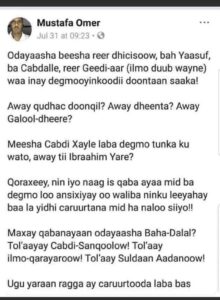
I recall another moment. In mid-February 2009, following the death of Dr. Mohamed Sirad Dolal of the Ogaden National Liberation Front (ONLF), Mustafa wrote privately, then accidentally shared publicly, that “we have broken the backbone of Reer Warfaa.” At the time, some dismissed it as irreverence. In hindsight, it reads as something more deliberate. 
These were not isolated incidents. Relationships were redefined, alliances recast, and positions reshaped depending on circumstance. On several occasions, President Mustafa has publicly accused a former friend of collaborating with the CIA—going so far as to publish his photograph. The more troubling issue is not the allegation itself, but what it reveals about the absence of an internal moral boundary. The charge was aimed neither at the Somali public nor the Ethiopian state. The CIA is not an avowed enemy of both . Rather, it hints instead at an appeal to shadowy, undefined forces—an impulse that reflects not a strategy but a lack of ethical restraint.
This proverb, “a horse without a bridle runs wild,” captures the intent well. The bridle, in this case, is not merely law or regulation; it is a moral conscience. Even Mustafa himself once expressed doubt that he could be elected president because he was “not Reer Hebel.” At the time it seemed like a passing remark. Now it reads as a moment of clarity. He understood the instability of his own positioning long before others did.
Contradictions in Power: Narrative, Policy, and the Collapse of Coherence
From the earliest days of his presidency, Mustafa’s leadership has been defined by contradictions. What appears as political dexterity is in fact something far more destabilizing: a governing logic in which conviction is contingent upon expediency and truth is calibrated to suit an audience.
Barely two weeks in office, Mustafa gave an interview in Amharic to SBS Australia, proposing that Somali elders “correct the wrong narrative” that Somalis had ever been oppressed or colonized. Century-long subjugation—including the campaigns and state violence associated with Menelik, Haile Selassie, and Mengistu—was to be recast as an EPRDF-era fabrication, stripped of legitimacy and reduced to the status of folk-tale villains like the Dhegdheer the ogress.
Addressing representatives of non-Somali communities in Jijjiga, he asserted that “claiming Jijiga belongs to Somalis would amount to nothing short of apartheid in South Africa.” A year later in Bahir Dar he repeated the same position, dismissing deeply rooted Somali grievances as propaganda. ( Video Speech in Amharic along with the Somali translation, can be accessed here: https://tinyurl.com/tmk4bmc8 )
Then came the reversal. At a gathering in Nairobi in late 2025, Mustafa warned that forces which had dominated Ethiopia’s political order for more than 150 years were not merely remnants of the past but active agents in the present, operating through entrenched institutions, narratives, and networks to undermine recent political transformations. When pressed to clarify his statement, in a recent interview with Bayfars Media, he denied referring to any specific group, insisting he had not mentioned the “Amhara” by name. His subsequent attempt to reframe his reference to “previous governments” as excluding the Amhara only raises a question that deepens the inconsistency. Which governments are simultaneously historical and active?
The contradiction betrays the shameless inconsistency of the man. What is dismissed as myth in one setting is invoked as a mortal living threat in another. The underlying facts do not change. The presentation is modified for the intended audience.
The same pattern extends into policymaking. In a widely discussed article in The Reporter, Mustafa argued for the abolition of ethnic federalism, proposing instead a geographically based system. When later confronted, he retreated, recasting the position as a personal reflection rather than a policy stance. Similarly, he advocated dismantling the region’s special force—an initiative he later implemented without hesitation.
Most revealing are the moments when this elasticity is most starkly personalized. In an Amharic-language interview, he stated clearly that, in disputes over property or otherwise between Somali and non-Somali parties, he would rule in favor of the non-Somali. It is difficult to predict that he would make the assertion before a Somali-speaking audience.
The transactional cynicism runs through smaller episodes as well. When the Somali Regional Alliance for Justice pushed for the return of the old regional flag, Omer was never fully sold; his earlier writings had preferred the label “Somali-Ethiopian DDSI.” Then came the Medemer book auction. While other regional leaders pledged the proceeds to schools and clinics, Mustafa chose instead to build a monument to Ethiopian soldiers fallen in the fictitious Battle of Karamara —a place Somalis remember as the site of a cold-blooded massacre of their elders and brightest young men. The gesture was deliberate.
He has repeatedly accused his critics of being “Jaajuus—government agents in Somali, proxies of the Tigray People’s Liberation Front (TPLF) in Amharic. Yet the very TPLF he now condemns are the ones he previously courted. Retired Colonel Gebre facilitated the renewal of his passport and those of his children, ensured his family’s safe passage out of Jijiga, helped secure the renewal of his UNOCHA contract, and was described by Mustafa on multiple occasions as “a good human and the best Tigre.” Mustafa made repeated visits to the Ethiopian embassy in Nairobi—alongside Hussein Hashi, Abdulhakim Yusuf, and others—where he reportedly presented himself as a more capable alternative to Abdi Iley.
His relationship with figures such as General Gebre Dilla and his role in the scheme to dismantle the ONLF remain critical chapters that further illuminate the same pattern.
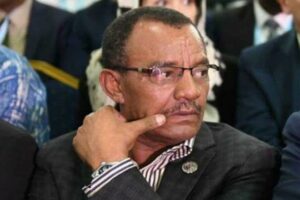
As George Orwell warned, “The most effective way to destroy people is to deny and obliterate their own understanding of their history.” In a striking display of dissonance, Mustafa has publicly asserted on Bayfars Media that the Somali Regional State outperforms the United States and Europe in its respect for human rights. What matters is not the claim itself but the absence of any consistent standard by which such claims are made. ( https://tinyurl.com/yvmn5u79 )
The Public Unmasking
Mustafa Omer’s recent tantrum is not just personal embarrassment. It is the public unmasking of a deeper moral failure in Ethiopian politics: the quiet elevation of shapeshifters to the status of statesmen. As Samuel Johnson famously observed, “Patriotism is the last refuge of the scoundrel.”
Citizens are not blind. They have seen the contradictions, heard the rival histories. They have learned the corrosive lesson that principles are for the naive, that memory is negotiable, and that power belongs to whoever tells the most convenient story.
In a multi-ethnic federation still carrying the unresolved weight of empire and civil war, this style of leadership is not merely inconsistent; it is dangerous. When a regional president treats his people’s historical trauma as a bargaining chip—invoked in one setting, discarded in another—the social fabric frays quietly but persistently.
At this stage, the burning question is not about one man, one region, or one political moment. It is more fundamental:
Will leadership continue to be entrusted to those who treat truth as situational?
Or will the country demand something far rarer—and far more difficult: leaders anchored in conviction, accountable to memory, and capable of sustaining coherence across audiences and time?
This is not merely a political choice. It is the fate of a country. In politics, as in the human soul, character is not optional; it is the only thing that endures. When truth becomes a wardrobe and a nation’s collective memory a bargaining chip, the slow unraveling of a society ensues.
I write this with no sense of triumph. Only with quiet, enduring sadness. Because I remember the man before the masks disfigured him beyond recognition.
The views expressed in this article are those of the author and do not necessarily reflect the position of Somali Stream.