


Staff Reporter
Somalia’s fragile political calendar, long defined by brinkmanship and last minute reversals, shifted again this week after what sources describe as sustained and unusually direct pressure from international partners forced a compromise among rival political actors.
The highly anticipated talks between the Federal Government of Somalia and opposition leaders, grouped within the Future Council and supported by Federal Member States rejecting the current electoral framework, have been formally postponed, only to be swiftly rescheduled following intense behind the scenes negotiations.
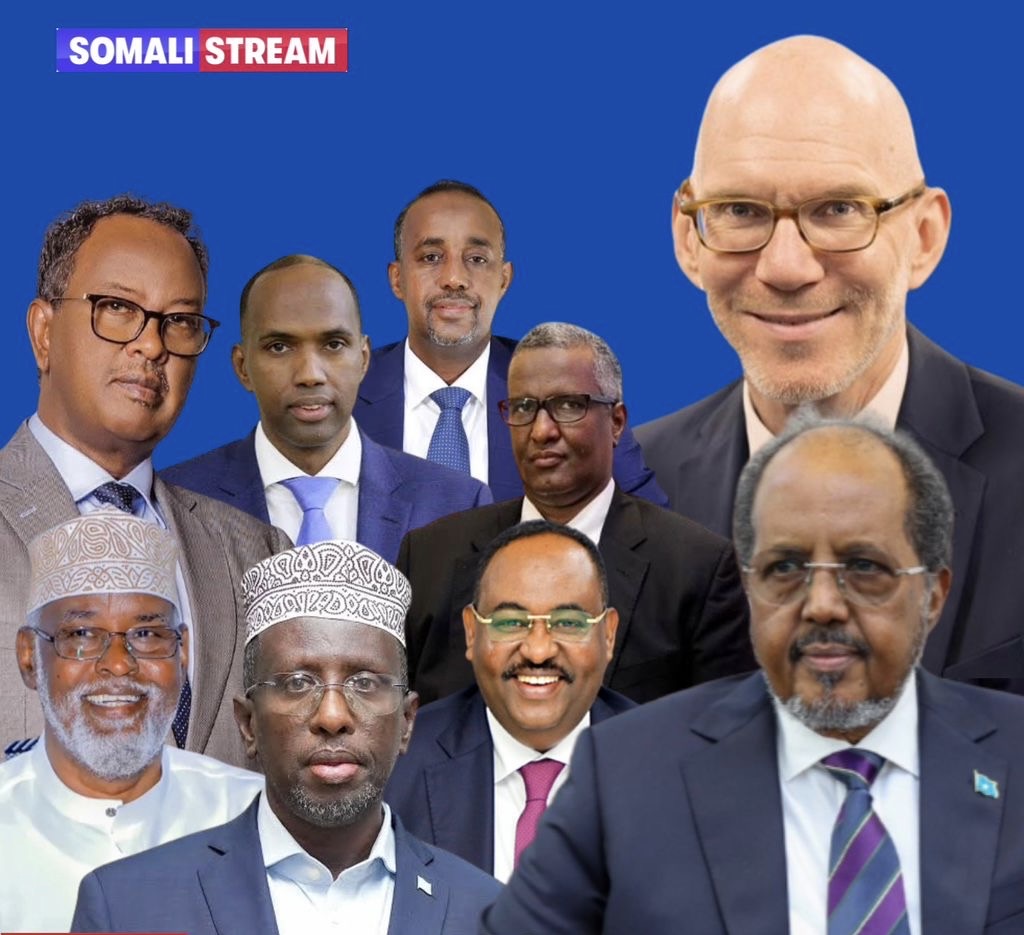
According to Somali Stream, the delay was initially triggered by President Hassan Sheikh Mohamud’s unexpected foreign travel plans to Doha and Cairo, trips officials insist are strategically critical to Somalia’s security and economic positioning. Yet by early evening today, diplomats and Somali intermediaries had brokered what multiple sources describe as a rapid political fix, restoring momentum to talks that many feared were collapsing altogether.
For much of the Wednesday, Mogadishu’s political atmosphere was thick with uncertainty. But officials familiar with the negotiations say the turning point came after coordinated intervention from international missions based in the Capital.
Over several hours of closed door consultations, some conducted remotely and others face to face, Somali leaders were pressed to step back from escalation and recommit to dialogue.
According to sources speaking exclusively to Somali Stream, International partners offered assurances on security arrangements and political guarantees, urging all sides not to squander what they framed as a narrowing window for compromise.
The message was blunt. A breakdown in talks would invite unilateral moves by both the federal government and regional administrations, deepening an already volatile constitutional and electoral standoff.
Under the revised agreement, President Hassan Sheikh Mohamud will proceed with his planned visits to Qatar and Egypt, where he is expected to finalize defense cooperation agreements and advance economic partnerships aimed at buffering Somalia against growing instability in the Horn of Africa.
The president is now scheduled to return to Mogadishu on the 9th of February, at which point he will personally lead the next phase of negotiations with the Future Council and dissenting Federal Member States. That date has become the new focal point of Somalia’s political chessboard.
In a development widely viewed as a political concession, the presidents of Puntland Said Abdullahi Deni and Jubbaland Ahmed Mohamed Islam Madobe have agreed to travel to Mogadishu on the next day as the president’s return.
Puntland’s leader, Said Abdullahi Deni, currently preparing to attend a high profile ceremonial event in Galdogob on the 8th, has committed to arriving in Mogadishu within 48 hours of that event.
The move is interpreted as a signal that Deni, long a vocal critic of the Federal Government’s constitutional and electoral approach, is willing to test dialogue over deadlock.
Jubbaland officials have made similar commitments, reinforcing a fragile but notable shift away from boycott and toward engagement.
Meanwhile, the Salvation Forum, a key faction within the Future Council, has emerged as a central broker in narrowing gaps between rival camps. The group is set to convene Thursday afternoon at Mogadishu’s Jazeera Hotel, where it will receive a briefing from technical committees tasked with preparing the groundwork for formal talks beginning on the 10th.
Those talks are expected to take place inside the heavily fortified Halane complex, with security and procedural matters delegated to joint subcommittees from both sides.
The Mogadishu talks will unfold against a widening regional backdrop. Once the conference concludes, President Hassan Sheikh is expected to travel to Addis Ababa on February 12 to attend the African Union summit, a meeting already overshadowed by internal and external political and diplomatic tensions.
On the Agenda, are Somalia’s objections to alleged Emirati involvement in domestic political dynamics and the broader fallout from Israel’s unilaterla recognition of Somalia’s breakaway region of Somaliland, that Mogadishu still considers an integral part of the Somali state.
These external pressures have sharpened the stakes of the current talks. Failure at home would weaken Somalia’s hand abroad.
For now, with all sides tentatively committed to meeting in Mogadishu, Somalia has entered what officials cautiously describe as a period of political calm. It is a pause rather than a resolution, one dependent on trust that has repeatedly frayed in the past.
Whether this latest reset marks the beginning of a durable political settlement or merely another delay in Somalia’s long cycle of confrontation and compromise will become clearer in the days ahead.
Somali Stream will continue to provide updates as developments unfold.