


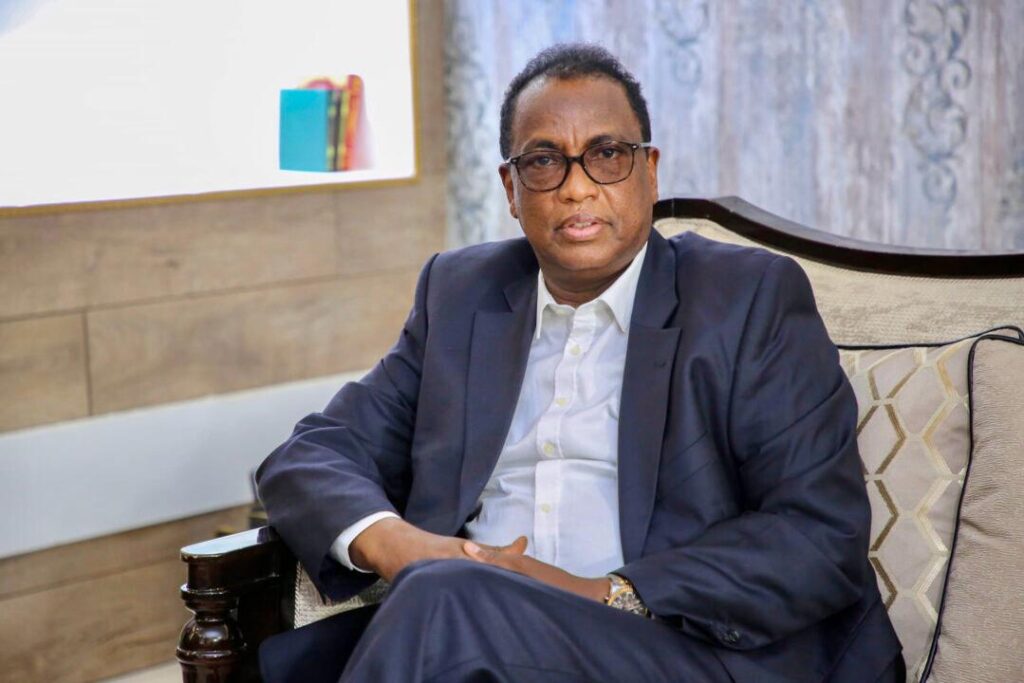
Dr. Ali Said Faqi
For more than six decades Somalia’s political arrangements have largely been shaped by ideas introduced from outside rather than by solutions developed organically by the Somali people. Since independence, different political systems have been adopted or encouraged by external actors, often reflecting international political models rather than Somalia’s own social realities. After sixty-six years, the results speak for themselves. None of these imported frameworks has succeeded in producing a stable and durable political order.
This history should force us to pause before rushing to adopt yet another model developed elsewhere. The current debate about introducing a multiparty system raises an important question: should Somalia continue importing political formulas, or should it begin building a system rooted in its own political and social conditions?
In this op-ed, I am attempting to introduce a Somali-owned perspective on this issue; one shaped by long observation of the country’s political and social realities. The goal is not to reject democratic participation, but to think more carefully about what type of political framework can realistically produce stability and effective governance in Somalia.
In my view, Somalia is not yet ready for a multiparty political system. This is not an argument against democracy. Rather, it is a recognition that political systems succeed only when they grow out of the realities of the societies they are meant to serve.
Before discussing the risks associated with multiparty politics, it is worth looking at the political arrangement Somalia currently has. Many people rightly criticize the system for concentrating too much power in the executive branch and for failing to provide adequate accountability, transparency, and respect for the rule of law. Those concerns are legitimate and should not be dismissed. Yet the current structure has at least one important advantage: it has provided a degree of political continuity. Despite recurring crises and disputes, governments have generally been able to survive their constitutional terms without the state itself collapsing. In a fragile country emerging from decades of conflict, even this level of stability should not be taken lightly.
Political systems must be judged not only by how democratic they appear on paper, but also by whether they can function in practice. For a country like Somalia, where institutions are still developing and political trust remains fragile, stability is a critical ingredient of progress.
Introducing a multiparty system at this stage could easily produce the opposite effect. Multiparty politics almost always requires coalition governments. Coalitions demand compromise, negotiation, and a willingness among political actors to accept partial victories rather than total control. In countries with mature political institutions this can work. In more fragile environments, however, coalition politics often leads to repeated government collapses.
History offers many examples. For decades Italy experienced frequent government breakdowns because coalition partners could not sustain workable agreements. Cabinets would fall shortly after being formed, producing cycles of instability that made effective governance extremely difficult. Italy eventually stabilized its system because it possessed strong institutions and a capable bureaucracy. Somalia does not yet enjoy those advantages.
The deeper challenge lies in the nature of Somali politics itself. Political competition in Somalia is rarely organized around policy programs, ideological differences, or competing visions for national development. More often it revolves around clan affiliations, personal alliances, and immediate political interests.
Under such conditions, political parties would not necessarily produce national political movements. Instead, they would likely mirror the existing clan landscape. Each major clan grouping could form its own party, turning elections into contests between clan-based organizations rather than debates over policy or governance.
If that were to happen, the introduction of political parties might deepen existing divisions rather than help overcome them. Instead of uniting citizens around national platforms, parties could reinforce the very fragmentation that Somalia has struggled with for decades.
Rejecting a multiparty system does not mean rejecting democratic participation. Somalia can still expand electoral participation in ways that reflect its own social realities.
One option would be to introduce a one-person-one-vote system without political parties. Under this approach, citizens would vote directly for individual candidates rather than party lists. The existing power-sharing structure could continue to determine how many seats are allocated to each clan or constituency. Within those constituencies, candidates from the same clan or sub-clan would compete openly for the available seats.
This model would still allow voters to choose their representatives while avoiding the risks associated with party-based political competition. Elections would remain competitive, but the competition would take place within clearly defined constituencies rather than through national party rivalries that could amplify political tension.
Such a system would not be perfect, but it could provide a practical bridge between the current political order and a more institutionalized democratic framework in the future.
More importantly, it would represent a political arrangement developed by Somalis themselves. Instead of importing yet another institutional design from abroad, the country could begin shaping a model that reflects its own history, culture, and social structure.
What Somalia needs most urgently is not a rapid multiplication of political parties but stronger governance. Institutions responsible for oversight, accountability, and the rule of law remain fragile and, in many cases, underdeveloped. Without strengthening these foundations, changes in the electoral system alone will not produce meaningful democratic progress.
Building stable institutions takes time. Countries that now enjoy stable democratic systems spent decades strengthening their legal frameworks, administrative capacity, and political norms. Expecting Somalia to replicate those systems overnight is unrealistic.
Multiparty politics is often presented as the universal pathway to democracy. In reality, it is simply one political arrangement that evolved under specific historical circumstances. It works well in some environments and poorly in others.
Somalia’s democratic evolution will succeed only if reforms reflect the country’s own conditions rather than outside expectations. Political stability, institutional strength, and gradual reform are far more important than adopting structures that may look democratic but cannot function effectively.
Conclusion
The central argument is straightforward: a multiparty system is not the most appropriate path for Somalia at this stage of its political development. What the country needs most is not more political parties, but stronger institutions, responsible leadership, and a political culture that places national stability above factional competition.
Until Somalia develops institutions capable of managing intense political competition, introducing multiparty politics could deepen division rather than strengthen democracy. A more prudent course would be to consolidate stability, improve governance, and allow democratic institutions to grow gradually on foundations that are strong enough to sustain them.
Dr. Ali Said Faqi is the former Ambassador of Somalia to EU and Current Speaker of the Southwest State of Somalia.