


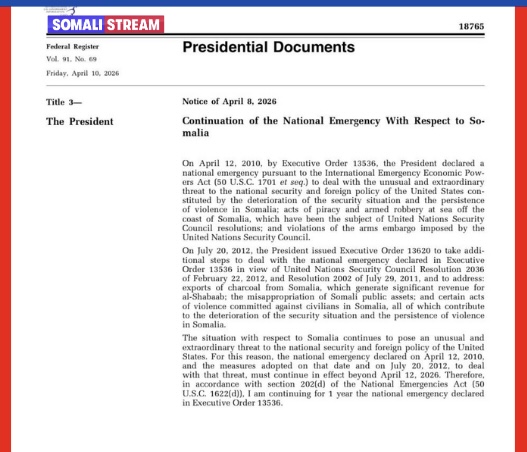
In the often overlooked US government’s Federal Register, a familiar notice has been updated. Dated April 8, 2026, and issued under the authority of Donald Trump, the United States, yet againformally extended its national emergency with respect to Somalia for another year—a decision that, while procedural in Washington, carries a particular political and strategic implications for Somalia.
In a move that passed with little attention across Somali media, the notice does not introduce a new policy but instead, renews a longstanding framework first established under Executive Order 13536 on 12th April 2010 is now an established U.S. policy toward Somalia for over fifteen years.
This is not a reactionary gesture under the ever-scornful President Trump, who seems to have an axe to grind with the Somali state due to the perceived threats from its nationals residing in the United States. It is an ever-present reaffirmation that Somalia continues to be classified as an “unusual and extraordinary threat” to U.S. national security and foreign policy. That language, repeated almost verbatim since the note’s inception in 2010, is the legal foundation that allows Washington to maintain sweeping emergency powers over all Somali-linked financial, political, and security matters.
The justification remains familiar. The United States cites the persistent deterioration of Somalia’s security environment, ongoing violence and the enduring presence of armed groups and factions. At the start, it also included piracy and armed robbery at sea (which has since been be sufficiently tackled), as well as a host of other violations including the United Nations Security Council arms embargoes. These factors, taken together, are presented as evidence that the underlying crisis has not fundamentally changed.
The notice also reinforces additional concerns introduced in 2012 through Executive Order 13620. These include the role of charcoal exports in generating revenue for Al-Shabab, the misappropriation of Somali public assets, and continued acts of violence against civilians. The cumulative message appears to be apparent: the threat is not only limited to military, but also economical and institutional.
What this renewal guarantees is a powerful and far-reaching policy architecture. It preserves the prosecutorial authority of the U.S. government to impose sanctions, freeze assets, and block financial transactions tied to individuals or entities deemed to contribute to instability in Somalia. It also hugely allows continued targeting of Al-Shabab through financial disruption, while also promising oversight of economic sectors linked to conflict financing.
This designation also keeps Somalia under a framework of governance scrutiny. By explicitly referencing corruption and misuse of public assets, the US government maintains the legal and political space to intervene—either directly or indirectly—in how Somali institutions are perceived and engaged internationally.
The deeper issue, however, is not the content of the renewal—but its continuity. Since its introduction under Barack Obama, the national emergency has been extended every year without interruption. It has survived multiple administrations, including Donald Trump,Joe Biden, and now continues under a second non-consecutive Donald Trump presidency. What was conceived as a temporary containment response has, in practice, become a recurrent permanent fixture.
Within U.S. political discourse, largely owing to Trump, Somalia continues to occupy a disproportionately negative space. It is frequently associated with instability, terrorism, and systemic fragility. The implications extend into immigration policy. Somalia’s long-standing designation for Temporary Protected Status terminated despite the US administration’s own admittance of Somalia’s precarious situation.
The same applies to sanctions and diplomatic pressure. Under the same legislation, the U.S. retains the authority to restrict entry, freeze assets, and target individuals within Somalia’s political and economic spheres. By extending the emergency under Donald Trump, the U.S government retains broad authority to deny or cancel visas for individuals linked to instability or corruption, reinforcing its ability to shape Somali political space without overt escalation as seen last week.
Whether justified or excessive, the policy points to a deeper strategic posture. The United States continues its view of Somalia, less of a state recovering towards stability, but more of a constant problem meriting ongoing containment. Until that designation is lifted entirely, not perpetually extended, the bilateral relations will forever remain underpinned in the logic of exception as opposed to normalcy.
And so, with a signature and a notice, the policy continues in place.