


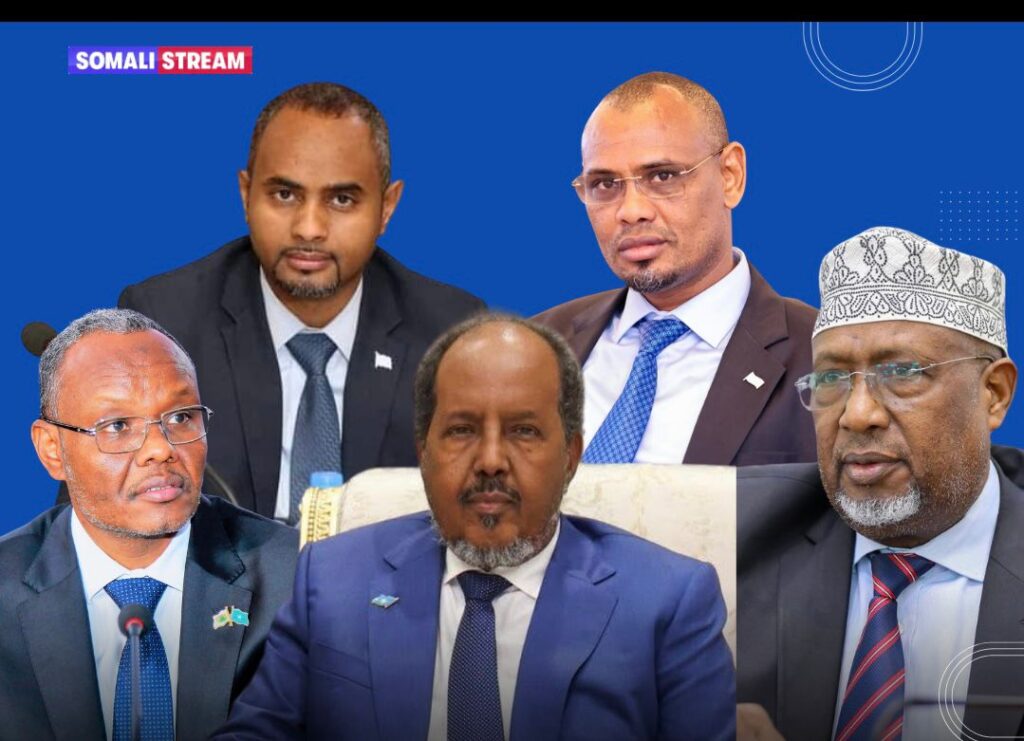
A fierce political showdown is brewing in Somalia, as President Hassan Sheikh Mohamud confronts what insiders say could become the most serious political challenge of his presidency since returning to power on May 15, 2022.
The Federal Government of Somalia presidency reportedly convened a meeting days ago with cabinet members opposed to Laftagareen, informing them to prepare for an escalating political confrontation in the South West State of Somalia.
Sources say the meeting signaled a coordinated push from the presidency of Hassan Sheikh Mohamud aimed at reshaping the political balance in the region.
Meanwhile, Laftagareen has moved quickly to counter the pressure, taking steps to tighten security in Baidoa and other key towns under his administration.
At the same time, the federal government is said to have sent financial support to the towns of Hudur and Qansax Deere in an effort to pull them away from the control of the Southwest administration.
These developments have further intensified the political struggle as Laftagareen digs in to defend his authority against mounting pressure from President Hassan Sheikh.
The crisis erupted after the leader of Southwest State of Somalia, Abdiaziz Hassan Mohamed Laftagareen, abruptly withdrew support for the Federal Government’s controversial constitutional changes and upcoming local council elections scheduled for mid-April.
Now, the standoff is threatening to derail a major political project backed by the Presidency in Villa Somalia and could ignite a wider power struggle between the Federal Government and one of the country’s most strategic regional administrations.
Constitution Fight Sparks the Crisis
For months, President Laftagareen had been a key ally in advancing the Federal Government’s constitutional reform agenda and plans for local elections. But according to sources familiar with the dispute, Laftagareen repeatedly urged the federal leadership to dismiss two ministers: Ports Minister Abdulkadir Mohamed Nur and Livestock Minister Hassan Hussein Eelaay.
Southwest officials claim the two ministers have been interfering in the region’s internal affairs and fueling political tensions.
When the federal parliament pushed through constitutional amendments despite objections from opposition leaders and two Federal Member States, Mogadishu reportedly asked Laftagareen to publicly endorse the move. He refused. That rejection marked the beginning of what insiders now describe as a full-scale political confrontation.
Quiet Plot to Unseat Laftagareen?
Sources say officials in Mogadishu have quietly explored options to replace Laftagareen. In one move, the Federal Government reportedly sent Adan Mohamed Nur Madobe, the Speaker of the Somali Parliament, to Addis Ababa to seek backing from Ethiopia for a leadership change in Southwest State. But the effort appears to have stalled. Ethiopia, which has significant security influence in the regional capital Baidoa, reportedly declined to support the plan.
Regional Diplomacy and Suspicion
The tensions escalated after President Mohamud made a one-day trip to Djibouti where he held a trilateral meeting with Djibouti’s President Ismail Omar Guelleh and Ethiopia’s Prime Minister Abiy Ahmed.
According to sources, Mohamud raised the issue of dealing with internal regional administrations and asked for support similar to what Ethiopia provided during the Presidency of Mohamed Abdullahi Farmaajo.
The president’s decision to bring Ports Minister Abdulkadir Mohamed Nur on the trip reportedly triggered suspicion inside the Federal Government itself. Speaker Adan Madobe, who had long been rumored to be eyeing the Southwest presidency, is now believed to feel sidelined.
Sources say Madobe and Laftagareen have since held private phone discussions and appear to have found common ground against Minister Abdulkadir Mohamed Nur, whom both sides reportedly see as a destabilizing figure.
If Mogadishu pushes ahead with a confrontation without Madobe’s backing, insiders warn it could fracture the ruling political alliance and even paralyze parliament.
Tax Revenue Clash at Elasha Biyaha
The political fight is now spilling into economic territory. According to informed sources, the Federal Government has begun moving to take control of tax revenues collected at the key checkpoint of Elasha Biyaha, located between Banadir and the Shabelle region. The site is a major revenue source for Southwest State’s Finance Ministry.
Federal intervention there has exposed months of simmering tensions between the two sides.
Rising Security Tensions
Security concerns are also intensifying.
Despite repeated assurances from President Mohamud that the Federal Government is not backing opposition movements inside Southwest State, officials in the region accuse the two ministers of orchestrating political mobilization in districts around Bur Hakaba.
At the same time, shipments of weapons and military supplies reportedly sent to several towns in the Bay Region have alarmed the Southwest leadership.
Military Pressure Mounts
In another dramatic move, federal security commanders have reportedly ordered senior officers to recall the commander of the Somali National Army’s 60th Division and the regional National Intelligence and Police chiefs serving in Southwest State.
Sources say officers who refuse to leave their posts could face salary suspensions and financial pressure. The moves are widely seen as an attempt to weaken Southwest State’s military leverage.
Speaker Madobe’s Political Gamble
Speaker Adan Mohamed Nur Madobe, once believed to be positioning himself to replace Laftagareen, now faces growing uncertainty. Sources say he has been quietly removed from the list of potential candidates for the Southwest presidency.
Instead, officials in Villa Somalia are said to be considering two alternative figures — Ports Minister Abdulkadir Mohamed Nur and Livestock Minister Hassan Hussein Eelaay.
If the presidency pushes forward without Madobe’s support, analysts warn the plan could collapse politically.
For now, the alliance between Madobe and Laftagareen appears to be holding strong, bolstered by support from powerful Southwest political figures including Adan Saransoor.
What Happens Next?
Behind the scenes, the Federal Government is reportedly considering measures to prevent Laftagareen from returning to Baidoa. Security agencies and immigration authorities have allegedly been drawn into the plan.
Meanwhile, mediation efforts involving business leaders and the Presidents of Galmudug and Hirshabelle have so far failed to produce a breakthrough.
Laftagareen is now expected to travel to Nairobi where he could meet opposition figures linked to the Future Council political platform.
One key factor complicating Mogadishu’s calculations: Ethiopian troops stationed in Baidoa continue to support security operations in Southwest State, making it difficult for the Federal Government to move aggressively.
With parliamentary and government mandates set to expire on April 14 and May 15 respectively, the clock is ticking, and Somalia’s political battlefield is heating up fast.