


The political centre of gravity in Somalia shifted south on Wednesday, 17 December 2025, as the coastal city of Kismayo transformed from a regional trade hub into the de facto command centre for the Somalia’s opposition alliance.
In a move that has sent shockwaves through the corridors of power in Mogadishu, a formidable alliance of the country’s political elite is converging here for a summit that could redraw the map of the nation’s democratic future.
This is the Kismayo Conclave: a gathering of former president, premiers, and regional heavyweights determined to challenge the Federal Government’s unilateral march toward one-person-one-vote elections.
In a scene reminiscent of a high-stakes diplomatic thriller, Sayid Mohamed Airport has become a parking lot for who’s who of Somali governance. The mission? A defining summit to finalize the “Somali Future Council”, a coalition designed to challenge Mogadishu’s roadmap for the 2026 elections.
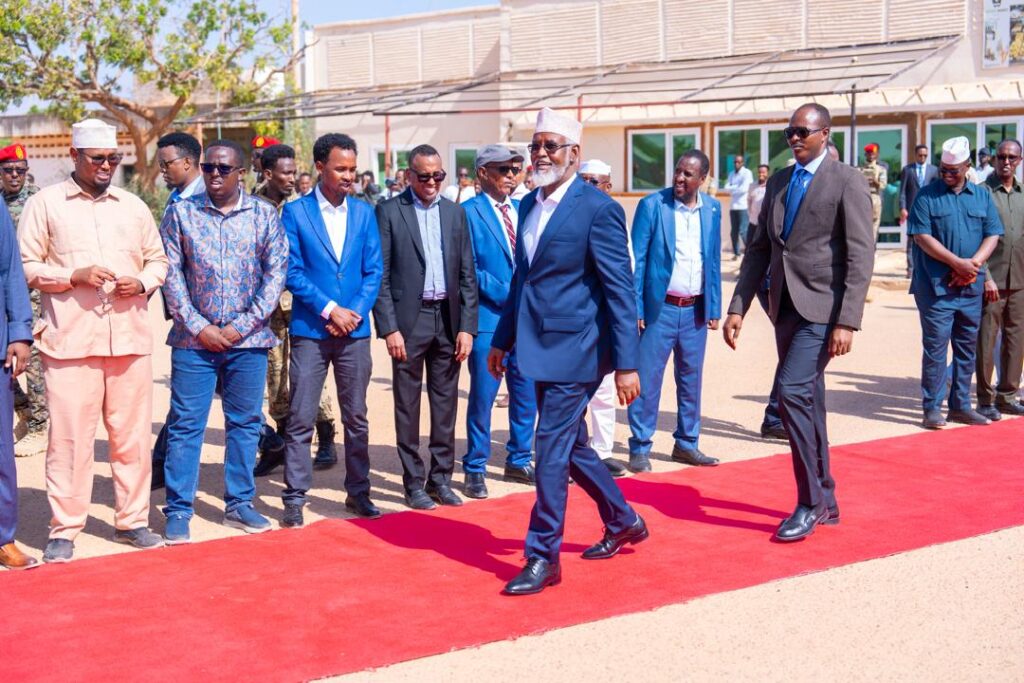
Over the last 24 hours, the tarmac at Sayid Mohamed Airport has witnessed a procession of private jets and VIP convoys, marking a rare and potent consolidation of influence. The host, Jubaland President Ahmed Mohamed Islam (Ahmed Madobe), a figure who has long proved a thorn in the side of centralizing forces, has rolled out the red carpet, orchestrating a display of unity intended to be seen as clearly in the Presidential Palace in Mogadishu as it is on the streets of Kismayo.
The momentum shifted decisively when Puntland President Said Abdullahi Deni touched down. His arrival, confirmed by the Puntland State House, was met with full ceremonial honours led by Madobe himself. The handshake and hug between the leaders of Somalia’s two semi-autonomous heavyweights , Puntland and Jubaland, symbolizes a hardening of the “federalist” front against the Capital. But the roster of attendees suggests this is far more than a regional dispute.
The imagery released by the Puntland State House, was unmistakable: a united front of the country’s two most powerful Federal Member States, locking arms against the central government.
Former Prime Minister Hassan Ali Khaire publicly lauding the “dignified reception” accorded to him, a subtle nod to the legitimacy he views in this alternative forum.
Adding significant weight to the coalition, former Prime Minister Abdi Farah Shirdon (Saacid) arrived fresh from Nairobi. Shirdon, the presidential candidate for the Union of Haybad Qaran, wasted no time in setting the tone. In a statement released shortly after his arrival via his official Facebook page, Shirdon framed the conference as a rescue mission.
“We are here to seek a Somali-led consensus,” Shirdon declared, warning that the country must be pulled back from a “political uncertainty and constitutional vacuum.” His remarks underscored the summit’s primary objective: to lay the groundwork for elections that are credible and consensual, rather than what the opposition views as a forced march by the incumbents in Mogadishu.
The table is not yet fully set. Exclusive Somali Stream reports from the Capital indicates that the exodus of influence toward Kismayo is continuing. Former Prime Minister Mohamed Hussein Roble and the prominent MP Abdirahman Abdishakur Warsame arrived from Mogadishu.
Warsame, never one to mince words, has already confirmed his attendance at what is being billed as the “Conference on Finalizing the Somali Future Council.” He previewed the talks as a necessary confrontation with the “complex transition period” and the institutional paralysis threatening the state.
Abdirahman Abdishakur, wrote on his Facebook shortly after arriving, setting the sombre yet determined tone for the summit:
“I have arrived today in Kismayo, Jubaland State, where the Conference on the Formation of the Somali Future Council will be held. The conference will also discuss the complex transition period and the deep political uncertainty facing the country. I specifically thank President Ahmed Mohamed Islam, and all the people and government of Jubaland, for welcoming us with dignity and honour.”
Former PM Mohamed Hussein Roble was equally blunt in his arrival statement, framing the gathering as a rescue mission for the state itself:
” The focus of the Kismayo meeting will be on finding a solution to the country’s political uncertainty, the conflict over electoral issues, the constitution, and other circumstances existing in the country.”
Perhaps most significantly, the summit awaits the arrival tomorrow of Sharif Sheikh Ahmed, the 7th President of the Federal Republic and a titan of the moderate Islamist bloc. His presence will arguably tip the gathering from a political pressure group into a shadow government-in-waiting.
At the heart of this three-day summit is the formalization of the Somali Future Council. This body, uniting Puntland, Jubaland, and the National Salvation Forum, is expected to emerge as a shadow authority, offering an alternative roadmap to the 2026 polls.
Their grievance is singular but explosive: the Federal Government’s push for a direct electoral model. While good on paper, the opposition argues the plan is technically unfeasible and politically designed to extend the current administration’s tenure without consensus.
As these leaders retreat behind closed doors to hammer out a unified strategy, the message to the Federal Government is stark: there will be no elections without the consent of the heavyweights sitting in Kismayo.
For President Madobe, playing host to this cadre of elites is a masterstroke of political theatre, asserting Jubaland as the sanctuary for Somalia’s democratic debate.
As the sun sets over Kismayo tonight, the hotels are full, the security is tight, and the backroom deals are beginning. Mogadishu may hold the Palace, but for the next 72 hours, Kismayo holds the cards.
The message to the Villa Somalia is clear: The road to the next election runs through Kismayo.
For observers of Horn of Africa politics, the optics are undeniable. Mogadishu may hold the international recognition, but Kismayo currently holds the political gravity.