


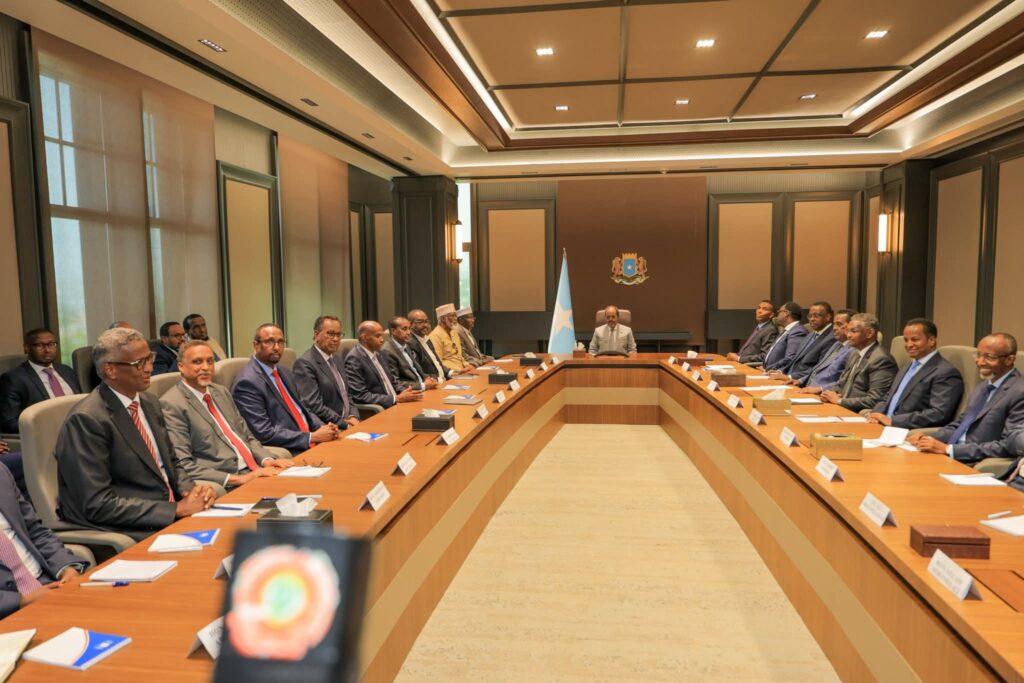
As President Hassan Sheikh Mohamud approaches the final year of his mandate, set to expire in May 2026, Somalia’s fragile political settlement is once again edging toward uncertainty.
Negotiations between the Federal Government and the opposition-aligned Future of Somalia Council have collapsed after months of stalemate over the structure, legality and management of the next elections.
What had been described publicly as technical discussions have hardened into a fundamental dispute over constitutional authority and the balance of federal power.
The presidency has pressed for one-person, one-vote elections for members of parliament, a reform framed as the long-awaited expansion of universal suffrage.
Under the proposal, MPs would be directly elected, while the president would continue to be chosen indirectly by parliament.
Under Somalia’s established electoral practice, the nomination of Members of Parliament has traditionally been shaped at the regional level, where Federal Member State leaders exercise decisive influence over who ultimately takes a seat in Villa Hargeisa. That decentralized model, however imperfect, reflects the federal character of the state and ensures that power flows upward from the regions, not downward from the center.
President Hassan Sheikh Mohamud has made clear his administration’s opposition to that arrangement. Framing it as elite gatekeeping, his government has instead championed universal suffrage, arguing that direct elections would shift authority from political intermediaries to the Somali people themselves.
But the opposition rejects that narrative outright.
They argue that in the absence of agreed constitutional safeguards, an independent and mutually trusted electoral commission, and credible security guarantees, the promise of “one person, one vote” risks becoming a political mirage. In their telling, the proposed system is neither neutral nor transitional, it is structurally tilted.
Far from broadening participation, opposition figures contend, the president’s plan would centralize unprecedented control over the design, management and enforcement of the electoral process in the hands of the federal executive. Control the rules, they argue, and you control the result.
“This is not democratization,” senior opposition figure Abdirahman Abdishakur remarked privately. “It is a match organized, refereed and played by the incumbent, and then presented to the public as competition.”
The concern is not with universal suffrage in principle. It is with sequencing, safeguards and trust.
The opposition insists that elections must be negotiated, not imposed; administered independently, not supervised by those with a direct political stake; and conducted within a consensual constitutional framework, not one amended amid dispute.
In short, they argue that credibility cannot be declared, it must be built. And without consensus, they warn, a rushed transformation of the electoral model could exchange one flawed system for a far more destabilizing one: a contested vote whose legitimacy is questioned before the first ballot is cast.
The opposition, however, sees the sequencing as politically loaded. In a sharply worded communiqué, the Future of Somalia Council insisted that the 2012 Provisional Constitution remains the country’s binding legal framework and that any amendments require broad national consensus and genuine public consultation.
Instead, it accuses the administration of continuing unilateral constitutional changes even as talks were underway.
More pointedly, the Council alleges that more than 50 members of parliament were prevented from participating in constitutional proceedings and that intimidation and security pressure accompanied the amendment process – claims that, if substantiated, would raise serious concerns about the integrity of the legislative environment.
The deepest fracture concerns control over elections in the Federal Member States. The opposition insists that overdue regional elections must be conducted in accordance with state constitutions and the federal separation of powers.
It accuses the federal government of seeking to subsume those elections under a federal electoral commission operating on the basis of disputed constitutional revisions, a move it compares to last year’s controversial process in Banaadir.
Reports indicate that the most contentious sticking points were federal-level elections and those of three Federal Member States considered aligned with the government such as Galmudug, Hirshabelle and South West.
According to sources familiar with the discussions, those disagreements ultimately caused the meeting at Villa Somalia to collapse without a breakthrough.
The Council says it proposed reaching a binding political agreement before April 14 on the framework, timeline and management of federal parliamentary elections to ensure transparency, inclusivity and completion within constitutional deadlines.
According to the opposition, the government countered by limiting the negotiating committee to an advisory role without decision-making authority.
That, opposition figures suggest, rendered the talks structurally meaningless.
The breakdown has drawn concern from international partners.
The United Nations Transitional Mission in Somalia (UNTMIS), issued a statement on Monday, expressing regret that the two sides had failed to reach agreement.
Mission leadership led by James Swan, alongside other international partners, met senior representatives from both camps and welcomed their stated commitment to continue seeking a solution. UNTMIS urged the parties to proceed in good faith and reiterated its readiness to support Somali-led efforts toward compromise on the outstanding issues.
With the president’s term ending in May 2026, there is still no agreed electoral framework, no ratified consensus on constitutional amendments, and no unified roadmap.
The opposition now warns of a potential constitutional vacuum if unilateral measures continue. The administration, for its part, argues that reverting to indirect elections would entrench elite bargaining and deny citizens their democratic rights.
Political maneuvering is already underway. Following the latest round of talks, Ahmed Mohamed Islam popularly known as Madobe, the president of Jubbaland, has returned to Kismayo.
Meanwhile, Said Abdullahi Deni, himself a presidential aspirant for the forthcoming Somali Presidential elections, is expected to remain in Mogadishu for several more days to continue consultations and meetings with various stakeholders.
Beneath the procedural arguments lies a volatile question: who controls the transition?
For the president’s camp, direct parliamentary elections represent overdue democratic normalization. For the opposition, without negotiated safeguards and balanced federal authority, they represent centralization disguised as reform.
Somalia’s recent history is marked by negotiated settlements reached at the eleventh hour. Whether this standoff ends in compromise or confrontation may determine not only how Somalis vote soonest possible, but how stable the federal experiment remains once the ballots are counted.