


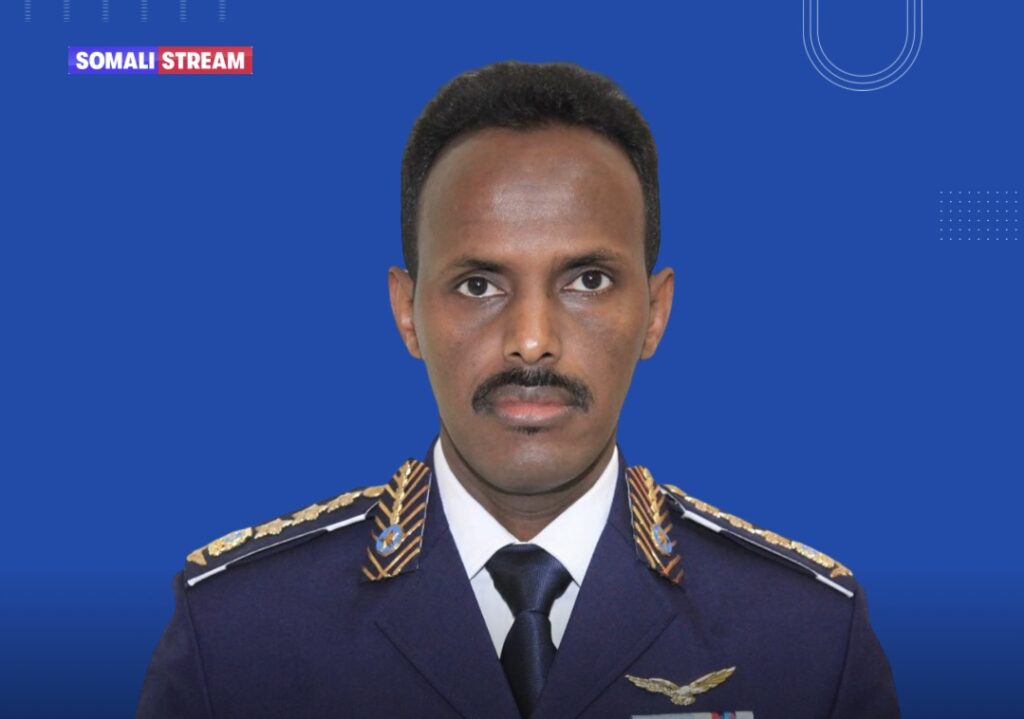
In a ceremony steeped in military tradition and strategic symbolism, Brigadier General Abdirisaq Mohamud Haji, known widely within defense circles by the call sign “Qaloombi” formally assumed command of the Somali Air Force on March 7, 2026.
The transfer of authority marks a decisive step in the continuing modernization of the air arm of the Somali National Armed Forces, as the country accelerates efforts to rebuild its aerial defense capabilities after decades of institutional disruption.
Held in the capital and attended by senior defense leadership, the ceremony underscored the growing emphasis on professionalization, operational readiness, and command continuity within the Somali military establishment. For security planners in Somalia, the appointment represents both a generational shift and a strategic investment in the future of the nation’s air power.
A Structured Transfer of Command
The formal handover was presided over by Brigadier General Madey Nurey Sheikh, widely known as “Uforow” the Deputy Commander of the Somali National Armed Forces, who oversaw the transition in accordance with military protocol.
Colonel Ali Ibrahim Abdi, who had been serving as Acting Air Force Commander while simultaneously holding the position of Deputy Air Force Commander, officially transferred operational authority to Brigadier General Qaloombi during the ceremony.
The event drew a cross-section of senior officers and defense administrators, including members of the General Staff and command representatives from multiple branches of the armed forces. Their presence highlighted the strategic importance the Somali defense establishment places on restoring a capable and disciplined air force as a pillar of national security.
In a decisive move underscoring the modernization drive within the Somali National Armed Forces, Brigadier General Abdirisaq Mohamud Haji, known widely by the call sign “Qaloombi” was appointed by the Federal Government of Somalia as the new Commander of the Somali Air Force in an announcement made on February 28, 2026,
The appointment marks a pivotal moment in the long-term campaign to rebuild the nation’s strategic air capabilities and restore the aerial arm of the Somali military to operational strength.
Within defense circles in Mogadishu, General Qaloombi’s elevation is being viewed as more than a personnel change. It is part of a broader institutional reset designed to cultivate a new generation of technically trained, strategically minded officers capable of steering the Somali Air Force through a period of rapid transformation.
As the service pushes forward with modernization, training partnerships, and force restructuring, Qaloombi’s leadership is expected to play a central role in shaping the force’s future doctrine and operational readiness.
General Qaloombi’s rise through the ranks reflects an unconventional but increasingly valued trajectory within modern military leadership. Originally trained in the health sciences, he began his professional life in the medical field before answering what colleagues describe as a “higher call to national service.”
Rather than continuing along a civilian medical career, he entered the military, trading clinical tools for command responsibilities and embracing the discipline of armed service. Over time, that decision would place him on a trajectory toward one of the most strategically significant posts in the Somali defense establishment.
Military officials say the combination of analytical training from the medical field and operational experience in uniform has shaped his reputation as a methodical and mission-focused officer, traits highly prized as Somalia rebuilds complex institutions such as its air command structure.
General Qaloombi was born in the city of Beledweyne in Somalia’s Hiiraan Region during the late 1980s, just before the collapse of the central government and the outbreak of nationwide conflict.
Like many Somali officers of his generation, his formative years unfolded against the backdrop of war and displacement. Following the outbreak of the Somali Civil War in 1991, his family spent several years as refugees in neighboring Kenya before eventually returning to Somalia. Much of his upbringing and professional development later took place in the capital, Mogadishu, where the country’s security institutions are now being rebuilt.
Behind General Qaloombi’s rise lies a powerful dual heritage that blends religious scholarship with a legacy of armed struggle.
On his father’s side, he comes from the respected “Qaloombi” lineage, a family known across Somalia and Kenya for its tradition of Islamic scholarship. Among the family’s most prominent figures was the late scholar Sheikh Abdullahi Haji Qaloombi (Sheikh Abdullahi Hiiraan), remembered for his influence in religious education and intellectual life.
That intellectual heritage is matched by a legacy of military sacrifice. His father, Mohamud Haji, served as an officer in Somalia’s armed forces and was wounded during the Ogaden War of 1977 between Somalia and Ethiopia.
Another powerful influence was his maternal uncle, Dr. Mohamed Siraad Doolaal, an Oxford-educated scholar who later joined the armed struggle and became one of the founding members of the Ogaden National Liberation Front. Doolaal ultimately died on the battlefield after years of involvement in the movement.
As commander of the Somali Air Force, General Qaloombi now assumes responsibility for one of the most strategically sensitive portfolios in the nation’s defense sector. The service is undergoing a gradual but determined reconstruction effort after decades of institutional collapse.
Defense planners envision a phased rebuilding process that includes pilot training pipelines, maintenance infrastructure, and airspace security capabilities—critical components for protecting national sovereignty and supporting ground operations against militant threats.
Senior security officials say the appointment of a disciplined and educated officer like Qaloombi reflects the government’s emphasis on professionalization within the armed forces.
For many Somali security experts, General Qaloombi’s story mirrors that of a generation shaped by conflict but determined to rebuild their country’s institutions.
From refugee camps to command briefings, from medical training halls to military flight lines, his journey embodies the evolving identity of Somalia’s security leadership. As the Somali Air Force reasserts its role in national defense, officials say the new commander represents a broader transformation underway across the armed forces.
Within the defense establishment, the message is clear: Somalia’s next chapter in national security may well be written not only on the ground—but in the skies above.