


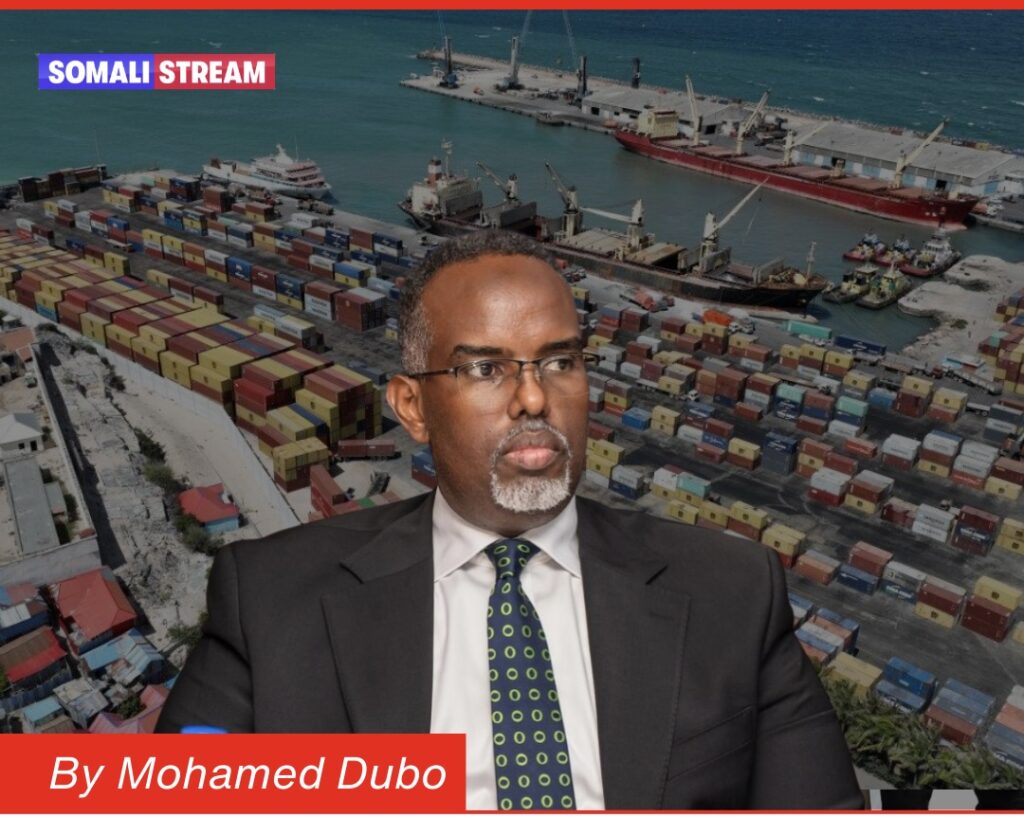
”The question is no longer whether Somalia can handle more containers. It is whether it will capture more value from them. Nations that treat ports as infrastructure move cargo. Nations that treat them as platforms reshape their economic destiny.”
Investors scanning East Africa’s trade corridors tend to focus on established hubs such as Mombasa, Djibouti and Dar es Salaam. Yet few coastlines in the region offer the geographic leverage of Somalia’s over 3,000km stretch along the Indian Ocean and the approaches to the Red Sea. A significant share of global seaborne trade passes nearby. As regional container volumes are projected to approach 12m Twenty-foot Equivalent Unit (TEUs)by 2030, Somalia remains underrepresented in these flows. The gap between geography and performance is striking — and for long-term investors, it signals opportunity.
The Gateway Model
Mogadishu port currently handles slightly less than 200,000 TEUs annually. Operationally, it functions with improving efficiency: vessels berth, containers are cleared and goods move inland. Economically, however, it operates under a traditional gateway model. Cargo passes through quickly, but little is processed, consolidated or re-exported. The port facilitates imports rather than anchoring production, services or export growth. In short, throughput exists; value retention does not.
This distinction is critical. Many developing economies equate port expansion with economic transformation. They deepen berths and acquire cranes, increasing capacity without altering the trade structure. Yet container handling is a volume-driven business with modest margins. The higher returns lie in what surrounds the quay — logistics services, processing, redistribution, financing and industrial clustering.
The Platform Precedent
The world’s most successful ports have evolved from gateways into platforms. Singapore, handling more than 37m TEUs annually, integrates trans-shipment with petrochemicals, advanced logistics and trade finance. Shanghai, processing over 47m TEUs a year, anchors vast bonded logistics zones and manufacturing clusters across the Yangtze River Delta. In Africa, Morocco’s Tanger Med — exceeding 8m TEUs annually — combines container throughput with adjacent automotive and aerospace export zones serving European markets. In each case, scale followed strategy. Traffic expanded because value was created locally.
Somalia need not replicate those volumes to benefit from the same logic. The principle is transferable. Gateway ports maximise velocity; platform ports maximise value-added. The former accelerate imports; the latter internalise value chains and generate recurring service revenues. Expanding quay length without integrating economic activity risks reinforcing import dependence rather than correcting it.
The ongoing development in Mogadishu offers a structural opportunity to pivot. The project combines a modernised port, an international airport and an adjacent economic zone within a unified framework. Co-locating maritime freight, air cargo and industrial land reduces transaction costs and encourages clustering. If supported by coherent policy, it can form the backbone of a platform-based trade model.
An adjacent economic zone allows light manufacturing, agro-processing, fisheries, packaging and cold-chain logistics to operate within a duty-free and policy-stable environment. Export-oriented businesses gain proximity to both sea and air freight. Import substitution industries gain reliable access to inputs. Instead of clearing containers rapidly out of the system, the ecosystem can retain them for processing, consolidation and redistribution.
Services and Scale
Services will be central to this transition. Warehousing, bonded storage, freight forwarding, inspection services, insurance and trade finance generate predictable, hard-currency revenues. These activities often yield higher margins than pure cargo handling. Somalia’s advanced mobile-money ecosystem offers a foundation for formal trade payments, escrow mechanisms and guarantees, strengthening transparency and investor confidence. Institutional predictability — transparent concessions, stable tariff regimes and efficient customs procedures — will matter as much as physical infrastructure
Regional dynamics reinforce the case. Ethiopia remains landlocked and dependent on maritime gateways. Gulf and Asian economies continue to deepen trade and investment links with East Africa. Competition among ports is intensifying, but so is trade integration. In this environment, reliability and regulatory clarity can matter more than sheer size. A well-governed Somalia por platform can secure niche roles in regional redistribution and specialised trade flows.
The arithmetic of transformation is straightforward. At about200,000 TEUs, Mogadishu’s throughput reflects a gateway ideology in which each container generates a single transaction before value exits the economy. Under a platform-based approach, each container can generate multiple revenue streams — storage, processing, logistics services and financial intermediation. Export-oriented production would increase backhaul cargo, improving shipping economics and attracting more frequent services.
Over time, annual volumes could plausibly approach one million TEUs — not solely through physical expansion but through economic integration. Retained cargo, regional redistribution and industrial clustering would generate endogenous growth in throughput. Scale would follow strategy. The result would not simply be higher port revenues, but stronger foreign-exchange earnings, employment creation and broader private-sector development.
A Strategic Choice
The strategic choice facing Somalia is therefore conceptual as much as operational. Ports can remain corridors that accelerate imports, or they can become platforms that anchor exports and services. The physical assets are increasingly in place. Policy coherence will determine whether they serve as transit points or engines of industrialisation.
For foreign direct investors, the appeal lies in timing. Entry at this stage offers exposure not merely to rising container volumes but to the formation of an integrated trade ecosystem. Somalia’s coastline has always offered access. The next phase of reform can ensure it delivers value.
Ports move goods. Platforms build economies
The writer is the Director of SOMINVEST with extensive experience in Strategic Communications, Investment Promotion and Diplomacy.