


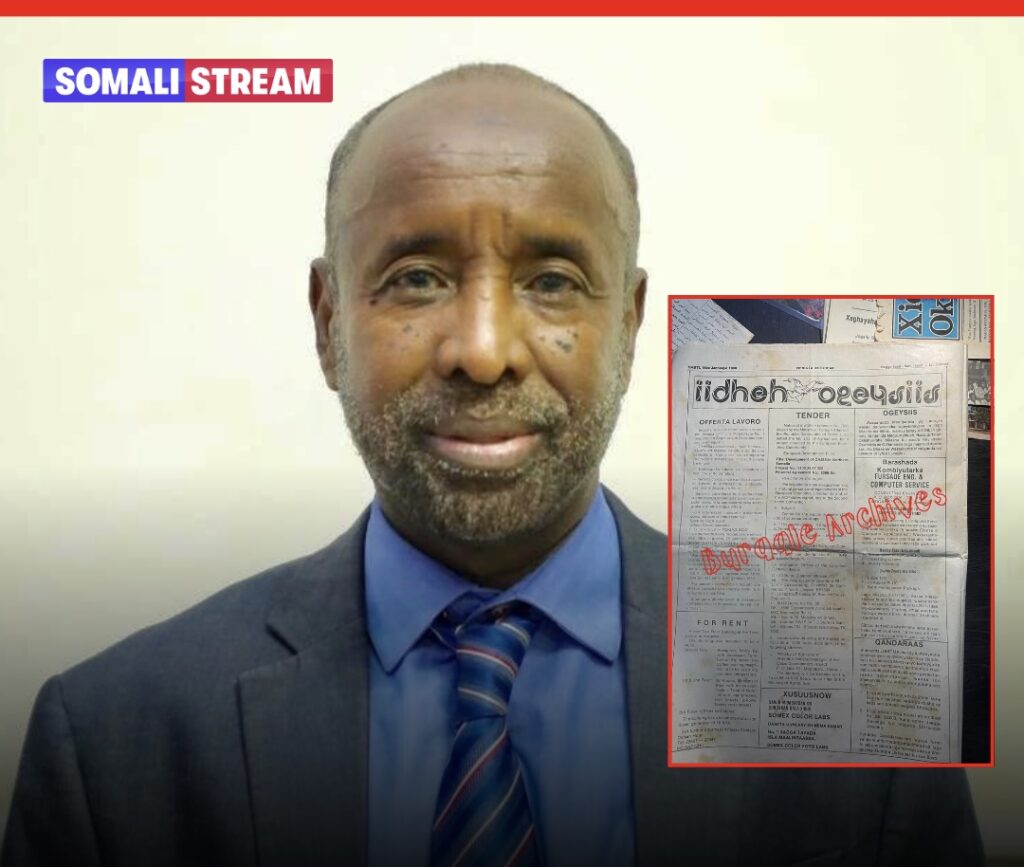
The morning sun slanted across the old archives before we began recording an interview with Abdullahi Mohamud, known as Buraale. On the table lay boxes, some crumbling at the edges, others still sharp with the scent of dust and old ink. Inside them: books with yellowing margins, forgotten reports, and editions of Xidigtii Oktoobar, the once-definitive voice of a rising nation.
We skimmed through them gently, each page a portal back to Somalia’s confident, modernizing years. And then, there it was half-buried, almost shyly, a newspaper advertisement from 1988. Its headline was simple, almost understated: “Fursade Engineering & Computer Services is launching a computer training program called ‘Intensive Course in Computer Applications.’” The advert went on to describe what, today, feels like a time capsule of technology: Introduction to Computer Science, Operating Systems, Word Processing.
Lotus 1-2-3. dBase III Plus. A Bank Management Package.
None of those programs are used anymore. But in 1987 Somalia, they were revolutionary. The presence of this advertisement, in a mainstream national newspaper, told a quiet truth: someone had dared to imagine Somalia as a technologically literate society; long before it was fashionable, long before computers became household objects. That someone was Eng. Nur Diriye Hersi “Fuursade.”
Fuursade Computer and Engineering Services, founded in 1987; was Somalia’s first private computer training school, born into a Mogadishu vibrant with ambition yet hungry for direction. Its classrooms sat near the busy KM4, a location chosen as much for accessibility as for symbolism: an intersection where the city’s future could begin.
That Xidigtii Oktoobar ad, dated Saturday, January 16, 1988, described two courses – each two months long, that introduced everyday Somalis to the digital world.
Many of those students, once novices learning to manipulate monochrome monitors, later became engineers, bankers, administrators, and policy minds shaping the country. And they all emerged from a single premise: technology must be taught locally, and taught early.
Before the collapse of the Somali state, long before he became an Advisor to President or a name whispered in policy circles, Fuursade was a boy in Beledweyne, born in 1952. He memorized the Qur’an in his hometown, then made the journey to Mogadishu where he attended Bartamaha and Raage Ugaas for middle and secondary school. From there, the trajectory seems almost poetic.
He joined the Somali National University, becoming part of the inaugural class of the Faculty of Engineering – a cohort determined to build the nation both physically and intellectually.
By 1978, he was already an academic: assistant lecturer, lecturer, then professor. His curiosity carried him farther, to the University of Missouri, where between 1983 and 1987, he earned both his Master’s and PhD, immersing himself in a world where computers were beginning to transform everything. And when he returned home, armed with this new knowledge, he did not hoard it. He built a school.
Many Somalis came to know Fuursade decades later when he emerged again in public life as Senior Strategic Advisor to President Mohamed Abdullahi Farmaajo, and later as head of the Presidential Chief of Staff. His name even circled the office of Prime Minister after the removal of Hassan Ali Khayre, though that path never materialized. Yet politics was never the heart of his legacy.
His true imprint lies in the quiet, transformative work he began long before.
After the country’s collapse, Fuursade went into exile in Canada, where he continued advising companies and banks, and true to form, kept teaching ICT to new generations. Like a scholar who cannot put aside his pen, he never stepped away from the discipline he helped introduce to Somalia.
Ask any Somali technologist of a certain generation where the country’s digital story begins, and the answer is surprisingly consistent: with him (Eng. Fuursade).
With the man who hauled computers into classrooms when few believed they were necessary.
With the engineer who returned from America not with wealth or comfort, but with a mission. With the professor who opened the first private center for computer education in a country still in the early throes of modernization. Today, often quietly and without fanfare, Eng. Fuursade is recognized as: “The pioneer of computer science in Somalia.”
He does not claim these titles. They are bestowed not by official committees, but by the thousands who passed through his school, the engineers who now teach their own students, and the professionals who built Somalia’s first digital institutions.
As we folded the brittle pages of Xidigtii Oktoobar back into their boxes, one thing became clear: history isn’t always found in battlefields or grand speeches. Sometimes it hides in an advertisement printed in black ink, written by a man who believed his people deserved access to the future. Eng. Nur Diriye Hersi “Fuursade” opened that door. And an entire generation walked through.