


Since gaining independence in 1960, Somalia’s national vision has rested on the pursuit of justice and the protection of human dignity. Yet for much of its post-independence history, these ideals remained largely aspirational. During the democratic era of the 1960s, despite constitutional efforts, Somalia lacked an independent, national institution tasked with safeguarding human rights.
The situation deteriorated dramatically after 1969, when a military regime suspended constitutional protections and systematically curtailed fundamental freedoms, ushering in more than five decades of conflict, instability, and widespread violations of basic rights.
From Post-Conflict Reconstruction to Institutional Foundations (1993–2025)
Following the collapse of the central government in 1991, Somalia entered a prolonged period of transitional governance. For decades, human rights issues were managed by ad hoc task forces and international organizations, as there was no legally recognized national body to monitor or enforce rights. In 1993, the United Nations appointed its first Special Representative to monitor the human rights situation in Somalia. Over the following decades, as Somalia embarked on gradual state-building, parallel efforts sought to strengthen domestic mechanisms for protecting human rights.
A key milestone came in 2013, when the Ministry of Human Rights presented legislation to Parliament establishing a monitoring commission to oversee human rights in Somalia—laying the groundwork for the creation of formal, national institutions.
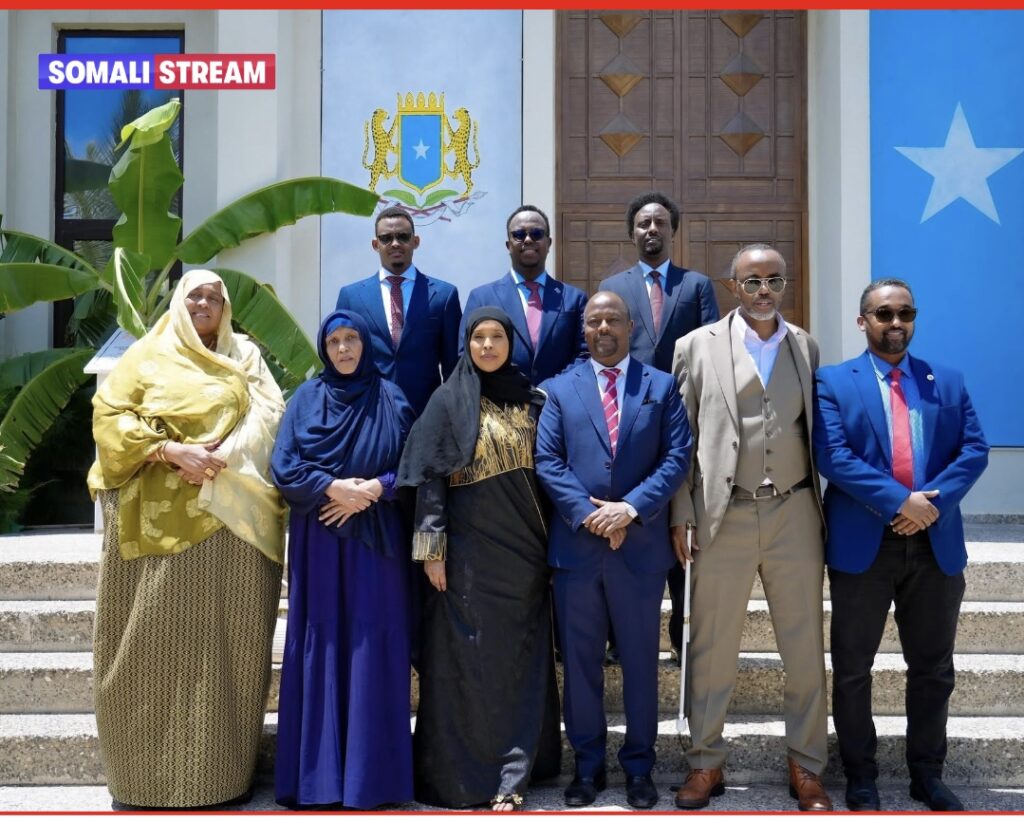
The real breakthrough, however, occurred on 25 September 2025, when the Somali Cabinet officially appointed the Independent Human Rights Commission, a nine-member body tasked with leading the country’s human rights agenda. On 8 October 2025, the United Nations Human Rights Council formally transferred authority and operational independence of human rights oversight to Somalia, and on 10 December 2025, the national law establishing the Commission was fully enacted, marking a historic achievement: for the first time, Somalia had a constitutionally mandated body with investigative, research, and awareness-raising powers, independent of executive interference.
Yet this hard-won progress now faces serious challenges. The Commission, led by Dr. Maryan Qasim Ahmed and formally appointed on 4 February 2026, has come under immediate threat from the Somali presidency, which has initiated systematic efforts to undermine its independence.
Angered that the candidate it supported did not win the chairmanship, the presidency has introduced a series of obstacles designed to curtail the Commission’s operational autonomy.
The first step came through blocking the Commission’s 2026 budget, effectively preventing it from executing nationwide mandates.
According to informed sources, the presidency has made clear that if its preferred candidate for the Commission’s leadership is not installed, it will seek to leverage the Director-General position to exert influence over the Commission’s decisions, threatening the integrity of its investigations and policy guidance.
Members of the Commission, aware of the executive’s intentions, initially complied with procedural formalities, but resistance has emerged after the appointment of a Director-General not aligned with the presidency. The executive has reportedly exploited internal divisions, targeting the elected chairperson and other members who voted for her to challenge her authority over appointments and administrative oversight.
On 10 February 2026, members supporting the defeated chairperson sent letters to international diplomats and Western embassies in Mogadishu, alleging that the new leadership was fostering partisanship, incitement, and extremism within the Commission, thereby undermining its ability to function effectively and independently.
The situation has prompted serious concern among human rights organizations supporting Somalia and Western embassies based in Mogadishu. They have explicitly called on the Federal Government to cease direct interference, warning that instigating internal conflicts threatens both the national law establishing the body and international standards for human rights protection.
While Somalia now possesses a national institution tasked with safeguarding citizens’ rights for the first time, executive interference risks rendering the Commission nominal rather than functional.
If these efforts to undermine independence are not halted, Somalia risks losing one of the most important achievements of its post-conflict reconstruction – the establishment of an autonomous mechanism to protect the rights of its citizens and uphold accountability, a milestone nearly three decades in the making since the collapse of the central government in 1991.