


Public trust in leadership rests not on eloquent speeches but on fidelity between words and deeds. When that bond erodes, institutions, not personalities, must restore the balance. Today, Somalia’s judiciary faces such a moment.
During his campaign, Hassan Sheikh Mohamud promised “Somalia at peace with itself and with the rest of the world.” It was an inspiring slogan. Yet slogans are not self-executing. They must be animated by conduct. The Qur’an warns with piercing clarity: “O you who believe, why do you say what you do not do? Most hateful it is in the sight of Allah that you say what you do not do.” (Qur’an 61:2–3).
These verses are not mere moral ornamentation; they are a constitutional ethic for Muslim societies. Public authority demands coherence between proclamation and practice.
The Tafseer of Surah Yusuf, verse 101, offers a profound lens through which to view political leadership. Prophet Yusuf (peace be upon him), after enduring abandonment, imprisonment, and humiliation, rose to power in Egypt. Yet in his prayer (“Cause me to die a Muslim and join me with the righteous”) he did not allow authority to alter his character. Earlier, in vulnerability, he turned to Allah in humility. Later, in sovereignty, he remained equally humble and morally anchored. Power did not transform him for the worse. The lesson is unmistakable, elevation in status increases one’s obligation to remain principled, not to drift into expediency.
Somalia’s present political turbulence raises the uncomfortable question of whether that standard is being upheld.
A unilateral constitutional review has been defended as fulfillment of campaign pledges. An argument reminiscent of the classical phrase “qawl al-haq yuradu bihaa al-batil” (a word of truth by which falsehood is intended). Yes, constitutional reform was widely promised. But reform without consensus, inclusivity, and procedural integrity transforms a shared aspiration into a divisive instrument.
Likewise, an electoral process designed and executed without broad political agreement, while presented as democratic progress, risks entrenching power rather than renewing legitimacy. If electoral engineering guarantees incumbency, it hollows out the very concept of choice.
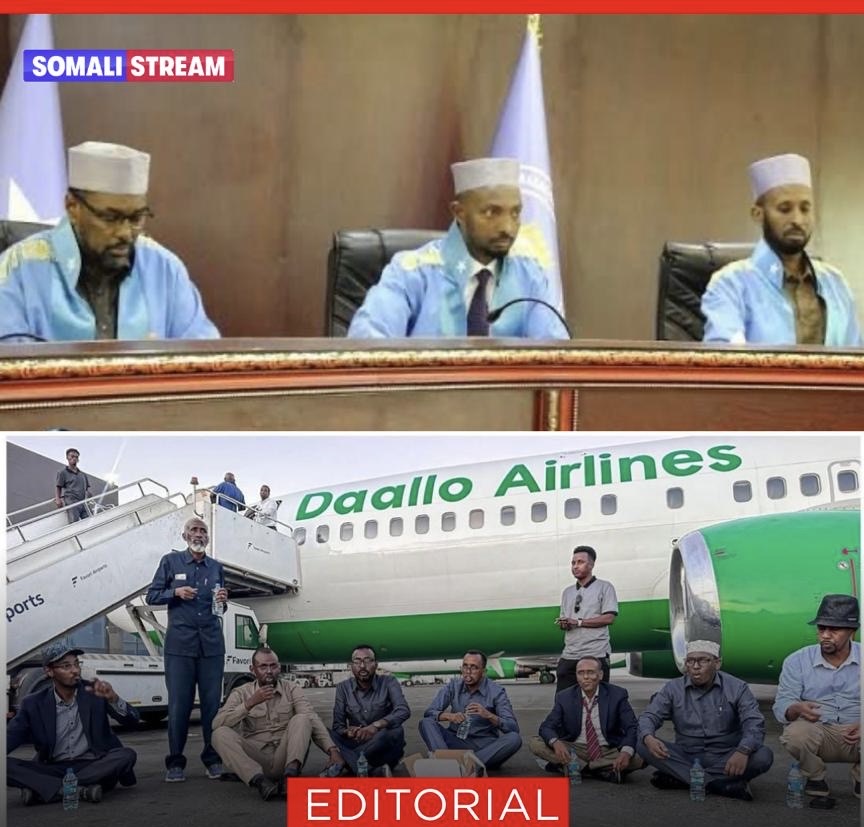
More troubling still are actions that touch directly upon citizens’ fundamental rights. The imposition of travel blockades affecting Jubbaland, the disruption of commercial flights, and restrictions on elected representatives seeking to travel for consultations are not abstract disputes between elites. They carry real human consequences. Reports of pregnant women unable to access emergency care, children and the elderly stranded without medical evacuation, and ordinary travelers caught mid-flight in political crossfire are stark reminders that collective punishment corrodes the social contract.
This is not political chess. It is Russian roulette with human lives. Lives have been lost, livelihoods shattered, citizens imprisoned, and families trapped behind blockades, only for the same president to later appear smiling, embracing, and laughing with the very rival he had sought to discredit, neutralize, or crush through courts and coercive force. For what purpose were these sacrifices extracted from the public? If adversaries can reconcile in comfort, why must ordinary Somalis pay in blood, tears and fear? When power treats institutions and citizens alike as expendable pawns, governance ceases to be principled and becomes perilous.
Freedom of movement is not a political favor to be granted or withdrawn at will. It is a constitutional and human right. When governments curtail it for political leverage, the burden falls disproportionately on those least able to bear it.
Somalia has seen this pattern before. Federal and state leaders alike employing dirty and repressive tactics against rivals, often at the expense of civilians. Each cycle deepens cynicism. Each episode chips away at institutional credibility and the pace of recovery. The question now is whether the courts, behold as they are to the Executive arm of government, will break this pattern to redeem its own reviled image. History is generous in one respect — it always offers a second act. Judicial legitimacy is not inherited. It is fit that earned, case by case, ruling by ruling.
The old fable attributed to Aesop sharpens the dilemma. In the tale, a band of mice terrorized by a cat propose hanging a bell around its neck so they can hear danger approaching. The idea is celebrated until one mouse asks the decisive question of who will bell the cat? Many agree the threat must be checked. Few volunteer to take the risk. In today’s Somalia, the analogy is unavoidable. If an unrestrained presidency stretches constitutional boundaries, who will fasten the bell of lawful restraint? Parliament has faltered. Political actors equivocate or play games. The burden settles, squarely and uncomfortably — as reviled and hopeless as it is— on the bench.
Yet courts do not act in a vacuum. They do not originate cases; they respond to those who dare to file them. And here lies another national test. If politicians distrust the judiciary, let them test it. If citizens doubt its independence, let them compel it to prove otherwise. Redemption is a two-way street. Litigants — state leaders, opposition figures, civil society organizations, and aggrieved individuals — must carry their grievances into the courtroom rather than rent the radio waves. To refuse to file is to concede the field, to push the country further into precipice. To file is to force a record, a ruling, a precedent.
If the domestic courts rise to the occasion, Somalia benefits immediately. If they falter, as expected, the effort is not wasted. Somalia is now a member of the East African Community. That membership opens the door to the East African Court of Justice, where treaty obligations, rule-of-law commitments, and fundamental rights can be tested against regional standards. The mere prospect of regional scrutiny can stiffen domestic resolve.
Simultaneously, internal accountability mechanisms must not be dismissed as fantasies. Where civil rights abuses are credibly alleged, indictments should follow— whether against executive officials who designed or enforced unlawful measures, legislators who enabled them, or even judicial officers who willfully subverted the law. The genesis of Somalia’s recurring political impasse is well known. Impunity has been its oxygen. Remove the oxygen, and the fire weakens.
The judiciary exists precisely for moments when executive overreach tests constitutional boundaries. By taking up the latest case concerning restrictions on movement and pronouncing clearly and courageously on the matter, the courts have an opportunity to redeem and fortify their independence.
A firm ruling compelling the Federal Government to restore citizens’ freedom of movement would do more than resolve a dispute. Such decision would establish a precedent that no leader, present or future, may suspend rights for political expediency. Independence is not declared; it is demonstrated. The most powerful rebuttal to accusations of subservience is a judgment that surprises power, not the public.
Such a judgment would also signal that accountability is not a slogan. Where unlawful actions have caused loss of life, economic harm, or institutional breakdown, legal consequences must follow. Immunity born of office cannot become impunity for misconduct. The likelihood of personal and institutional accountability is itself a deterrent against future abuses.
This is not a partisan appeal but rather a constitutional one. Leaders come and go. Political fortunes rise and fall. But if courts falter at critical junctures, the damage to the Republic endures. If Somalia’s court-look-likes occasionally to rose to the occasion and acted out of public greater public good, at the expense of the individual careers of the concerned justices, the 2021 pre-elections violence and preceding causalities could have been avoided and so could its reliving it allover again under another authority.
This cycle of curse must be broken. And it would be great, if this generational curse is broken by an unlikely savior that Somalia’s otherwise soiled courts are.
The Qur’anic warning against hypocrisy and the prophetic example of Yusuf converge on the single truth that integrity under power is the ultimate test of leadership. When leaders fail that test, institutions must not. If both fail, the people fail and everyone perishes with it.
Somalia’s judiciary now stands at a crossroads. The chamber is silent, but history is not. By defending freedom of movement and affirming the supremacy of law over political maneuvering, it can help steer the nation closer to the peace, within itself and with the world, that its current leader so eloquently promised but banished in his same breath. The question, lingering with forlorn hope yet undeniable urgency, remains: who will bell the cat?