


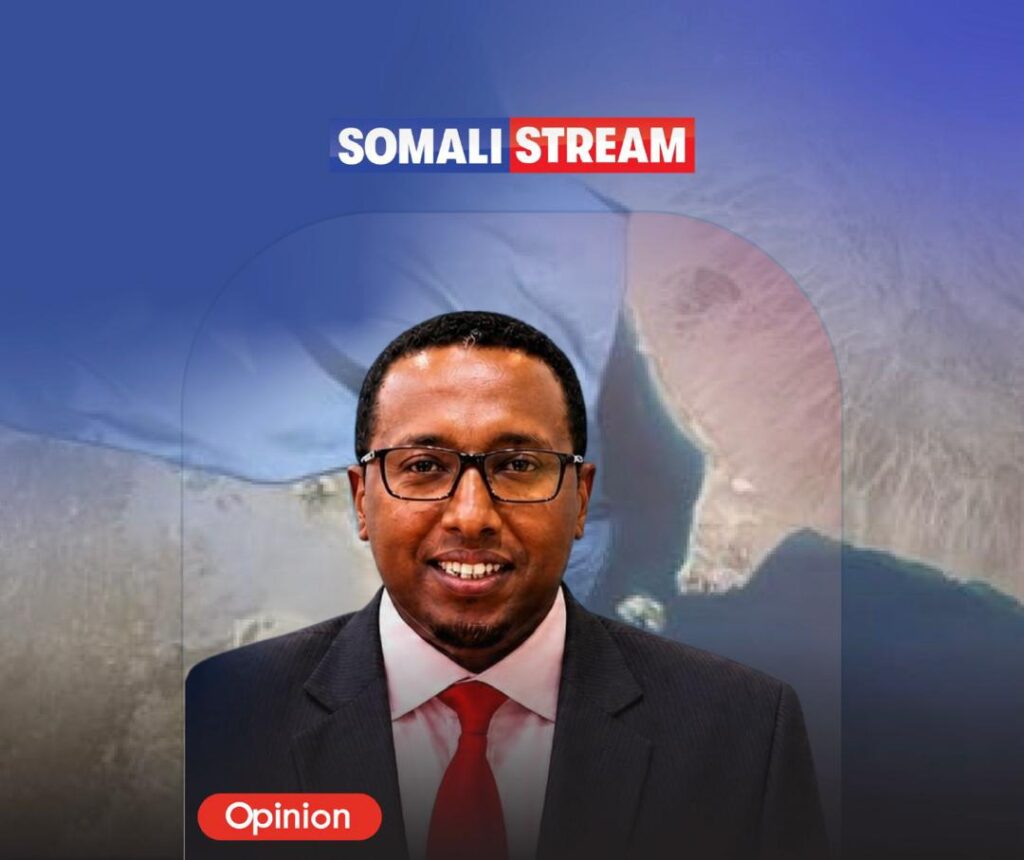
Somalia has spent years arguing about how to organise power at home. The world has spent the same years rediscovering why power matters in the waters around it. Those two conversations are now converging. The Bab el-Mandeb, the narrow passage between the Horn of Africa and the Arabian Peninsula, was for decades treated as a secondary concern. Hormuz mattered. Suez mattered. The strait beside Somalia did not. Time has overtaken that assumption. Roughly twelve percent of global seaborne trade and a substantial share of the world’s energy shipments pass through it. Houthi attacks have already pushed major shipping lines around the Cape of Good Hope, at a cost measured in billions of dollars and weeks of delay. For half a century the world worried about Hormuz. The same anxieties are now migrating to Bab el-Mandeb.
The Israel-Iran confrontation has accelerated the shift. In a recent Foreign Affairs essay, Ian Bremmer and Firas Maksad argue that the Middle East is moving toward two broad regional alignments: one anchored by Israel and the United Arab Emirates, the other increasingly centred on Saudi Arabia, Turkey, Pakistan and Egypt. Whether those alignments harden into durable blocs remains to be seen. What is already clear is that the Horn of Africa belongs to the strategic space in which this competition will unfold. That has consequences for the country beside the strait. Nations become strategically important for one of two reasons: because of what they have, or because of where they are. Somalia has both. As the strait grows in importance, so does the coastline beside it. That is a logic foreign capitals have already begun to apply to the Horn.
What was once discussed as a future possibility is now visible across the Horn. The United Arab Emirates is deepening its presence along the Red Sea littoral. Turkey is expanding its naval and training footprint. The Saudi-Somali defence understanding earlier this year reflects a parallel logic. Bremmer and Maksad themselves report that Saudi Arabia held talks with Egypt and Somalia in January on a possible military coalition in the Horn. Egypt watches it all with the attention of a country whose economy depends on the Suez approach.
It is against this backdrop that Israel’s recognition of Somaliland in December 2025 should be understood. Somalia’s territorial integrity is well established and internationally recognised. The broader question is whether introducing a new sovereignty dispute into an increasingly contested maritime region serves stability. History suggests that strategic waterways become dangerous when local disputes, regional rivalries and great-power competition begin reinforcing one another. Somalia’s territorial integrity is neither a new question nor an unresolved one in international law. What is changing is its strategic significance. As Bab el-Mandeb grows in importance, developments affecting Somalia’s sovereignty increasingly carry implications far beyond Somalia’s borders. A coastline that the world will rely on for trade and energy security cannot afford to be the site of unresolved sovereignty contests engineered from outside the region. None of these outside actors are arriving in the Horn because they have suddenly developed a new interest in Somali domestic affairs. They are arriving because the geography has become decisive. A Somali coastline once treated as peripheral is now seen as an asset with which to be aligned.
The strategic importance of Somalia’s geography is rising faster than the institutions required to manage it. That imbalance will not remain politically neutral for long.
The question is no longer simply what constitutional arrangement Somalia prefers. It is whether Somali institutions can develop quickly enough to match the strategic importance of the region around them. History suggests that countries of growing strategic importance benefit most when political legitimacy keeps pace with geopolitical relevance. Decisions are likely to arrive at speeds the political system has not been called upon to manage. Offers carry obligations not always visible on the day they are signed.
The principle is a familiar one. The stronger Somali institutions become, the more freedom Somalia will have in its dealings with outside powers. A federal compact recognised as legitimate by all major political actors. An electoral pathway accepted at home and credible abroad. A foreign policy owned by the state rather than contested between competing centres of decision. These are not academic propositions. They are the difference between a country that shapes its own role in a changing region and one whose role is shaped for it.
Somalia is not faced with a choice between solving its internal challenges and preparing for a changing region. The two are increasingly one and the same.
The Bab el-Mandeb has long been known as the “Gate of Tears”. The strategic challenge facing Somalia is to help ensure that, in the twenty-first century, it becomes a gateway to commerce, connectivity and prosperity rather than a gateway to new rivalries and old conflicts. Geography has already secured Somalia a seat at the table. Whether that opportunity becomes an asset or a liability will depend less on geography than on the quality of the institutions through which Somalis govern themselves.It is one of the few strategic choices in the new Middle East that still rests in the hands of those most affected by it.
Awale Kullane is former Somali Ambassador to China and Sweden, former Deputy Permanent Representative of Somalia to the United Nations, former Chief of Staff and Permanent Secretary in the Office of the Prime Minister of Somalia, and a candidate for the Presidency of Galmudug State.
