


For many decades, the promise of Somalia’s offshore riches has been more myth and dream than reality. A talking point used to spark hope without ever breaking ground. However, the arrival of the Turkish deep-sea drillship Çağrı Bey at the Port of Mogadishu signals a definitive end to the era of speculation. Somalia is no longer just talking about its resources, but it is moving toward extraction and exploration. At the same time, the country stands at a decisive crossroads, facing a future that carries a high-stakes gamble, a light of hope, and a defining test of statehood.
The Gamble: CURAD-1 as the 40-years Silence Breaker
Much of the African continent is marked with the remains of failed resource extraction projects which led to environmental ruin and triggered the Dutch Disease, which is an economic phenomenon where the discovery of natural resources leads to the decline of other sectors, the rise of corruption, emergence of rent-seeking elite.
This milestone follows the comprehensive 3D seismic survey conducted by the Oruç Reis, which spent about 234 days mapping over 4,400 square kilometers of the Somali basin. While the Oruç Reis provided the decisive data, it was time for Çağrı Bey to bring the tools to dig.
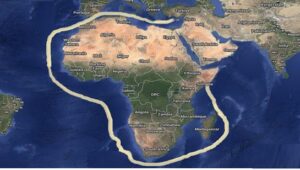
The journey of the Çağrı Bey was a maritime logistical maneuver. Departing Taşucu Port in Mersin, Türkiye in February, the vessel undertook a 53-days journey across the Atlantic, passing through the Strait of Gibraltar and navigating around the Cape of Good Hope.
The decision to bypass the Suez Canal and cover around 15,000-kilometer voyage was a technical necessity, because with a width of 42 meters and a towering height of 114 meters, the vessel’s massive dimensions make navigating narrow straits a significant risk.
The target is CURAD-1, which literally means first born in Somali language. An exploratory well located approximately 372 kilometers off the coast of Mogadishu. This operation is ambitious by global standards. The Çağrı Bey is capable of drilling to depths of 12,000 meters.
The CURAD-1 well itself is planned to reach a water depth of 3,495 meters, and will go another 4,005 meters deep below the seabed, for a total of around 7,500 meters depth. CURAD-1 is expected to be one of the deepest offshore wells globally, second only to the record-breaking Z-44 Chayvo well in Russia. The drilling phase is expected to last roughly 288 days to ensure comprehensive data and safety.
It is worth noting that CURAD-1 is not Somalia’s first exploratory well. In the 1970s, offshore wells like Hafun-1 in Xaafun, Garad Mare-1 in Garacad, and Maregh-1 in Mareeg were drilled with high hopes but no commercial success.
Even earlier, between the 1950s and 1980s, onshore wells like Gira-1, Obbia-1, Afgoi-1, and Coriole-2 in Mudug, Hobyo, Afgoye, and Qoryoley respectively were drilled across the Somali landscape. Furthermore, while the Oruç Reis survey was a milestone, it built upon earlier 2D datasets acquired by Soma Oil & Gas (2014) and Spectrum/TGS (2016). The gamble today is whether modern Turkish deepwater technology can finally unlock what previous decades of exploration could not.
The Hope: Beyond the 5% Share
A wave of skepticism has flooded Somali social media, with many claiming that Somalia will only receive 5% of its oil wealth while Türkiye takes 95%. This narrative, while politically potent, reveals a fundamental misunderstanding of Production Sharing Agreements (PSAs).
In the early years of any project, the industry enters the Cost Recovery Phase. Because the investing partner in this case, Türkiye/TPAO bears the upfront costs of exploration and drilling, which allows them to have the higher share of initial revenues, typically allocated to recover these expenses.
Once the cost is recovered, the Profit Oil is shared. Historically, in successful models, the host nation eventually receives the biggest share of the profits. The issue for Somalia is not the percentage on the paper today, but rather the integrity of the institutions that will manage those funds tomorrow.
The Test: A Crucial Test for Somalia
Natural resources are a double-edged sword. In Norway and the Gulf States, they built sovereign wealth funds that secured the future of generations. In South Sudan, Nigeria, and Angola, mismanagement transformed opportunity into a catalyst for corruption, environmental degradation, and civil suffer.
The biggest question is whether it will turn out to a resource curse, opportunity or regret? And Somalia faces two primary risks:
- Institutional Transparency: Are our oversight bodies strong enough to prevent the leakage of revenues into private pockets?
- Federalism Lense: Without a finalized, inclusive federal resource-sharing agreement, this resource extraction may threaten to reignite old tensions. If the federal framework is ignored, oil could become a source of conflict rather than a tool for unity.
The arrival of the Çağrı Bey and the birth of CURAD-1 is more than a technical achievement; it is a moral and political exam for the Somali leadership. It tests whether we have the governance to manage wealth, the transparency to earn public trust, and the maturity to move from rhetoric to sustainable action. It’s only in our hands what we choose for our upcoming generations.
Somalia stands at a crossroads. We can follow the path of the resource curse that has plagued much of the continent, or we can follow the footsteps of Norway or the Gulf by using our God-given resources to build a resilient and modern state.
The outcome of CURAD-1 will eventually tell us if we have a blessing or a new set of challenges. If successful, the oil drilling program could transform Somalia’s economy, infrastructure and positioning the country as a significant regional energy power in the Horn of Africa.
KAMAL HASSAN
