


Since Somalia officially completed its accession to the East African Community (EAC) on March 4, 2024, questions have arisen about the real benefits this membership brings to the Somali people.
Although the Somali Parliament swiftly ratified the membership agreement on February 10, 2024, and President Hassan Sheikh Mohamud repeatedly defended his Dan Qaran administration’s decision, calling EAC membership a major national achievement, the ambitious promise made to the Somali people has yet to materialize.
While Somalia’s Ministry of Foreign Affairs and International Cooperation has asserted that, “as Somalia deepens its engagement within the East African Community, the Ministry remains committed to ensuring effective representation across all EAC organs and institutions, in support of Somalia’s national interests and regional integration,” the empty seats reserved for Somalia in the East African Legislative Assembly tell a far more sobering story.
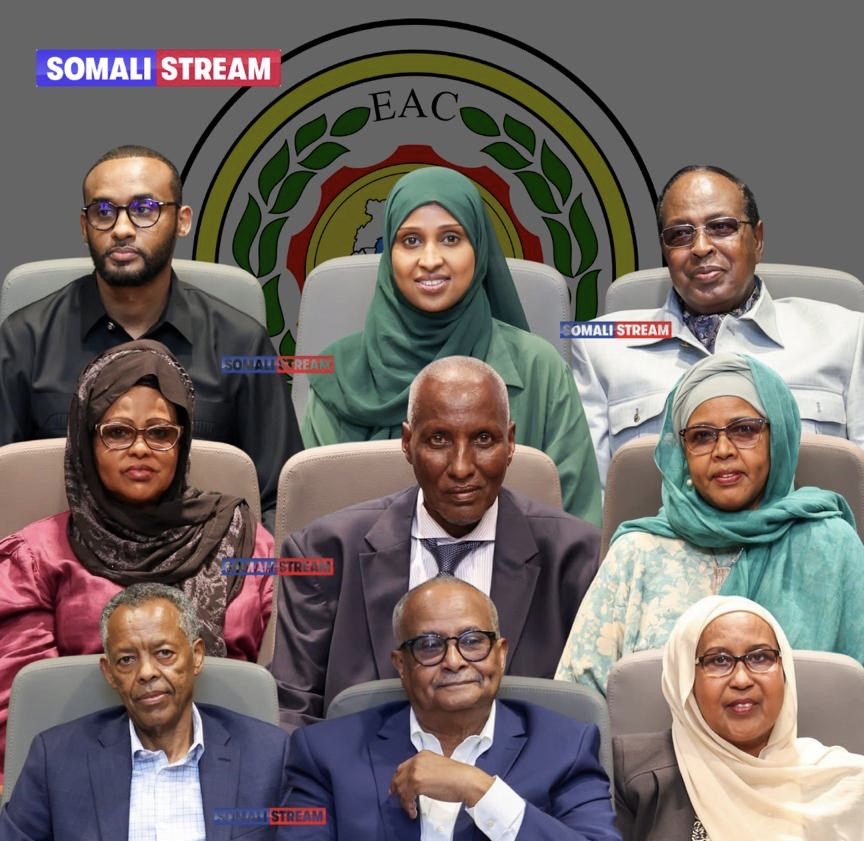
As a result, nine duly elected lawmakers, Hussein Hassan Mohamed, Ilhaan Ali Gasar, Faysal Abdi Roble, Abdisalaam Hadliye, Abdirahman Bashir Sharif, Fahma Ahmed Nur, Fadumo Abdullahi, Abukar Mardaadi, and Sahra Ali Hassan, remain unable to take their seats, leaving Somalia without a voice in the regional parliament at a moment that should have marked its first full and meaningful participation in the EAC since formally joining the bloc in 2024.
As previously reported, membership in the EAC comes with obligations that must be fulfilled to unlock the rights of the union, starting from parliamentary representation to regional integration.
EAC membership is not free.
Each member state is required to pay an annual contribution of roughly $7-9 million, a fee that is key to securing real rights such as the swearing-in of Somalia’s elected members to the East African Legislative Assembly (EALA) and granting them the budgetary authority and participation rights in regional decision-making.
Before becoming full members, Somalia officially paid the 2024 contribution, yet the country did not have representatives entitled to sit in the EALA.
This suggests that the payment was executed rapidly, potentially for reasons beyond genuine regional integration, a point we will explore later in this article.
A year after the Somali Parliament ratified the EAC membership, Somalia’s accession remains incomplete. The representatives chosen to sit in the EALA have yet to be officially sworn in.
Although the elections for Somalia’s EALA representatives were held October 2025, they have still not been sworn in.
Information exclusively obtained by Somali Stream confirms that the main obstacle is the Federal Government of Somalia’s refusal to pay the annual contributions for 2025 and 2026.
Legally, the elected Somali representatives meet all the requirements and are fully qualified to serve. Yet the EAC insists that the swearing-in cannot proceed until the Federal Government fulfills its financial obligations.
Complicating matters, a case brought before the EACJ (East African Court of Justice) on November 21, 2025 provided the government with a legal pretext to delay payment, citing a “legal dispute” to avoid releasing the millions owed.
One Somali government official, frustrated with the federal government’s handling of the EAC, revealed that the initial 2024 payment had been a political maneuver by President Hassan Sheikh Mohamud to gain fast recognition and diplomatic prestige, without fully planning for the long-term consequences.
Indeed, emerging information shows that the federal government has no clear strategy for managing the ongoing costs of membership.
The first payment was politically motivated and sourced from state revenues from public land, rather than being allocated as part of the national annual budget.
Somalis have a right to ask why tax revenues in 2024 were spent on a membership that has yet to produce tangible results.
The simplest explanation seems to be that the President prioritizes political gains over any tangible activity that does not immediately serve his agenda.
However, beyond political calculation, this reflects a recurring pattern in Somali governance: half-finished initiatives.
In this case, it has left Somalia’s elected EALA representatives blocked by their own government, rather than supported, undermining the very goal of regional integration they were elected to achieve.