


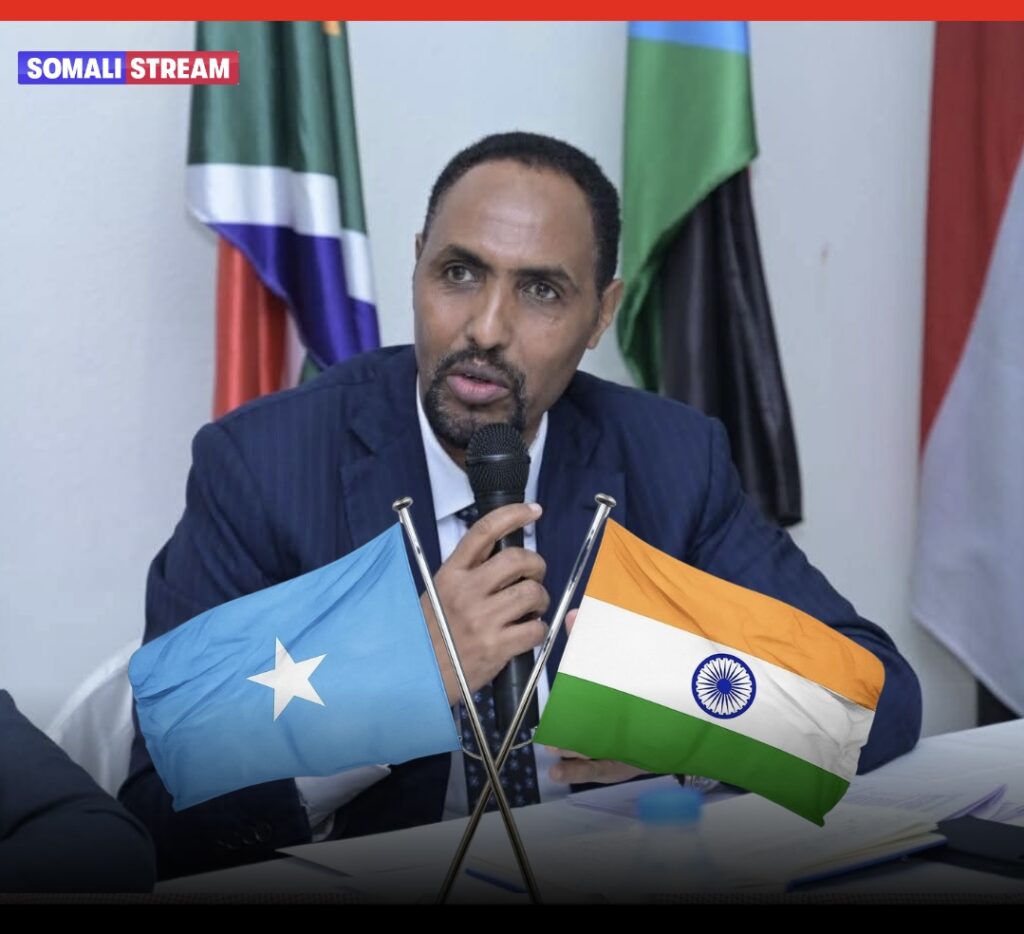
What was scheduled as a routine diplomatic courtesy call has instead exposed a deep and unsettling fault line within Somalia’s foreign representation — and raised troubling questions about loyalty, recognition, and foreign influence in the Horn of Africa.
On early January 2025, behind the closed doors of India’s Ministry of External Affairs in New Delhi, senior Indian officials met with Dr. Abdullahi Mohammed Odowa, Somalia’s newly appointed ambassador to India. The meeting, held far from public view, would later reverberate through diplomatic circles in both countries.
The encounter began at 11 a.m. in the manner such meetings always do: polite handshakes, cordial smiles, and warm references to the “ancient cultural and trade ties” linking India and Somalia. India’s Joint Secretary for West Asia and North Africa, Dr. Suresh Kumar, recalled his recent visit to Mogadishu and spoke optimistically about plans to reopen India’s embassy there — a gesture signalling renewed confidence in bilateral relations.
Then, according to official records of the meeting, the tone changed.
In an exclusive minutes obtained and seen by Somali diplomatic circles, Ambassador Odowa is said to have gone further; overlooking the trust and responsibility vested in him by the Federal Republic of Somalia, and straying perilously close to articulating a parallel foreign policy of his own.
Ambassador Odowa informed his Indian hosts that he hails from Somaliland — a self-declared breakaway region whose independence is not recognised by Somalia’s federal government or the international community. What followed would stun seasoned diplomats.
The ambassador went on to encourage India to engage directly with Somaliland, particularly in the areas of mining and mineral extraction. He suggested that Indian companies could travel to the region via Ethiopia, bypassing Mogadishu entirely. There was, he said, no need to involve Somalia’s federal government, as relations between Somaliland and Mogadishu were “strained”.
In plain language, a serving ambassador of the Federal Republic of Somalia appeared to be urging a foreign power to ignore the very government he was appointed to represent and to deal directly with a breakaway authority instead. India’s response was immediate and unequivocal.
Dr. Kumar made it clear that New Delhi would not engage with any constituent state of a foreign country without the explicit consent of its central government. As a democracy, he stressed, India adheres strictly to international diplomatic norms and respects national sovereignty.
India, he added, maintains formal channels of communication with Somalia through its High Commission in Nairobi and would not be drawn into internal political disputes.
The message was courteous — but unmistakable: India would not legitimise parallel diplomacy.
Though conducted in private and without any public announcement, the meeting has since emerged as a stark illustration of the tensions simmering beneath Somalia’s federal structure.
That a federal ambassador would raise Somaliland’s interests in such a forum is likely to alarm officials in Mogadishu and unsettle foreign partners. It also raises a fundamental question: whose interests are Somalia’s diplomats representing abroad?
For India, which is steadily expanding its diplomatic and economic footprint across Africa, the episode highlights the delicate balance between opportunity and principle and the risks of being drawn into internal political fractures. The meeting ended formally, with routine commitments to strengthening trade and cultural ties. There was no press release, no official statement.
Diplomats familiar with the correspondence describe its tone as unusually candid and deeply unsettling, suggesting a willingness to sidestep Mogadishu’s authority while using the prestige of a federal diplomatic post to advance regional interests.
Whereas Somali ambassadors are appointed to represent the state — not the politics of their birthplace, the episode exposes a blurred line between national duty and personal allegiance, raising serious concerns that Somalia’s external representation is being undermined from within.
The letter, now circulating quietly among Somali and foreign missions, has fuelled unease and whispered questions within diplomatic circles: how could a federal envoy openly promote direct engagement with a breakaway region — and what does this reveal about cohesion within Somalia’s diplomatic corps?