


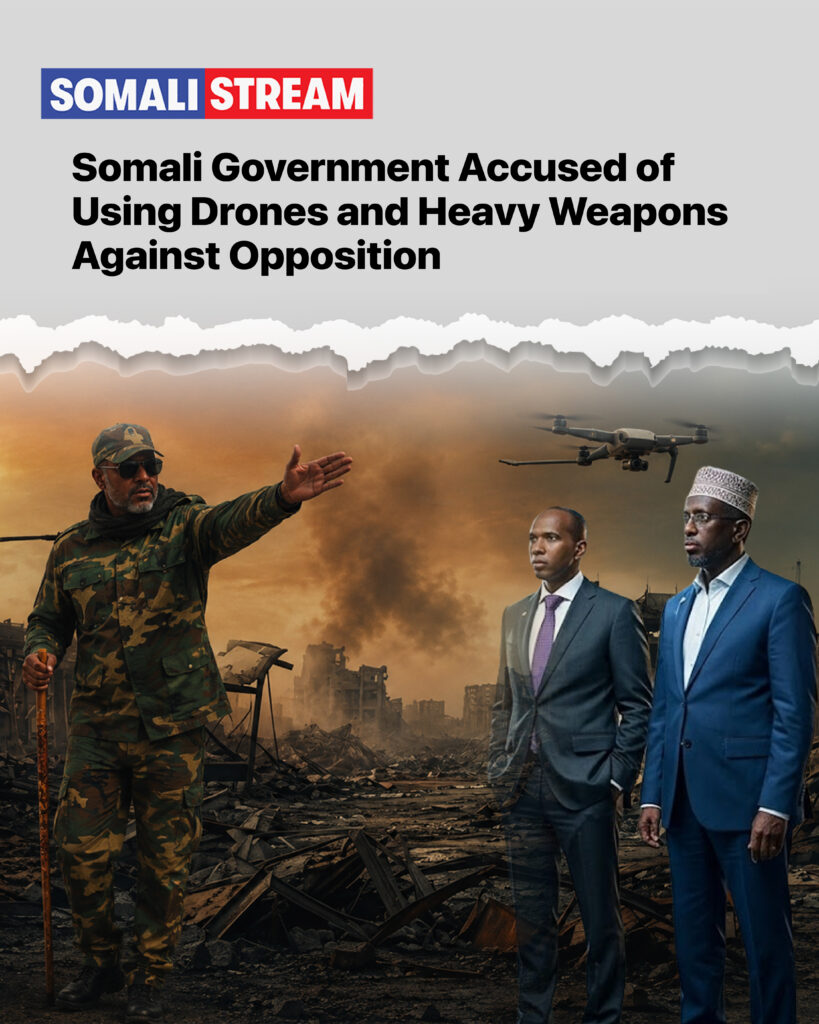
Somalia’s government has been hit by explosive accusations that it unleashed drones, mortars and heavy artillery meant for use in the fight against Alshabab, against opposition politicians in the capital, triggering deadly clashes, mass displacement and fresh fears over the country’s political future. Violence erupted across Mogadishu on June 3 and 4, leaving a trail of destruction through the districts of Hawlwadaag and Abdiaziz, as well as surrounding neighborhoods. The fighting claimed lives, injured hundreds and forced thousands of residents to flee their homes. The clashes came after presidential candidates opposed to President Hassan Sheikh Mohamud’s illegal term extension announced plans to hold peaceful demonstrations against what they described as an unconstitutional power grab and the absence of a national political agreement.
Opposition figures allege that, rather than allowing peaceful protests to proceed, the presidency launched military operations targeting leading rivals, including former Prime Minister Hassan Ali Khaire and former President Sheikh Sharif Sheikh Ahmed, both candidates seeking the country’s highest office. According to figures cited by humanitarian agencies, the fighting resulted in more than 13 deaths, left approximately 189 people injured and displaced over 12,500 civilians. But the most shocking allegations concern the weapons reportedly used during the confrontation.
Former President Sheikh Sharif and former Prime Minister Khaire claim government forces fired heavy weapons into residential areas, including mortars, artillery rounds, shoulder-fired missiles and explosive drones, weaponry critics say should never be used in densely populated civilian neighborhoods.
Speaking on June 5, Khaire alleged that the attack was coordinated directly from Villa Somalia, Somalia’s presidential compound. “Mortars were being fired. Drones were being launched. Weapons larger than ordinary firearms were being fired from the presidency,” Khaire claimed. The Himilo Qaran Party, led by former President Sheikh Sharif, issued a statement condemning what it described as an assault involving “heavy weapons, explosive drones, mortars and field artillery” against its leader. Speaking from his office on Sunday, June 7, former President Sharif Sheikh Ahmed leveled serious allegations against the government, asserting that drone warfare has been weaponized against opposition figures—most notably in a recent strike targeting former Prime Minister Hassan Ali Khaire.
The allegations follow the emergence of social media footage appearing to capture the moment drones struck civilian homes. While Somali Stream cannot independently verify government involvement in the operations, audio tracks embedded in the footage match the acoustic signature of the weapons used during the assault on Khaire’s compound.
The claims add to previous accusations made by the regional administrations of Jubaland and South West State, which have also claimed that the federal government used explosive drones during military operations against political opponents. Somali leaders argue that such equipment was supplied by international partners to help Somalia combat terrorist groups, not to settle domestic political disputes.
The Somali government has acknowledged carrying out security operations but insists it was targeting armed groups accused of destabilizing the capital and operating within Hawlwadaag and Abdiaziz districts in Mogadishu. Opposition leaders reject that explanation, arguing that those targeted were former national leaders and political figures rather than militia forces. The controversy has intensified scrutiny over how Somalia’s government is using military assets intended for counterterrorism operations.
Hassan sheikh’s Critics warn that weapons supplied to strengthen national security could instead be deployed against political opponents at a time of deepening tensions over governance, elections and presidential authority. With accusations flying, thousands displaced and political divisions widening, concerns are mounting that Somalia may be entering one of its most dangerous political confrontations in years.
