


The latest wave of violence in Mogadishu serves as a stark reminder of Somalia’s endless political struggles. The fragility and structural weaknesses of the state became evident when government forces associated with President Hassan Sheikh Mohamud attacked the residence of former Prime Minister Hassan Ali Khaire. Taking place amid public discontent, delays in the electoral process, and highly contested elections, the attack exposes a familiar and destructive pattern: entrenched leaders who prefer to ignite conflict in the capital rather than hold free and fair elections.
Following the fall of the central government, Somalis have faced continuous cycles of displacement, civil war, and terrorism. However, today’s instability is not merely the work of old-school warlords; it is deliberately crafted by a deeply rooted political class. These individuals weaponize weak institutions, exploit clan loyalty, and create artificial emergencies solely to maintain their grip on power. Instead of stepping aside when their terms end, they change the laws, weaponize state security against rivals, and compromise the country’s peace to serve their own ambitions.
However, placing all the blame on corrupt officials overlooks a deeper, systemic problem. The uncomfortable reality is that the Somali public has largely been denied the essential tools and skills needed to distinguish between principled leaders and opportunistic politicians, influenced by bribery and favoritism
The Marginalization of Competent Leaders
It is a myth that Somalia suffers from a shortage of capable thinkers. The country has plenty of forward-thinking individuals with the skills and character needed to pull the nation back from the brink. Yet, the current system effectively blocks them from taking office, as they refuse to participate in a political framework defined by corruption, extortion, and organized deceit. By choosing self-exclusion over complicity, they leave a profound void. For this reason, the public often struggles to recognize genuine leadership, their political vision obscured by the heavy blindfold of clan allegiance
The Deficit of Critical Thinking
The core of this national deadlock is a severe lack of critical thinking. A healthy democratic society requires citizens to consciously evaluate information, question their own assumptions, and prioritize truth. In Somali politics, strong clan loyalty has largely replaced fact-based analysis.
A Somali citizen often struggles to separate a political stance from the person presenting it. Arguments are rarely assessed based on facts, evidence, or sound reasoning; instead, what often matters to the Somali individual is simply who said it. If the person belongs to their clan, it is automatically considered correct, regardless of how weak or flawed the argument may be.
This has created a toxic environment where accountability is lost. A politician can say whatever they want today and say something completely different tomorrow, without facing meaningful criticism. Because clan loyalty often outweighs rational thinking
President Hassan Sheikh is perhaps the most prominent example of a politician whose statements constantly contradict one another. Yet, people continue to support him, driven either by clan affiliation or the desire for political appointments. What is worst of all is his indifference; he simply does not care because there is no mechanism to hold him accountable.
Clan Loyalty as a Dangerous Mental Shortcut
Human psychology relies on mental shortcuts to process information quickly, and in Somalia, clan affiliation has become the ultimate destructive shortcut. Rather than doing the hard work of investigating claims, checking facts, and guarding against personal bias, many citizens rely on a simple default: side with my clan and oppose everyone else.
This lack of critical scrutiny gives the politicians a massive advantage. Leaders routinely obscure their corruption behind the guise of religious devotion or tribal defense, confident that their supporters will not question the narrative. The consequences of this collective intellectual surrender are devastating. While those in power hoard wealth and violently secure their positions in Somalia, ordinary citizens bear the costs, dying in manufactured wars, risking their lives in search of refuge abroad, or languishing in displacement camps.
Somalia will remain politically paralyzed until the public develops the capacity to challenge its own biases. The cycle of self-serving leadership will only be broken when citizens begin to prioritize facts over ethnic ties and intellectual integrity over clan allegiance.
About the Author
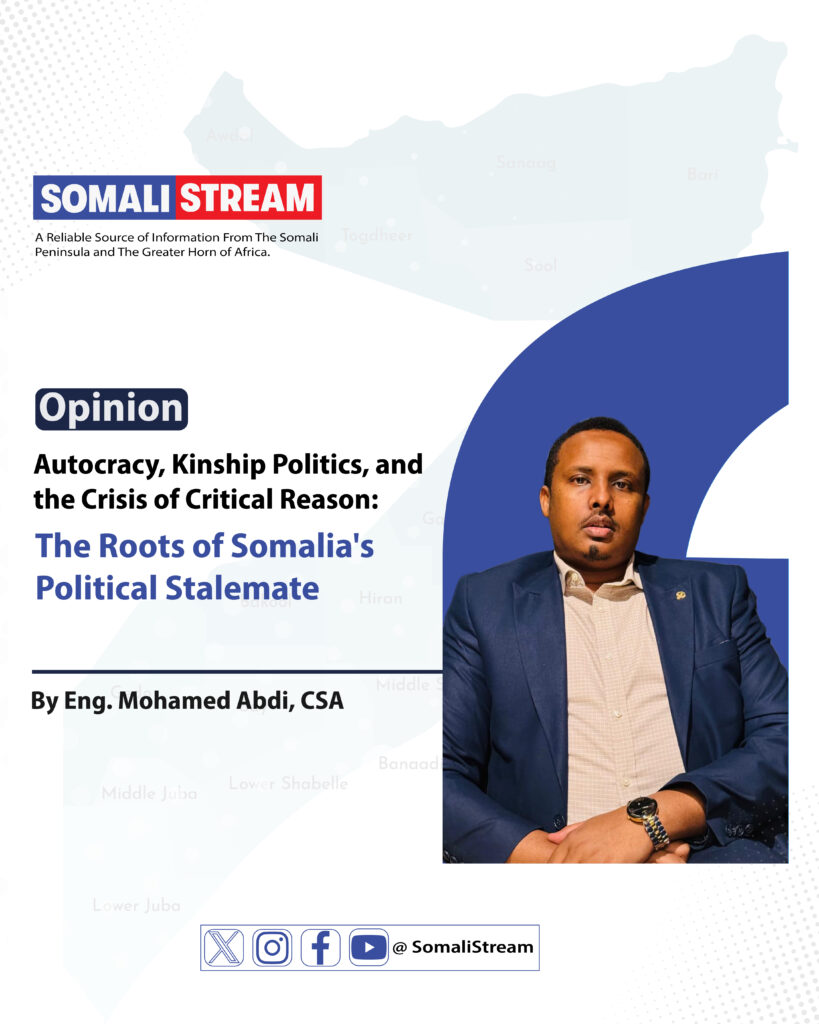
Eng. Mohamed Abdi is a Cyber Security Analyst specializing in the intersection of digital governance, intelligence institutions, and political risk analysis in the Horn of Africa.
