


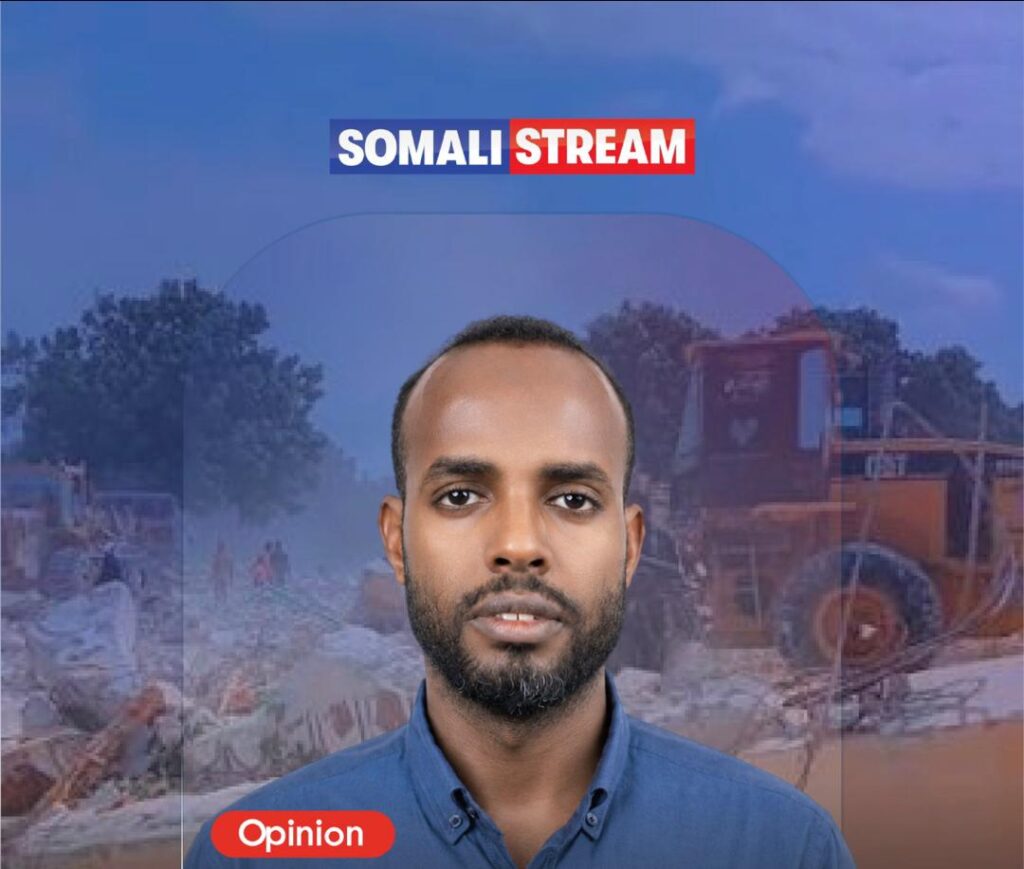
The Price of a Seat
Picture a hotel room in Nairobi, or Djibouti, or Dubai. The curtains are drawn. On the table sits a briefcase, or sometimes just a manila envelope. Across from it sits a clan delegate one of perhaps two hundred plus men who, under Somalia’s indirect electoral system, holds the power to decide who enters parliament. A candidate’s representative slides the envelope across the table. No speech is given. No manifesto is discussed. The negotiation is simple: how much, and when.
This scene, repeated hundreds of times in the weeks before every Somali election, is where the state actually dies. Not in the battlefields that war has been ongoing for decades and the world has grown accustomed to it. The quieter destruction happens in these rooms, in these transactions, where the fundamental contract between a citizen and their representative is replaced by a purely commercial one. By the time a member of parliament takes their oath of office, they have already made a business calculation; the investment must be recovered. Public service was never the point. Constituency representation is an afterthought and only becomes relevant if the voter base grows large and influential enough to threaten the arrangement.
The going rate for a parliamentary seat has been reported at anywhere between five thousand and hundreds of thousands of US dollars’ money paid not by the people, but by the candidates themselves, to the very delegates who are supposed to represent clan interests. Election commissioners, too, have had their elbows greased. The transaction does not end at the delegate level; it merely begins there.
This is the founding corruption of Somalia’s political system the original sin from which everything else descends. The looting of ministries. The sale of government land. The collapsed bridges and the roads that remain flooded with sewage while officials ride in armored luxury cars. All of it flows from this original transaction, because a man who buys his seat does not govern. He recoups.
“Somalia does not fail despite its politicians. It fails because of them.
The argument of this article is straightforward; Somalia’s state-building project has been systematically undermined by the very elite entrusted to lead it. Politicians at every level from parliamentary delegates to presidents participate in a chain of transactions that transforms public office into a mechanism for personal enrichment. Until this is confronted directly, no amount of international support, constitutional reform, or institutional design will produce a functioning state. The change must come from within.
From Warlords to Suit-Wearing Predators
To understand where Somalia is, you have to understand what replaced the warlords and why the replacement was not the improvement it appeared to be.
When the Somali state collapsed in 1991, it did not leave a vacuum so much as it redistributed power to those willing to use violence. The warlords who carved up Mogadishu and the regions were predatory by design; control of a checkpoint meant control of revenue; control of a port meant wealth; control of territory meant survival. The logic was brutal but transparent. During the warlord era, you knew who was stealing from you.
What changed in the years that followed was not the logic of predation, but its costume? As international support flowed toward the Transitional Federal Government and its successors, a new class of political entrepreneurs emerged men who traded their militias for neckties, who learned to speak the language of governance and reconciliation, and who positioned themselves as the legitimate faces of a recovering Somalia. Former warlords became statesmen. Clan elders became power brokers. The battlefield moved indoors.
The 4.5 power-sharing formula which divides political representation among Somalia’s four major clan families plus a minority coalition was designed to prevent any single group from monopolizing power. In practice, it created something else: a system of institutionalized bargaining in which every appointment, every ministry, and every government contract became a clan entitlement to be negotiated, priced, and sold. The federal system, established to bring stability and spread governance across regions, multiplied the number of offices available for capture. More presidents, more prime ministers, more ministers more opportunities for the same extractive logic to repeat itself at every tier of government. The article does not reject federalism as an ideal. Rather, it exposes how the current system and the way our state operates has transformed federalism’s promise into something sinister; an architecture designed not for governance, but for theft.
How the Chain Works
The corruption is not incidental. It is a choice of structural chain in which each link finances the next and breaking any one link threatens the entire arrangement. Follow the money from beginning to end, and you will understand why nothing changes.
It begins with the delegates. Candidates for parliament pay these men directly sometimes through intermediaries, sometimes in person, always in cash. The bribes are open knowledge among political circles; the only variable is the price, which fluctuates based on the perceived competitiveness of the seat. A delegate who holds out can usually get more. Everyone understands this. No one is ashamed.
Once in parliament, the MPs find themselves sitting on the most valuable asset in the country: the vote that elects the president. Under Somalia’s current system, the president is chosen not by the public but by parliament. The candidate who pays more wins. The same MPs who were purchased now sell their votes again at a significantly higher price. They may receive cash, promises of ministerial appointments, or both. Some collect from multiple candidates before making a final decision. This is not unusual. This is the market.
The newly elected president arrives in office having spent a fortune. The mathematics are straightforward: that fortune must be recovered, and then some cabinet appointments become the currency of repayment. The prime minister pays in money or political concessions to survive the parliamentary confidence vote. Ministers pay for their portfolios or are appointed as settlement of campaign debts. By the time a cabinet takes its oath, it has been comprehensively purchased, and every member knows what is expected of them.
What follows is almost predictable. Government revenues collected at ports, airports, markets, streets, business licenses, airspace fees, and property taxes disappear long before they ever reach the treasury. Civil servants demand bribes for permits, signatures, and documents that should be free. Senior officials build houses in Nairobi and Istanbul on salaries that could not plausibly fund them. Revenue collectors sport Rolex watches. The roads which could be repaired with the taxes already collected from the people who use them remain rivers of sewage when it rains. Government land is sold without public auction, residents are displaced by police and soldiers acting on behalf of officials, and those who protest find the state turned against them.
“The state collects taxes from its citizens and delivers nothing in return. This is not dysfunction. It is theft with legal cover.”
There are two dimensions to this corruption worth separating. The first is material: stolen funds, solicited bribes, contracts awarded to connected insiders. The second is moral: the normalization of injustice, the institutional protection of the corrupt, and the slow death of any public expectation that government exists to serve anyone but itself. Material corruption can theoretically be prosecuted. Moral corruption is far harder to reverse because it rewires how an entire society understands power. When moral corruption takes hold alongside material corruption, institutions do not merely fail. They become weapons turned against the people they were created to serve.
What Somalia Loses
When the rains come to Mogadishu, the water has nowhere to go. The drainage systems that should carry it away were never built or were budgeted, contracted, and paid for on paper, with the money disappearing somewhere in the chain between ministry, Banadir Regional Authority and construction site. So the water rises in the streets. It enters homes. Mothers gather their children and whatever they can carry. And somewhere across the city, in a hotel restaurant or a private compound, a government official orders dinner.
This is not a metaphor. It is a description of what happens, repeatedly, in a country where the gap between those who govern and those who are governed has become a chasm. The cost of predatory politics is not abstract it is measured in the roads not built, the hospitals not staffed, the schools not opened, the young men who see no legitimate path forward and find other uses for their energy.
A functional state is built on trust. Courts only work when citizens believe their case will be heard on its merits. Police only deter crime when communities believe they protect rather than prey. Tax systems only function when people believe their money will be used for shared purposes. In Somalia, every interaction with a government institution carries a price. The courts dispense justice to those who can afford it. The police serve those who pay them. The citizen who walks into a government office without an envelope in their pocket walks out without what they came for. This is not dysfunction it is a parallel economy, one that runs entirely on the extraction of ordinary people.
The consequences compound over time. Citizens who expect nothing from institutions give nothing back no taxes, no cooperation, no trust. Investors who cannot rely on contract enforcement keep their money elsewhere. Young men who see the only path to stability running through clan patronage or foreign migration take those paths. Each departure, each withheld investment, each withheld tax weakens the state further and makes the next round of corruption cheaper to perpetrate. It is a cycle that feeds itself.
And then there is the spectacle. When ministers are seen dining on imported cuts of meat flown in from abroad, choosing between grilled fish and fillet steak while elderly citizens sleep in the open through floods and dust storms the message delivered to the Somali public is not merely that government is inefficient. It is that government has decided, at a fundamental level, that ordinary Somalis do not matter. That message lands, it stays, and it makes every future appeal to national unity and every call for civic patience ring hollow.
The Web of Complicity: Business, Aid, and Deliberate Chaos
Corruption of the scale described in this article does not sustain itself on political will alone. It requires infrastructure financial, commercial, and diplomatic. And that infrastructure is provided, knowingly or not, by three distinct sets of actors who rarely appear in the same sentence; Somali businessmen, international development partners, and foreign states with a direct interest in Somalia’s continued weakness.
Begin with the businessmen, because their role is the most intimate and the least discussed. The Somali business elite and the political elite are not separate classes they are the same class wearing different hats and thobes on different days. The businessman who wins a port contract through a minister he helped finance does not see himself as corrupt. He sees himself as pragmatic, as someone who understands how the system works and has learned to work it. The minister who steered the contract his way does not see himself as a thief. He sees himself as honoring an obligation to someone who invested in him. This is how corruption reproduces itself without anyone feeling responsible each participant in the chain has a justification that stops just short of the full picture.
The consequences are not abstract. When government contracts go to politically connected companies rather than capable ones, the road is not built, or is built badly, or exists only on paper. When import duties at the port are negotiated privately between officials and traders rather than collected transparently, the revenue that should fund schools and hospitals disappears into a parallel economy that serves a handful of families. The Somali business environment has, in places, become a cartel a system in which access to the market is controlled by proximity to power, and in which genuine competition, the kind that might drive quality and lower prices for ordinary Somalis, is actively suppressed.
“The politician and the businessman shake hands across a table that was built with public money. The public was not invited to the meeting.”
Then there is the international community and here the story becomes harder to tell without nuance, because the actors are varied and their intentions are genuinely mixed. Billions of dollars have flowed into Somalia’s reconstruction over two decades, channeled through the United Nations, bilateral donors, and international NGOs. Some of that money has reached people who needed it. Some has funded genuine institutional progress. But a significant portion has been absorbed by the same predatory system it was designed to reform not despite the oversight mechanisms in place, but through them, by people who learned quickly how to speak the language of accountability while doing the opposite.
International funding that flows through government ministries becomes another resource to capture. Contracts go to companies linked to officials. Government payrolls carry the names of workers who do not exist even though partially reformed recently. Humanitarian funds designed to reach displaced families pass through so many layers of subcontracting each layer extracting its share that a fraction of the original sum ever reaches anyone in genuine need. The system is not invisible to those funding it. Many donors are aware, at least in outline, of where the money goes. But the pressure to demonstrate progress to show headquarters and parliaments that the investment is working creates an incentive to fund activity rather than outcomes, to count workshops and not ask about actual work done.
This is the passive dimension of international complicity; well-intentioned money, poorly protected, flowing into a system designed to absorb it. But there is an active dimension too, and it demands to be named directly.
Not every foreign state operating in Somalia wants Somalia to succeed. This is an uncomfortable sentence, but it is true, and the evidence for it stretches across two decades of regional and international politics. Somalia sits at one of the most strategically sensitive positions on earth at the mouth of the Gulf of Aden, bordering Djibouti, Ethiopia and Kenya, with a coastline that matters to global shipping and a population that matters to the politics of the Horn of Africa and the wider Muslim world. For certain regional powers, a weak Somalia is not a problem to be solved. It is a strategic condition to be maintained.
A Somalia that cannot control its own borders is a Somalia through which influence, weapons, and money can flow freely. A Somalia whose political class is permanently fractured along clan lines is a Somalia that can be managed through competing proxies rather than engaged as a unified partner. A Somalia whose institutions are too fragile to independently investigate or prosecute is a Somalia that cannot hold foreign actors accountable for what they do within its territory. The chaos, from this perspective, is the point and some of the funding that arrives in Somalia labeled as support for stability is, in practice, support for a particular configuration of instability that serves the funder’s interests.
This does not mean every foreign actor in Somalia is malicious. It means the landscape is more complicated than the language of international partnership suggests. Some partners are genuinely trying to help and failing. Some are trying to help in ways that serve their own interests first and Somalia’s second. And some have concluded, at a level of strategic calculation that is never stated publicly, that a functional Somali state would be a problem rather than a benefit. Somalis navigating this landscape deserve to do so with clear eyes.
The fiction that Somalia’s governance crisis can be solved by technical assistance and capacity building while leaving the incentive structures of predatory politics, business capture, and deliberate foreign interference entirely untouched has been tested for twenty years. The evidence is not ambiguous. It has not worked. Somalia does not only need better-governed aid. It needs a political class willing to refuse the terms on which that aid has been delivered, Somali businessmen willing to compete on merit rather than on access, and an international community willing to hold itself to the same standards of accountability it demands from Somali institutions. Until all three move together, the web holds.
The Passport Politicians
Somewhere in Stockholm, or London, or Minneapolis, a man is preparing for a trip. He has lived in this city for fifteen years. His children attend school here. His wife has built her career here. The family home is paid for, the car is new, the neighborhood is quiet and safe. He has citizenship. He has stability. He has everything Somalia could not give him and everything Somalia desperately needs people to build.
He is also, at this moment, considering running for office in Somalia.
This figure the diaspora returnee with a foreign passport and a political ambition has become one of the defining characters of Somali governance. And the story of his arrival in politics is more complicated, and more troubling, than the hopeful narrative of reinvestment would suggest.
Not all diaspora politicians are the same, and it is important to say so plainly. Somalia’s diaspora includes some of the country’s most principled advocates people who send remittances home every month, who fund schools and clinics, who use their positions abroad to document abuses and demand accountability. They are essential, and this is not about them.
This is about the subset who want the title without the prerequisite education, experience, and territory. Who fly to Somalia for the elections, position themselves for ministerial appointments or parliamentary seats, and then govern to the extent that they govern at all with one eye permanently on the return flight. Their families remain safely in Helsinki or Toronto. Their children are enrolled in European schools. Their assets are held abroad. They have, in the most literal sense, not committed themselves to the country they claim to lead. Their tenure in office reflects that lack of commitment, with a return ticket booked and a foreign passport tucked safely in their back pocket.
“A man who will not take responsibility for his own household has no business claiming responsibility for a nation.”
The behavioral dimension matters too and deserves to be named without cruelty but without evasion. Some returnees arrive carrying habits formed in Western cities that sit poorly in a country navigating profound social strain. The late-night gatherings, the conspicuous socializing, the casual mingling that signals wealth and leisure in a city where families are sleeping under open sky these are not merely personal choices. They are visible. They are noticed. They communicate to the Somali public that their leaders occupy a different world, feel a different reality, and are not serious about the weight of what they have taken on. Leadership is partly performance not performance in the sense of falseness, but performance in the sense of demonstrating, through daily conduct, that you understand what you are there to do. When that demonstration is absent, trust does not merely erode. It collapses.
There is also, frankly, a competence gap. Holding a European passport and fluency in English or Swedish are not qualifications for running a ministry. They are the residue of having lived abroad. Yet in the absence of stronger selection criteria the absence, that is, of genuine meritocracy these credentials have sometimes been treated as sufficient. Officials are appointed on the basis of diaspora and political connections and clan arithmetic rather than demonstrated ability, arrive in positions they are not equipped to manage, and fill the gap with the tools they do have money, connections, and the willingness to look the other way. The result is governance by negotiation and impunity rather than governance by competence.
None of this is a case against the diaspora. It is a case for a higher standard. Somalia does not need politicians who visit. It needs leaders who stay who are present for the difficulty, not just for the prestige, who are accountable to Somalis because they actually live among them. The man who keeps his family in Helsinki while governing Mogadishu has already answered, by his actions, the question of where his real priorities lie.
The Price of Silence
Go back to that hotel room. The envelope on the table. The delegate who has traveled, perhaps from a distant region, to exercise the only formal political power his community will have in this election cycle. He knows what is in the envelope. He knows where the money comes from. He knows, on some level, what accepting it means not just for him, but for the road that will not be built, the hospital that will not be staffed, the child who will not survive a preventable illness because the health system was looted before it could function.
He takes the envelope.
It is easy to condemn him. It is more honest to ask what system produced his choice a system in which integrity is unrewarded, in which the honest delegate goes home with nothing while his neighbor goes home with cash, in which no one who has played by the rules has ever been seen to win. Individuals make choices. But they make them within systems. And the system Somalia has built around its politics makes corruption the rational option at every level, for almost everyone involved.
That is the most chilling thing about what has been described in these pages. It is not the venality of individual politicians, though that venality is real and should be named. It is the architecture the way the incentives are arranged so that the honest path leads nowhere and the corrupt path leads to everything worth having. Moral corruption, in the end, is more dangerous than material corruption because it does not just steal money. It steals the imagination of an alternative. When theft becomes normal, when impunity is expected, when speaking truth attracts the hostility of officials rather than the gratitude of citizens the silent acceptance of predatory governance can curdle, suddenly and without warning, into the kind of public rupture that erases a decade of fragile progress overnight.
Somalia’s state-building project is not failing for lack of blueprints, or international support, or constitutional engineering. It is failing because it has been captured from within by men in suits who replaced the warlords not by offering something different, but by offering the same extraction with better paperwork and a seat at the international table. The guns have been put away, mostly. The business model has not changed.
Building a state requires leaders willing to serve. It requires people who will take the envelope off the table, walk out of the hotel room, and accept the harder, slower, less lucrative work of building something that outlasts them. Somalia has produced such people. It has produced them in every generation, in every profession, in every corner of the diaspora and at home.
The question is whether they will be allowed to lead or whether the system will continue to select for those who are willing to pay the price of a seat and govern accordingly. The reader may wonder whether this article is laying the groundwork for one-person-one-vote elections or advocating for the wider electoral model currently being presented. It is not. Such proposals risk becoming little more than another scheme designed to dazzle the public. Unless there is genuine political change from within, any electoral model will produce the same outcome. As the saying goes: if you feed a system garbage, it will process it and produce garbage.
Is There a Way Forward?
Every few years, Somalia gets a new government. New slogans. Almost the same faces at the podium. A new prime minister whose name is announced to cautious optimism, a new cabinet photographed in pressed suits, a new set of priorities delivered in the language of transformation. And then, with a reliability that has become its own kind of dark comedy, the cycle begins again. The contracts vanish. The appointments become transactions. The promises dissolve into the same arrangements they were supposed to replace. Somalis watching from home and abroad have a word for this feeling. It is not disappointment. Disappointment implies surprise. This is something heavier the exhaustion of people who have hoped too many times.
It would be dishonest, then, to offer easy hope at this point in the argument. The picture drawn across these pages is not a portrait of isolated failures it is a portrait of a system. And systems are harder to change than individuals. They have their own logic, their own self-reinforcing momentum, and their own beneficiaries who will resist disruption with every tool available to them: money, clan pressure, legal obstruction, and, when necessary, physical intimidation.
Consider the precedent of Hassan Sheikh Mohamud, Somalia’s first re-elected president. On the surface, this could be read as democratic progress continuity through the ballot rather than the gun. But many Somalis do not read it that way. The current administration feels to them not like a new chapter but like a rerun familiar faces, familiar methods, familiar distance between what is promised and what is delivered. The pattern of each administration trying to entrench its position, to tailor the electoral machinery toward its own survival, to extend mandates or delay votes when the arithmetic does not favor them, suggests something important; it does not matter what electoral model is used, how many constitutional amendments are passed, or how much international support is mobilized. If the incentives underneath remain unchanged, the outcomes will remain the same. The names rotate. The system does not.
“Somalia has experimented with new governments, new institutions, new federal arrangements, and new political formulas. The results remain strikingly familiar — because the incentives remain unchanged.”
And yet. Here the argument must pause, because Somalia is not only its political class and to pretend otherwise would be its own kind of dishonesty.
Think of the journalist, expert, and/or analyst in Mogadishu and other cities in Somalia who files a story exposing a minister’s corruption, knowing that her movements may be monitored, that a knock on the door is possible, that colleagues have been arrested or fired from their jobs. She files it anyway. Think of the young lawyer who joins a nascent judiciary not for the salary which is meagre and sometimes unpaid but because he believes, still, that law can mean something in this country. Think of the mother in the diaspora who sends money home every month, not to a political campaign, not to a clan fund designed to purchase a parliamentary seat, but directly to her sister’s family, to a school she went to as a child, to a neighborhood she has not forgotten. These people are Somalis too. They are, in many ways, the more durable Somalis the one that persists underneath the political theatre, that keeps the country breathing when the institutions fail to.
The frequency of political crises in Somalia is not only evidence of dysfunction. It is also, in its way, evidence of refusal. A public that had completely surrendered to predatory governance would be quiet. Somalia is not quiet. It keeps producing crises, contestations, demands the difficult, sometimes chaotic expression of a population that has not accepted that this is simply how things must be. That matters. It is the raw material of change, even if change has not yet come.
What would genuine change require? Not another constitutional amendment, though constitutional clarity matters. Not another electoral model debated in foreign capitals, though direct elections; elections that remove the delegate-bribery layer from the system’s foundation are essential. Not another donor-funded capacity-building programme delivered to the same ministries that have absorbed dozens before it, though international accountability has its role. These are instruments. They are not the thing itself.
The thing itself is simpler and harder. Somalia needs leaders who understand that power is borrowed, not owned who will leave office when the law requires it, when the constitution demands it, when the people have chosen someone else, even when the machinery exists to prevent that choice from being heard. It needs a judiciary that will act against an official regardless of his rank, his clan, or his proximity to the presidency. It needs a business class that competes on merit rather than access. And it needs the Somali public at home and in the diaspora to make the cost of impunity higher than the cost of accountability, to demand these things with enough persistence that those in power cannot simply wait out the noise.
A state cannot be built by leaders whose primary concern is remaining in power. It can only be built by leaders willing to use power in service of something beyond themselves and willing to surrender it when their time is done. Somalia is not short of institutions, constitutions, or international frameworks. It is short of that, until public office is understood as a responsibility rather than an investment, until accountability is more valuable than patronage, the cycle will continue. The names will change. The slogans will change. The result will not.
Liban Abdilahi Hussen is a specialist in security, governance, and geopolitics in the Horn of Africa. He has advised top government institutions on national security, security sector reform, conflict management, and regional dynamics. His work centers on security governance, state-building, political analysis, and how security and geopolitics interact in fragile or conflict-affected areas. He can be reached at Liban779@gmail.com
